Pierre Wunsch
National Bank of Belgium
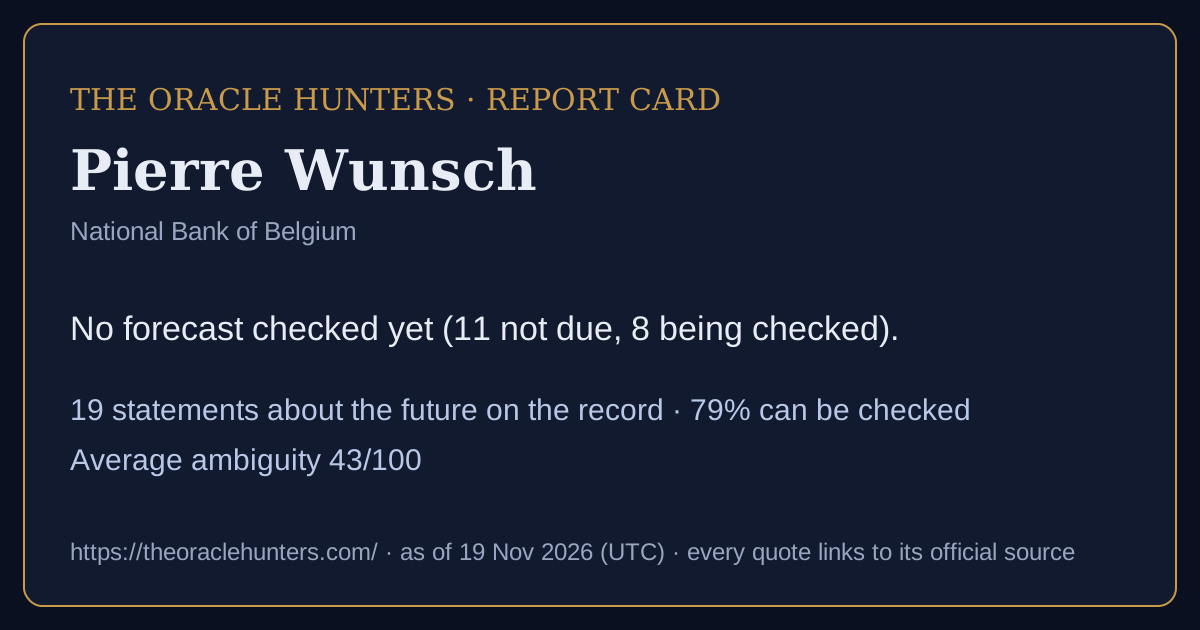
Track record: No forecast checked yet (11 not due, 8 being checked).
19forecasts & commitments on the record
79%can be checked as stated
43average ambiguity (0-100)
0goalpost moves recorded
0confirmed U-turns
Timeline
came true partly did not not due / being checked / too vague
Calibration score: shown after 10 checked forecasts with a stated likelihood (now 0).
How they speak about the future: based on data 14, stated on authority 3, educated guess 2.
Kinds of claim: forecast 14, mixed claim 4, scenario (if… then) 1. · Download this report card as a picture
In the nine words
πρόγνωσιςInference from evidence14 · 74%μαντείαInspired knowledge3 · 16%εἰκασίαConjecture1 · 5%πρόνοιαPreparing for the future1 · 5%
How to read this
Each box is one sentence a public figure or institution said about the future, word for word, with a link to the official text. Can be checked means it names what will happen, by when, and how likely - so it can be compared with official figures later. Too vague to check means it does not. Ambiguity (0-100) is how many different ways the sentence can be read. When the date passes, the forecast is compared with official data and marked came true, partly or did not come true. Labels judge the sentence, never the person. Full guide and glossary.On the record (19)
arguably higher than the unease one might experience during prolonged episodes of inflation in the 0-1% range.
I called for a hike of at least 200 basis points to bring real rates to zero, a level at which monetary policy was unlikely to harm economic prospects (monetary policy would be considered broadly neutral), while signalling a clear resolve to deliver on our
In fact, maintaining inflation at 2% is simply about doing the right thing, conditional on what we think we know about the state of the economy and its likely evolution over the medium term.
As wages are intrinsically more rigid than prices, wage growth is expected to remain broadly constant this year.
After the last rate hike in September 2023, long-term rates plunged by about 90 basis points by the end of the year due to expectations for monetary policy easing after better-thanexpected inflation data.
14 Reuters, 5 April 2022, 'ECB could raise interest rates back to zero this year - Wunsch'.
Virtually all the models that underpin inflation forecasts assume a long-term mean that is more or less "hard-coded" around 2%.
The prevailing idea that inflation would smoothly converge to 2% from below largely emerged from model-based forecasts.
In many Member States, public deficits are well above 3% and are expected to stay at high levels in several countries.
The Governing Council may well be able to get inflation down while implementing rate cuts this year.
In Belgium, the latest projections of the National Bank indicate that the public deficit will remain at around 5% until 2026.
If inflation gets back to 2% by 2025, as forecasts suggest, rate cuts will have to be considered at some point this year.
inflation variable, the steady state can be calibrated, or 'hard coded' if you will, at 2% for instance.
If the slowdown is shallow and accompanied by a further rise in inflation - and inflation expectations - real interest rates will have to move above the current market consensus.
But like others, I am not sure that bygones are bygones and therefore expect the pass-through of inflation to wages to increase in the coming months.
Today, the curve suggests that the €STR will stabilise at around 3% by the end of 2023.
neutral rate is around 2%, the policy rate will need to be brought slightly above that level to bring inflation back to 2% within a reasonable timeframe.
Thus, if inflation is projected at 2% for the next quarter, the two-RMSE confidence interval spans a range running from 1.8% to 2.2%.
But if the reduction is too large, there is a potential danger that they could be denied access to credit if lenders consider that the lower rates no longer cover the risks.
Also said - not checkable as stated (11 newest)
Remarks about the future with no date, figure or likelihood that could be checked. They are kept on the record and shown here, but not scored.
- In my humble opinion, the new mindset will have to recognize some of the difficult trade-offs we are facing.
- The new mindset will also have to shift from one where easy money can solve all problems (typically after they happen) to one where we have realistic plans to handle difficult transitions (climate, digital, demographic), as well as communication strategies that better recognize the challenges ahead.
- Second, I think we could and should rethink the official communication around the climate transition.
And we should say it because if public authorities are caught living in denial, they will lose their most precious asset: credibility.
- o But we should still do our homework on the 'who will pay ?' part of the question.
So, yes, one might ask : is there a future for EU energy intensive firms ?
Any change in the regulations should therefore pay attention to the need for finance and the potential credit constraints, but also to the risk of over-indebtedness.
It's obvious that changes to the regulations may have an impact on access to the consumer credit market for certain categories of borrowers.
While a rise in maximum interest rates offers lenders incentives to grant loans to consumers with a higher risk profile, it's clear that this could also overburden borrowers.
A lender might consider that the lower maximum rates are no longer enough to generate an adequate profit margin, which could lead to a market situation where lenders cease to offer certain credit types.
At the same time, the consumer credit market is undergoing accelerated changes that may lead to new challenges for regulation.