Pierre Moscovici
European Commission · EU
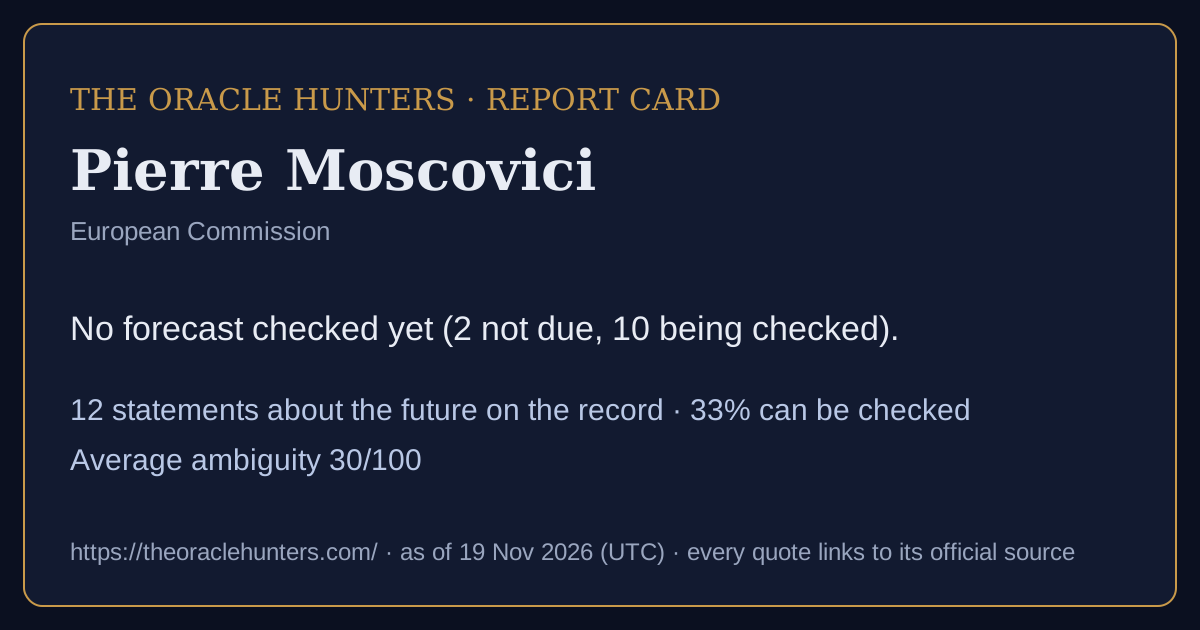
Track record: No forecast checked yet (2 not due, 10 being checked).
12forecasts & commitments on the record
33%can be checked as stated
30average ambiguity (0-100)
0goalpost moves recorded
0confirmed U-turns
Timeline
came true partly did not not due / being checked / too vague
Calibration score: shown after 10 checked forecasts with a stated likelihood (now 0).
How they speak about the future: based on data 9, stated on authority 3.
Kinds of claim: forecast 11, mixed claim 1. · Download this report card as a picture
In the nine words
How to read this
Each box is one sentence a public figure or institution said about the future, word for word, with a link to the official text. Can be checked means it names what will happen, by when, and how likely - so it can be compared with official figures later. Too vague to check means it does not. Ambiguity (0-100) is how many different ways the sentence can be read. When the date passes, the forecast is compared with official data and marked came true, partly or did not come true. Labels judge the sentence, never the person. Full guide and glossary.On the record (12)
The first EU blacklist will be ready next year – and I am confident that this will encourage many problematic third countries to start playing fair.
They also need a swift and efficient system to solve double tax disputes, and the Commission will make proposal to improve the current situation by the end of this year.
One is a plan to prepare a proposal on business insolvency by the end of the year, and the other is a recast of regulations regarding cross-border insolvencies, which will enter into force in 2017.
We will use these figures and the validated data for 2015 to assess Member States’ compliance with the Stability and Growth Pact and take any necessary decisions in that context later next month.
It will participate in the rest of the Semester process already this year.
I will continue at the same pace and with the same ambition in 2016 and in the coming years.
This is why the Commission is currently examining all the possible options and will then decide on the direction to take in 2016.
The legislation will enter into force in January 2017, marking the Union's first concrete achievement towards implementing the BEPS project.
The global standard for the automatic exchange of information will come into effect in 2017: we can therefore say that the era of secrecy, which shielded tax evaders, is over.
Fiscal transparency has been at the top of my agenda since I took up my duties as European Commissioner a year ago and it will remain there throughout my term of office at the Commission, until the end of October 2019.
The Draft Budgetary Plan targets an improvement of zero, and the Commission's ad-hoc forecast projects a deterioration by 0.2% of GDP.
The Draft Budgetary Plan foresees a smaller improvement of 0.2 percentage points, whereas the Commission's forecast points to a deterioration of 0.5 percentage points, notably due to the significantly different appraisal of one-off operations in line with the Commission classification.
Also said - not checkable as stated (12 newest)
Remarks about the future with no date, figure or likelihood that could be checked. They are kept on the record and shown here, but not scored.
I do not think that we can reach a minimum rate – some might like it, but the rule of unanimity forbids it – but I think we also need to restore a level playing field between companies, and all taxpayers.
This means defining what kind of Europe we want to build and what means we will give to it.
On 1 July, just two days from now, Member States will for the first time begin to share information about tax rulings with each other, finally tearing down the wall of secrecy around the tax arrangements they grant to businesses and companies.
With the relaunch of the CCCTB, Europe will have a decisive tool against corporate tax avoidance.
For the first time, companies will have a single rulebook for calculating their taxable profit throughout the EU.Large multinationals will no longer be able to exploit mismatches between national tax systems, benefit from preferential tax regimes and play with transfer pricing rules to reduce their own tax liability.
We do not talk that much VAT but I think that it is probably the most important reform that we would engage in the few years to come.
Under today's proposals, intermediaries will have to report any cross-border scheme which could potentially be used to evade or avoid tax.
They will have to give the details of these arrangements to their tax authorities.
In short, Member States will have to be able to assess tax arrangements more effectively and to react much more quickly against abusive plans.
And they will have to do so at a very early stage.
Without their help, international tax avoidance simply could not happen in the way it does today.
The advice they give is never revealed to the tax authorities – regardless of how harmful it might be.