Piero Cipollone
European Central Bank · EU
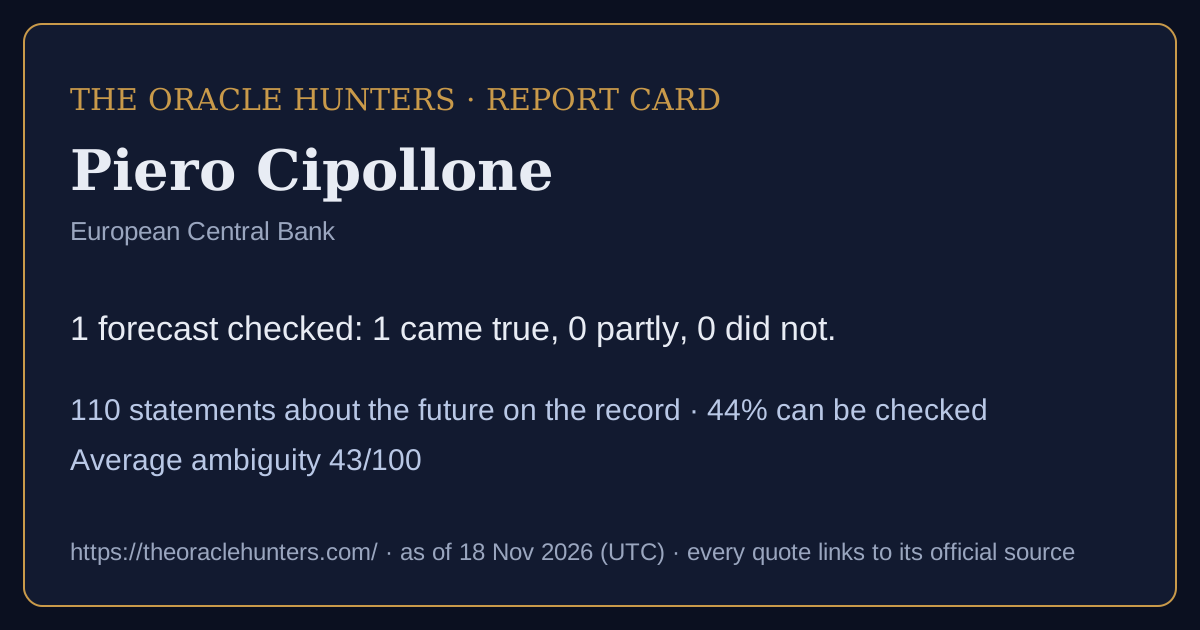
Track record: 1 forecast checked: 1 came true, 0 partly, 0 did not.
110forecasts & commitments on the record
44%can be checked as stated
43average ambiguity (0-100)
0goalpost moves recorded
0confirmed U-turns
Timeline
came true partly did not not due / being checked / too vague
Calibration score: shown after 10 checked forecasts with a stated likelihood (now 1).
How they speak about the future: based on data 83, stated on authority 21, educated guess 6.
Kinds of claim: forecast 86, mixed claim 12, scenario (if… then) 6, commitment 5, speculation 1. · Download this report card as a picture
In the nine words
πρόγνωσιςInference from evidence81 · 74%μαντείαInspired knowledge16 · 15%πρόνοιαPreparing for the future6 · 5%προαναγγελίαPublic pre-announcement5 · 5%πρόβλεψιςSeeing the signs1 · 1%εἰκασίαConjecture1 · 1%
How to read this
Each box is one sentence a public figure or institution said about the future, word for word, with a link to the official text. Can be checked means it names what will happen, by when, and how likely - so it can be compared with official figures later. Too vague to check means it does not. Ambiguity (0-100) is how many different ways the sentence can be read. When the date passes, the forecast is compared with official data and marked came true, partly or did not come true. Labels judge the sentence, never the person. Full guide and glossary.Checked
We now expect inflation to average 2.3 % in 2024, 2.0% in 2025 and 1.9% in 2026.
Came true. Said: inflation around 2% in 2025. Official figure for Euro area: 2.5% (World Bank open data). On target. Off by 0.5 points. official data · checked 14 Nov 2026 · automatic check against official data (rules v3)
On the record (110)
The survey results will inform the ECB Governing Council’s decision on the final design concept, expected around the end of this year.
In September we launched a new call for expression of interest, inviting private companies and organisations to explore how the digital euro can foster market innovation. The next wave of activities, including testing conditional payments and exploring applications of artificial intelligence in payments, will run from January to June 2027.
The final selection of merchants will be announced early next year.
Starting in the second half of 2027, the pilot will involve Eurosystem staff, participating payment service providers (PSPs) and selected merchants offering everyday services – for example in canteens – at the ECB and participating national central banks.
Current Pontes services will be expanded gradually, with enhanced features, such as immediate settlement finality on the Eurosystem DLT platform and longer operating hours, being introduced as we move towards 24/7/365 availability in 2028.
The digital euro pilot is planned to start in the second half of 2027 and will run for 12 months.
The ECB’s Governing Council expects to decide on the final design concept around the end of this year.
Less than a year from now, on 11 October 2027, Europe will move to T+1 settlement.
SPEECH Next-day securities settlement, tokenisation and the transformation of Europe’s financial infrastructure Keynote address by Piero Cipollone, Member of the Executive Board of the ECB, at an EU T+1 Industry Committee event on “One year to T+1” Frankfurt am Main, 29 October 2026 We are approaching an important milestone. Less than a year from now, on 11 October 2027, Europe …
We will do so in steps, for example by extending the operating hours significantly by mid-2027 and moving to 24/7/365 availability in 2028.
And only nine of those, representing 0.1% of total banking sector assets, would be at risk of liquidity buffers going below that level.
A reverse-waterfall mechanism could be used to automatically transfer to the linked bank account incoming amounts above the holding limit – or an even lower threshold if the customer so wishes.
Full implementation is expected by mid-2028, when we plan to offer a 24/7 service as well as greater programmability, state-of-the-art resilience and multi-currency capability.
The choices we make in the coming months – and the Governing Council’s final decision around the end of this year – will shape the appearance of our currency for many years to come.
If the use of stablecoins increases in the future, banks will also lose retail deposits.
Assuming the legislative process is completed by the end of this year, the digital euro could be issued for the first time in 2029.
In this way, they will continue to guide customers towards innovation, just as they have done successfully in recent years. The costs are manageable: we estimate total investment across the euro area at between €4 billion and €5.8 billion over four years, which represents around 3.4% of the annual technology budget of significant banks.
Together we will strengthen trust in money and the banking system.
On Tuesday we published the list of payment service providers selected to take part in the pilot project, which we will launch in September 2027.
Once this “TIPS clone” is operational later this year, it will be technically possible to link it with TIPS.
In addition, a bilateral link between TIPS and India’s Unified Payments Interface will go live in 2027, and we are actively exploring similar opportunities with Switzerland, Brazil and Nexus Global Payments, a network which will connect fast payment systems from Malaysia, the Philippines, Singapore, Thailand, India and Indonesia.
Norway will follow in 2028 and Iceland has also expressed an interest.
If US dollar-denominated stablecoins were to fill this gap, the euro’s share of global export invoicing – which, at over 40%, is currently on a par with that of the US dollar – could be put under pressure.
To outline a more long-term vision as to how a fully integrated tokenised ecosystem could work, we engage with the private sector on a continuous basis, including by asking for feedback on the roadmap for the Appia programme published at the start of this year.
The pilot itself is expected to start in the second half of 2027.
The new design will be based on either “European culture” or “Rivers and birds”. We expect to have decided on the final theme by the end of this year.
On 1 January 2027 we will mark the 25th anniversary of euro banknotes and coins entering circulation.
We will announce which PSPs have been selected in July, with a view to starting development in the third quarter of this year.
They hamper international trade and financial integration and make remittances slow and costly. Addressing these frictions is a shared international policy objective which we are pursuing by giving strong support to the G20 cross-border payments agenda. But these frictions could worsen if new technologies increase fragmentation.
We are working continuously with the private sector to establish a longer-term vision for how a fully integrated tokenised ecosystem could operate, including by inviting feedback on the Appia roadmap published earlier this year.
As part of our Pontes project, this service will be available as of the third quarter of this year.
Assuming that European co-legislators adopt the Regulation on the establishment of the digital euro this year, a pilot exercise and initial transactions could take place as of mid-2027, and the digital euro could be ready for first issuance in 2029.
Second, we will make it possible to settle DLT‑based transactions in central bank money as of September this year.
There are also clear downside risks to growth, which already came out below our projections in the first quarter of the year, at 0.1% quarter-on-quarter.
Under the baseline scenario in our March staff projections, higher energy prices are likely to keep inflation well above 2 per cent in the near term.
In particular, we will be looking at the indirect pass-through of higher energy costs to the broader consumption basket prices and possible second-round effects.
Credit standards for loans to firms have already tightened in the first quarter, according to our latest bank lending survey. This warrants close monitoring, especially as banks anticipate further tightening, which is expected to accelerate in the next quarter.
In such a scenario, inflation is cumulatively 6.3 percentage point higher until 2028 than what we projected last December.
In such a scenario, inflation is cumulatively 1.5 percentage point higher until 2028 than what we projected last December, while growth is cumulatively 0.8 percentage point lower.
In such a scenario, there is a risk of currency substitution in digital form, which could weaken the effectiveness of domestic monetary policy. In other words, if households and businesses switched to foreign currency-denominated stablecoins for payments and savings, domestic monetary authorities could lose control over the money supply and interest rates.
This piloting activity is a concrete part of our preparations to ensure technical readiness for potentially issuing the digital euro as of 2029, based on the working assumption that the co-legislators will adopt the Regulation in the course of this year. The Eurosystem’s readiness is just one side of the coin.
Selected PSPs will be notified in June, with a view to starting development already in the third quarter, ensuring readiness to launch the pilot in the second half of 2027, which will run for 12 months.
We will actively engage with businesses to explore a wide range of payment instruments that could support business-to-business use cases, as well as micropayments. In this workstream, we will also keep investigating cutting edge areas such as the use of artificial intelligence in payments and machine-to-machine use cases.
Pontes will provide this anchor in the near term: it will be launched in the third quarter of this year.
Norway will follow in 2028 and Iceland has also expressed an interest. In addition, a bilateral link between TIPS and India’s Unified Payments Interface will go live in 2027, and we are actively exploring similar opportunities with Switzerland, Brazil and Nexus Global Payments, a network which will connect fast payment systems from Malaysia, the Philippines, Singapore, Thailand, India and Indonesia.
According to Swift data, active correspondent banking relationships declined by 29% between January 2011 and December 2022. Should US dollar-denominated stablecoins fill this gap, the euro’s share of global export invoicing – which, at over 40%, is currently on a par with that of the US dollar – could be put under pressure.
Assuming that European co-legislators adopt the Regulation on the establishment of the digital euro in the course of next year, a pilot exercise and initial transactions could take place as of mid-2027, and the digital euro could be ready for first issuance in 2029.
For instance, we collaborated with market participants to explore the digital euro’s innovative potential. And we will launch a pilot exercise that will offer banks an opportunity to gain first-hand experience in a simulated digital euro ecosystem. In supporting this digital transformation, we remain technology neutral.
Second, starting next year, we will make it possible to settle transactions based on distributed ledger technology (DLT) in central bank money.
This “TIPS clone” is due to become operational in July 2026, after which it will be technically possible to link it up with TIPS.
Showing the newest 50 - the ledger has all 110.
Also said - not checkable as stated (12 newest)
Remarks about the future with no date, figure or likelihood that could be checked. They are kept on the record and shown here, but not scored.
A swift conclusion of the ongoing trilogue negotiations would pave the way for the adoption of the Single Currency Package by the end of the year as foreseen in the One Europe, One Market Roadmap.
At that point, we will also publish the survey results.
In two months’ time we will mark the 25th anniversary of euro banknotes and coins entering circulation.
The future euro banknotes should enter circulation gradually from the early 2030s, while existing banknotes will remain valid.
In any case, the TIPS clone should by its very nature already support integration, as payment services providers operating in both the euro area and the Western Balkans will be using two platforms that are technically very similar.
The next generation of euro banknotes will incorporate enhanced security features, have a smaller environmental impact and improve accessibility.
We will continue working closely with market participants and other European authorities to ensure that the transition to T+1 settlement goes smoothly.
We will ensure that our collateral framework keeps pace with innovation while upholding our statutory requirement for collateral to be adequate.
This means that the time from the moment a security is traded to the moment the buyer receives it and the seller is paid will be reduced from two days to one.
Implementation and testing need to advance with the same determination and cooperation that have been the driving force behind the project so far.
Behavioural research suggests that this approach could drive up digital euro adoption while reducing individual holdings. The limits will have to be calibrated to balance three objectives: making the digital euro convenient to use, safeguarding financial stability and preserving the smooth implementation and transmission of monetary policy.
Banks could integrate the digital euro into existing cards or mobile applications alongside their own payment solutions.