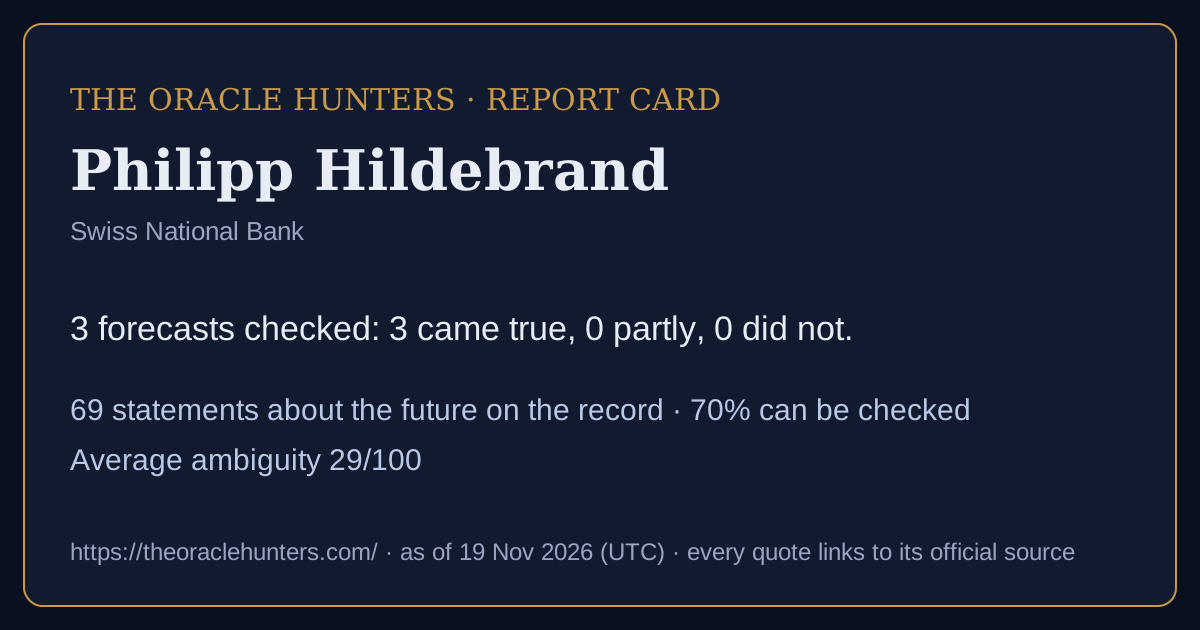
Philipp Hildebrand
Swiss National Bank
Track record: 3 forecasts checked: 3 came true, 0 partly, 0 did not.
69forecasts & commitments on the record
70%can be checked as stated
29average ambiguity (0-100)
0goalpost moves recorded
0confirmed U-turns
Timeline
came true partly did not not due / being checked / too vague
Calibration score: shown after 10 checked forecasts with a stated likelihood (now 2).
How they speak about the future: based on data 59, stated on authority 5, educated guess 5.
Kinds of claim: forecast 57, mixed claim 6, scenario (if… then) 5, commitment 1. · Download this report card as a picture
In the nine words
πρόγνωσιςInference from evidence59 · 86%πρόνοιαPreparing for the future5 · 7%μαντείαInspired knowledge4 · 6%προαναγγελίαPublic pre-announcement1 · 1%
How to read this
Each box is one sentence a public figure or institution said about the future, word for word, with a link to the official text. Can be checked means it names what will happen, by when, and how likely - so it can be compared with official figures later. Too vague to check means it does not. Ambiguity (0-100) is how many different ways the sentence can be read. When the date passes, the forecast is compared with official data and marked came true, partly or did not come true. Labels judge the sentence, never the person. Full guide and glossary.Checked
For 2012, the SNB is expecting inflation of -0.3% and for 2013, of 0.4%.
Came true. Said: inflation around -0.3% in 2012. Official figure for Switzerland: -0.7% (World Bank open data). On target. Off by 0.4 points. official data · checked 14 Nov 2026 · automatic check against official data (rules v3)
Consequently, the SNB expects GDP to grow by some 1.5% in 2011, following growth of about 2.5% in the current year.
Came true. Said: economic growth around 1.5% in 2011. Official figure for Switzerland: 1.4% (World Bank open data). On target. Off by 0.1 points. official data · checked 14 Nov 2026 · automatic check against official data (rules v3)
The SNB expects GDP to grow by some 1.5% in 2011, following growth of about 2.5% in the current year.
Came true. Said: economic growth around 1.5% in 2011. Official figure for Switzerland: 1.4% (World Bank open data). On target. Off by 0.1 points. official data · checked 14 Nov 2026 · automatic check against official data (rules v3)
On the record (69)
For 2011 as a whole, real GDP growth of 1.5-2.0% can be expected.
From the third quarter of 2012, inflation rises above the previous forecast, because at this point the negative base effect of price declines since mid2011 disappears.
Until the second quarter of 2012, the SNB's new conditional inflation forecast is below the previous quarter's forecast.
For 2012, the SNB is expecting economic growth in the order of 0.5%.
For 2012, the SNB is expecting inflation of -0.3% and for 2013, of 0.4%.
Came true. Said: inflation around -0.3% in 2012. Official figure for Switzerland: -0.7% (World Bank open data). On target. Off by 0.4 points. official data · checked 14 Nov 2026 · automatic check against official data (rules v3)
For 2012, the SNB is expecting economic growth in the order of 0.5%.
For instance, if inflation rises due to increasing commodity prices, employees will not immediately ask for higher wages because they are confident that the increase in inflation is only temporary.
For 2011, the SNB is maintaining its forecast of real growth in Swiss GDP of around 2%.
During the course of 2012, the path of the new forecast falls below that of March, due to the slowdown in inflation attributable to the latest appreciation in the Swiss franc.
Until the beginning of 2012, the path of the SNB's new conditional inflation forecast lies above that of the previous quarter's forecast.
Over the course of 2012, the path of the new forecast is lower than that of March because of the latest appreciation of the Swiss franc and the slightly slower development of international growth.
Until the beginning of 2012, the path of the SNB's conditional inflation forecast lies above that of the previous quarter's forecast.
Assuming an unchanged three-month Libor of 0.25% over the forecast horizon, the SNB expects average inflation rates of 0.9% for 2011, 1.0% for 2012 and 1.7% for 2013.
For the coming months, the SNB expects economic growth to continue.
The SNB's conditional inflation forecast for 2012 and 2013 is slightly below the September forecast.
It shows the future path of inflation, assuming that the three-month Libor remains constant at 0.25% over the entire forecast horizon, and it covers the period from the fourth quarter of 2010 to the third quarter of 2013.
Consequently, the SNB expects GDP to grow by some 1.5% in 2011, following growth of about 2.5% in the current year.
Came true. Said: economic growth around 1.5% in 2011. Official figure for Switzerland: 1.4% (World Bank open data). On target. Off by 0.1 points. official data · checked 14 Nov 2026 · automatic check against official data (rules v3)
Assuming an unchanged three-month Libor of 0.25%, average inflation for 2010 is expected to amount to 0.7%, for 2011 to 0.4% and for 2012 to 1.0%.
The SNB expects GDP to grow by some 1.5% in 2011, following growth of about 2.5% in the current year.
Came true. Said: economic growth around 1.5% in 2011. Official figure for Switzerland: 1.4% (World Bank open data). On target. Off by 0.1 points. official data · checked 14 Nov 2026 · automatic check against official data (rules v3)
It covers the period from the second quarter of 2010 to the first quarter of 2013 and shows the future inflation development on the assumption of the three-month Libor remaining constant at 0.25% over the entire forecasting horizon.
By May 2010, it had nearly tripled in size to over CHF 300 billion.
The SNB's conditional inflation forecast for 2010 and 2011 has increased slightly since March.
Thereafter, inflation is projected to remain below 1% until the second quarter of 2011.
Assuming an unchanged three-month Libor of 0.25%, average inflation for 2010 is expected to amount to 0.9%, for 2011 to 1.0% and for 2012 to 2.2%.
The forecast shows that - should the Libor remain at the level targeted today inflation accelerates from the third quarter of 2011 onwards.
For 2010, the SNB is currently expecting real GDP growth of about 1.5%.
If this succeeds, the competitive position of the Swiss banking sector will be reinforced in the long-term as a result of increased safety, reliability and credibility.
The consultation package on this matter will be published in early 2010.
The leaders of the G20 countries were quick to recognise the significance of these risks and they asked the Financial Stability Board to elaborate proposals before the end of October 2010 on how the 'too big to fail' and 'too big to rescue' issues could be addressed.
The FSB will conduct a peer review by spring 2010.
The new regulation will enter into force in spring 2010.
To this end, the Basel Committee will conduct a quantitative impact study in 2010, before determining the final calibration of the improved requirements.
In good times, the capital base has to account for at least 5 per cent of the total adjusted assets. 9 To prevent a procyclical impact, these targets will apply as of 2013 at the earliest, giving banks enough time to recover from the crisis.
FINMA expects the big banks' 'leverage ratio' to be well over 3% at group level and well over 4% for individual institutions in good times.
In our basis scenario we expect the economy to recover gradually as of 2010, both internationally and in Switzerland.
The new FINMA targets will apply as of 2013 at the earliest, and an extension would be an option for the big banks if compliance becomes impossible due to the situation on the capital markets or the big banks' individual earnings position.
We will deploy these measures aggressively for as long as this remains appropriate, both within the context of our monetary policy strategy and with a view to our inflation forecast.
an effective tax rate of 20%, the increase in capital will reduce the bank's total market value by less than 1%.
The CHF 50 banknote will mark the beginning of the new series of banknotes and is scheduled to be issued in autumn 2010.
However, if the situation on the capital markets or the individual earnings position of the big banks make it impossible to achieve the objectives by 2013, it may be possible to defer this date.
The orders already issued by the SFBC relating to the reform of the capital regulation state that the big banks will not be required to comply with the higher risk-weighted capital ratio and the leverage ratio until 2013.
Regardless of who moves into the White House in January 2009, the new President's longer-term fiscal policy options will be constrained by the legacy of the past.
Moreover, even if global imbalances were to unwind quickly, for instance in association with a sharp and protracted recession in the United States, the power of compound return will continue to be a substantial source of growth for SWFs that already exist.
As you know, the GIC recently committed to subscribe to CHF 11 billion of a mandatory convertible bond which will be issued by UBS in an effort to raise capital in the aftermath of losses on large sub-prime mortgage positions.
20 In Germany, legislation has been drafted that would enable the German government to veto any foreign investors intending to take a stake of 25% or more in a German company that may threaten national security;
Ideally, a first set of guidelines will be agreed upon jointly between the G7 countries and the most prominent SWFs by the 2008 spring meetings of the IMF and the World Bank.
11 The estimates of Merrill Lynch, Deutsche Bank, Morgan Stanley and Standard Chartered are, respectively, that SWFs will grow to USD 7.9 trillion by 2011, USD 9 trillion by 2015, USD 12 trillion in 2015 and USD 13.40 trillion by 2017.
This is particularly relevant in view of the new capital adequacy requirements that will also be introduced in Switzerland next year.
Even the short-term corrections in the financial markets in February of this year and May of the previous year did not result in a change of attitude in this regard.
indexed bond will always reflect an expected inflation rate of 2% in ten years time.
Showing the newest 50 - the ledger has all 69.
Also said - not checkable as stated (12 newest)
Remarks about the future with no date, figure or likelihood that could be checked. They are kept on the record and shown here, but not scored.
Also, 'Democratic principles demand that, as an agent of the government, a central bank must be accountable in the pursuit of its mandated goals, responsive to the public and its elected representatives and transparent in its policies.' Cf. speech given by Ben Bernanke on 26 May 2010, on 'Central Bank Independence, Transparency and Accountability,' Tokyo.
(1993), Central Bank Independence and Macroeconomic Performance: Some Comparative Evidence, Journal of Money, Credit and Banking , 25 (May), pp 151-162.
Incidentally, that also applies to mandates other than the monetary policy core mandate, which I will not be talking about today.
Under article 9 of the National Bank Act, we may use a great many instruments, as needed.
In addition, very volatile results may be expected in the next few years because of the current size of the balance sheet and the uncertain situation in the capital markets.
We will have the privilege of hearing from Minister Lagarde about this important endeavour later during lunch.
Opening remarks by Mr Philipp Hildebrand, Chairman of the Governing Board of the Swiss National Bank, at the High-Level Conference on the International Monetary System, Zurich, 10 May 2011.
As a small open economy, Switzerland could not escape this historical collapse in world trade.
I will concentrate on three factors in particular, namely the geographical, the sectoral and the qualitative dimensions of the Swiss export industry.
And judging by Asia's strong growth prospects, it is likely that it will become even more important in the future.
As you can imagine, there were probably very few patients who restricted their medical treatment due to the recession.
Thus, in addition to using unit values for aggregate exports, I will also include unit values for individual sectors.