Philip Smith
Foreign & Commonwealth Office · GBR
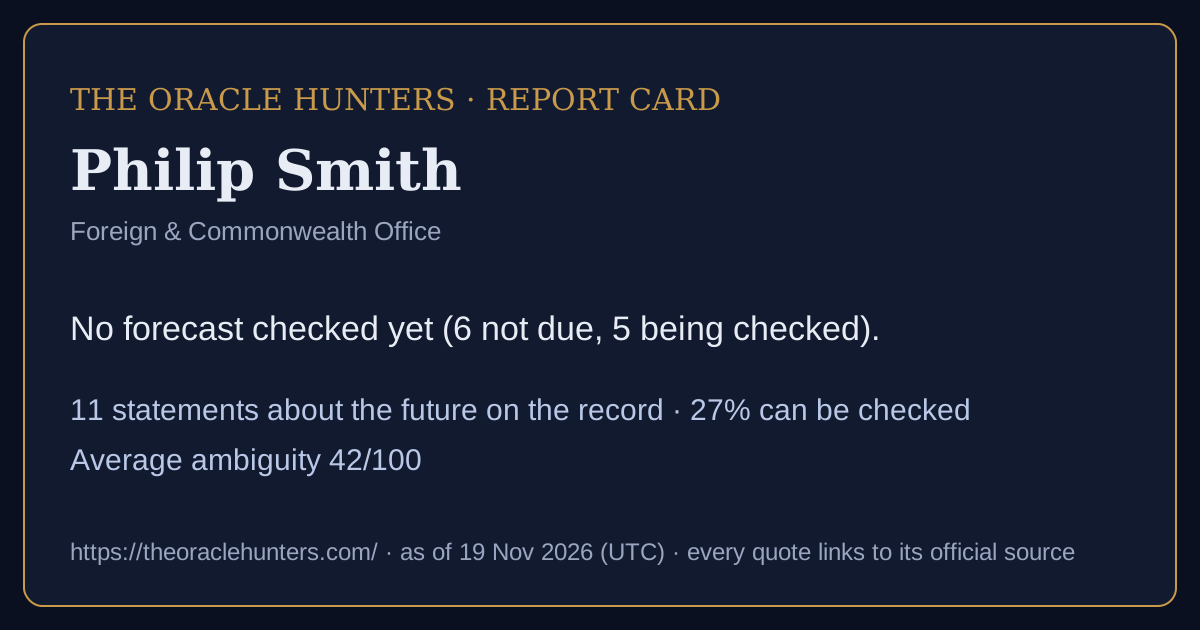
Track record: No forecast checked yet (6 not due, 5 being checked).
11forecasts & commitments on the record
27%can be checked as stated
42average ambiguity (0-100)
0goalpost moves recorded
0confirmed U-turns
Timeline
came true partly did not not due / being checked / too vague
Calibration score: shown after 10 checked forecasts with a stated likelihood (now 0).
How they speak about the future: based on data 9, stated on authority 2.
Kinds of claim: forecast 8, scenario (if… then) 2, mixed claim 1. · Download this report card as a picture
In the nine words
πρόγνωσιςInference from evidence7 · 64%πρόνοιαPreparing for the future2 · 18%μαντείαInspired knowledge2 · 18%
How to read this
Each box is one sentence a public figure or institution said about the future, word for word, with a link to the official text. Can be checked means it names what will happen, by when, and how likely - so it can be compared with official figures later. Too vague to check means it does not. Ambiguity (0-100) is how many different ways the sentence can be read. When the date passes, the forecast is compared with official data and marked came true, partly or did not come true. Labels judge the sentence, never the person. Full guide and glossary.On the record (11)
This important project – £940,000, part of a £1.2 million project, has been granted to BasicNeeds UK to work with BasicNeeds-Ghana and three other NGOs to deliver the project.
If current trends continue, over the next decade 150 million girls will be married before their 18th birthday.
The Ministry of Gender will commit 3% of the Ministry’s budget towards the operationalisation of the National Strategic Framework to Ending Child Marriage.
The UK will also continue to support the MoE’s teacher education reform through ongoing technical assistance from DFID’s T-TEL programme over the next two years.
That’s why we are so excited to support the Ministry of Education’s ambitious new agenda for reform, which sets out in practical terms how the vision of Ghana Beyond Aid will be implemented in the education sector, in line with the Education Strategic Plan 2018-2030, and Sustainable Development Goal 4.
Can I take a moment here to applaud the Government of Ghana …. under the Honourable Minister’s leadership, the Ministry of Education is now taking on leadership of CBE, and we welcome the commitment that 1% of the basic education budget will now go to CBE to reach the 450,000 children still out-of-school in Ghana.
T-TEL has also supported universities to develop a new ‘world-class’ 4-year Bachelor of Education degree curriculum, which - from this year - will make teaching a degree a profession for the first time.
If we don’t take sufficient action, 10 million people will die annually from AMR-associated causes by 2050, and the majority of these deaths will occur in Africa and Asia.
In May this year, the Vice President launched Bank of Ghana’s mobile money inter-operability system, making it easier and cheaper for people to make mobile money transactions across different networks.
Ghana, as it prepares to organise a Girls’ Summit in 2018, could take a leadership role in addressing VAWG across the region, if not the continent.
We anticipate that by the time ENGINE ends in 2018, 500 SMEs will have been helped to overcome barriers to growth and build competitive businesses in Ghana with firms supported growing by 400% and creating 1,770 new jobs.
Also said - not checkable as stated (12 newest)
Remarks about the future with no date, figure or likelihood that could be checked. They are kept on the record and shown here, but not scored.
Secondly, the UK will support government to scale up social services – including cash transfers to the poorest households- with a new focus on jobs and skills.
We will support Ministry of Health to integrate quality mental health services through primary health care at scale.
We will provide technical support to ensure better use of disaggregated data by disability status and support government to mainstream gender across its programmes.
And thirdly, we will support the efforts of civil society, disability persons organisations and self-help groups to address stigma, discrimination and human rights violations to support Ghana’s efforts to transform attitudes and behaviours that drive social exclusion.
This will include a specific focus on promoting community-based care and supporting long-term reforms to de-institutionalise people with disabilities/mental health conditions from hospitals, prayer camps and other institutions.
As Ghana continues to make progress towards self-reliance, we look forward to growing the partnership between our two countries – ensuring that persons with disabilities and mental health conditions, especially the poorest and most marginalized, will have access to the care they need and can contribute to their communities.
Development Partners are supporting Ghana to improve domestic capacity for tax and other revenue collection that can – given the right political will - generate sufficient national revenue to finance health, education and social services for the people.
how will insecurity and climate change impact on the Northern Ghana and what does this mean for our efforts to accelerate development?
For example, at this year’s Education World Forum in London in January, DFID’s Secretary of State highlighted how the Varkey Foundation GEC project in Ghana has used technology to run distance interactive lessons to tackle challenges of poor teacher quality and learning outcomes, and lack of safe spaces and role models for girls.
We encourage the Ministry of Education to support policies and budget allocations which will enable real improvements in gender equality and social inclusion in education.
The birth of a new baby is a time of great joy, but can also be a time when mental health conditions that a woman may have previously experienced can return.
Specifically, it will make it possible to detect early on mental health conditions - particularly depression - among pregnant women and new mothers that will allow them to access treatment – whether counselling or medical management.