Philip N Jefferson
Federal Reserve System · USA
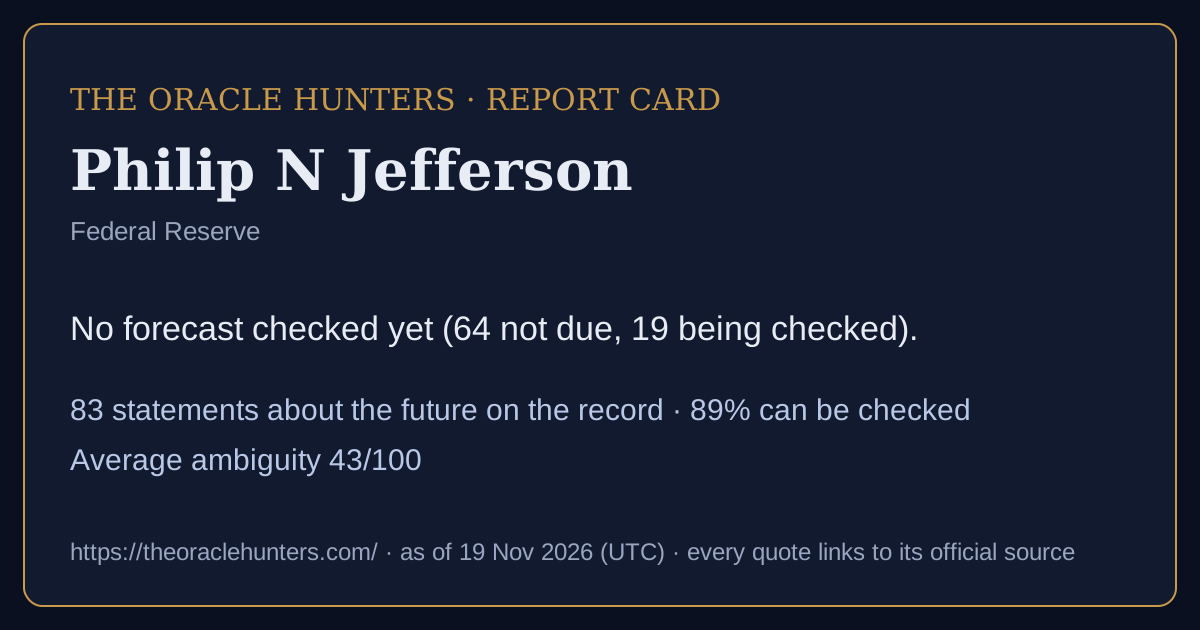
Track record: No forecast checked yet (64 not due, 19 being checked).
83forecasts & commitments on the record
89%can be checked as stated
43average ambiguity (0-100)
0goalpost moves recorded
0confirmed U-turns
Timeline
came true partly did not not due / being checked / too vague
Calibration score: shown after 10 checked forecasts with a stated likelihood (now 0).
How they speak about the future: based on data 56, stated on authority 18, educated guess 9.
Kinds of claim: forecast 62, scenario (if… then) 12, mixed claim 6, commitment 3. · Download this report card as a picture
In the nine words
πρόγνωσιςInference from evidence45 · 54%μαντείαInspired knowledge16 · 19%πρόνοιαPreparing for the future12 · 14%πρόβλεψιςSeeing the signs5 · 6%προαναγγελίαPublic pre-announcement3 · 4%εἰκασίαConjecture1 · 1%φρόνησιςPractical wisdom1 · 1%
How to read this
Each box is one sentence a public figure or institution said about the future, word for word, with a link to the official text. Can be checked means it names what will happen, by when, and how likely - so it can be compared with official figures later. Too vague to check means it does not. Ambiguity (0-100) is how many different ways the sentence can be read. When the date passes, the forecast is compared with official data and marked came true, partly or did not come true. Labels judge the sentence, never the person. Full guide and glossary.On the record (83)
I expect the expansion will continue roughly in line with potential output next year.
As my base case, I expect inflation to be elevated in the short run before resuming its decline toward our 2 percent goal as the effects of energy and other price shocks fade.
Looking ahead, I anticipate that AI-related investments will continue to support growth this year, and, accordingly, I expect near-term real GDP growth to remain roughly the same as the pace seen in the first half of the year.
This was an important step to ensure longer-term inflation expectations remain well anchored and to validate the public's confidence that we will achieve our 2 percent inflation objective in a timely manner.
If, on the one hand, the demand effects from stronger investment and consumption are realized sooner than the supply effects from productivity growth, AI could exert upward pressure on inflation.
When the public trusts that the FOMC will return inflation to our 2 percent longer-run goal, policymakers have more flexibility to respond appropriately to the full range of shocks the economy might experience.
We may have a positive output gap, with employment above its maximum sustainable level and inflation above 2 percent.
I expect inflation to decline later this year as the effects of tariffs and the energy shock wane, but I view risks around my inflation outlook as tilted to the upside.
Recent economic growth in the U.S. has been solid, though I expect a more modest pace of growth this year as households face high energy costs.
If the current elevated level of uncertainty persists, there is a risk that firms' reluctance to hire could also persist and hold down job growth for longer.
It has been my expectation that the disinflationary process would resume once higher tariffs are no longer pushing up consumer prices.3 In addition, the strong productivity growth and deregulation efforts, which I previously mentioned, may further help in bringing inflation down to our 2 percent target.
Still, overall, I see the labor market as roughly in balance, and my baseline forecast is for the unemployment rate to remain roughly steady this year.
As a policymaker, I will monitor to see if these higher costs become embedded in prices throughout the economy.
In addition, the strong productivity growth and deregulation efforts, which I previously mentioned, may further help in bringing inflation down to our 2 percent target.
I see the labor market as roughly in balance and expect the unemployment rate to remain near its current level throughout this year.
Even if AI ultimately succeeds in greatly enhancing the productive capacity of the economy, a more immediate increase in demand associated with AI-related activity could raise inflation temporarily, absent offsetting monetary policy actions.
During the pandemic, well-anchored longer-term inflation expectations likely helped to prevent the surge in inflation from becoming entrenched and subsequently facilitated progress toward the FOMC's 2 percent inflation objective without a large increase in unemployment.
Productivity growth in the business sector is reported to have increased at an average annual rate of 2.2 percent from the start of 2020 to the third quarter of last year, notably faster than the 1.5 percent pace over the previous business cycle.5 If this more rapid pace of productivity growth persists, it will have important economic implications.
In addition, projected strong productivity growth may be a source of further help in bringing inflation down to our 2 percent target.
I see signs suggesting that the labor market is stabilizing, that inflation can return to a path toward our 2 percent objective, and that sustainable economic growth will continue.
Certainly, some upside risks remain, but I expect the disinflationary process to resume this year once increased tariffs pass through more fully to prices.
As the balance sheet shrank over the next few years, the federal funds rate remained about 7 basis points below the interest on reserve balances (IORB) rate for most of this period.
While some upside risks remain, moving forward I expect to see inflation return to a sustainable path back to our 2 percent target.
Some analysts estimate that future investments in AI infrastructure will require a lot more debt.16 If that turns out to be the case, leverage in the AI sector could increase—and so could the losses if sentiment toward AI shifts.
A finding in the most recent survey is likely of particular interest to a conference exploring financial stability in a time of technological change—30 percent of contacts surveyed cited a turn in the prevailing sentiment toward AI as a salient risk to the U.S. financial system and the global economy.
Given that outlook, I supported last month's decision to reduce our policy rate by 1/4 percentage point.
This lack of progress appears to be due to tariff effects, with signs that inflation excluding the effects of tariffs may be continuing to make progress toward 2 percent.
The Pony Express was founded just north of here in St. Joseph, this is the greeting card capital, and, next year, this area will bring people together from around the globe for soccer's World Cup.
I expect that the unemployment rate is likely to inch up slightly by the end of the year from the relatively low 4.3 percent rate recorded in August.
The lack of progress on headline inflation appears to be due to tariff effects, with signs that underlying inflation may be continuing to make progress to 2 percent.
Instead, the revised document more precisely states that "the Committee recognizes that employment may at times run above real-time assessments of maximum employment without necessarily creating risks to price stability."3 As Chair Powell pointed out, preemptive action could well be warranted if tightness in the labor market or other factors pose risks to price stability.
As such, I expect the disinflation process to resume after this year and inflation to return to the 2 percent target in the coming years.
Instead, the revised document more precisely states that "the Committee recognizes that employment may at times run above real-time assessments of maximum employment without necessarily creating risks to price stability."2 As Chair Powell pointed out, preemptive action could well be warranted if tightness in the labor market or other factors pose risks to price stability.
With the unemployment rate at 4.3 percent, the labor market is softening, which suggests that, left unsupported, it could experience stress.
The unemployment rate could edge a bit higher this year before moving back down next year.
Providing liquidity at this rate supports the implementation of monetary policy because institutions can turn to the Fed if conditions tighten in money markets that might otherwise push overnight money market rates above levels that would be consistent with the Fed's target range.
For example, if a bank needs a loan of $100, a portfolio of securities valued at $200 may be required to be posted if the discount or haircut associated with that portfolio is 50 percent.
At the same time, higher tariffs could lead to higher inflation this year.
Various measures of consumer and business sentiment have declined sharply this year, and I will be watching very carefully for signs of weakening economic activity in hard data.
Beyond the next year or so, however, most measures of longer-term inflation expectations remain consistent with our 2 percent inflation goal.
The median FOMC participant forecasts overall PCE inflation at 2.7 percent this year and 2.2 percent next year.
That said, I anticipate that there could be some modest softening in the labor market this year.
While Fed policymakers and many private-sector forecasters expect growth to continue, they broadly anticipate a slower pace of expansion this year.
In the SEP projections, the median FOMC participant expected the unemployment rate to be 4.4 percent at the end of this year and 4.3 percent over the next two years.
In the SEP released after the March FOMC meeting, the median participant projected GDP to rise 1.7 percent this year and to move up a bit below 2 percent over the next two years.
In December 2019, the median Federal Open Market Committee (FOMC) participant expected the aggregate unemployment rate to remain below 4 percent through the end of 2022 while inflation was expected to move back up to the Committee's 2 percent objective.5 Had this long, non-inflationary expansion continued as the Committee forecast, gaps in employment and earnings across groups may have continued …
If consumer spending continues to grow at the same pace as it has in the past two years, however, that could cause me to revise up my outlook for overall economic growth.
By September of last year, I had growing confidence that with an appropriate recalibration of our policy stance, strength in the labor market could be maintained in a context of moderate economic growth and inflation moving sustainably down to 2 percent.
While the downside risks of a rapidly weakening labor market appear to have lessened, I expect some further softening that could cause the unemployment rate to edge just slightly higher this year but stay in a range consistent with recent readings.
Overall, I see the economy as continuing to grow at a healthy pace this year, though I anticipate growth to be slightly lower than what we observed in 2024.
Showing the newest 50 - the ledger has all 83.
Also said - not checkable as stated (12 newest)
Remarks about the future with no date, figure or likelihood that could be checked. They are kept on the record and shown here, but not scored.
While the new technology should ultimately generate higher output and income in the aggregate, I recognize that this transition could be painful for some workers and businesses.
Over the medium term, the supply of these goods should catch up, and the broader boost to aggregate productivity from adoption should materialize.19 Both of those developments should ease the upward pressure on prices we see today.
It may be reasonable to apply this model to the development of AI.
It may have far-reaching implications for workers, firms, and government agencies, including central banks.
However, this surge in productivity began before the debut of popular AI chatbots in 2022 and likely reflects a variety of factors, including a pickup in new business formation.
Rather, we must consider how this cascade might affect the entire economy when setting policy to achieve our dual-mandate objectives.
My colleagues and I will need to come to our own judgment, which may take more time.
I see the economy as likely to show continued resilience, despite these challenges, by adding jobs and extending a six-and-a-half-year-long expansion.
Working together, we will continue to fulfill the fundamental purpose of the discount window as established over a century ago—and thereby achieve the best outcomes for the American people.
The discount window is as old as the Federal Reserve itself, which will be 113 years old in December.3 Over its long history, the Federal Reserve has used the discount window to support the liquidity and stability of the banking system and to implement monetary policy.
Now, I will move on to what we are doing at the Federal Reserve to modernize the discount window to meet 21st-century banking needs.6 Over the past few years, the System has conducted extensive outreach to banks and other stakeholders to understand better their experiences with the discount window, including the Board's issuance of a request for information (RFI) on …
As many of you may know, the FHLBs are important liquidity providers to banking organizations, and both the Federal Reserve and FHLB Systems share the goal of supporting the stability and resilience of the U.S. banking system.