Philip Lowe
Reserve Bank of Australia
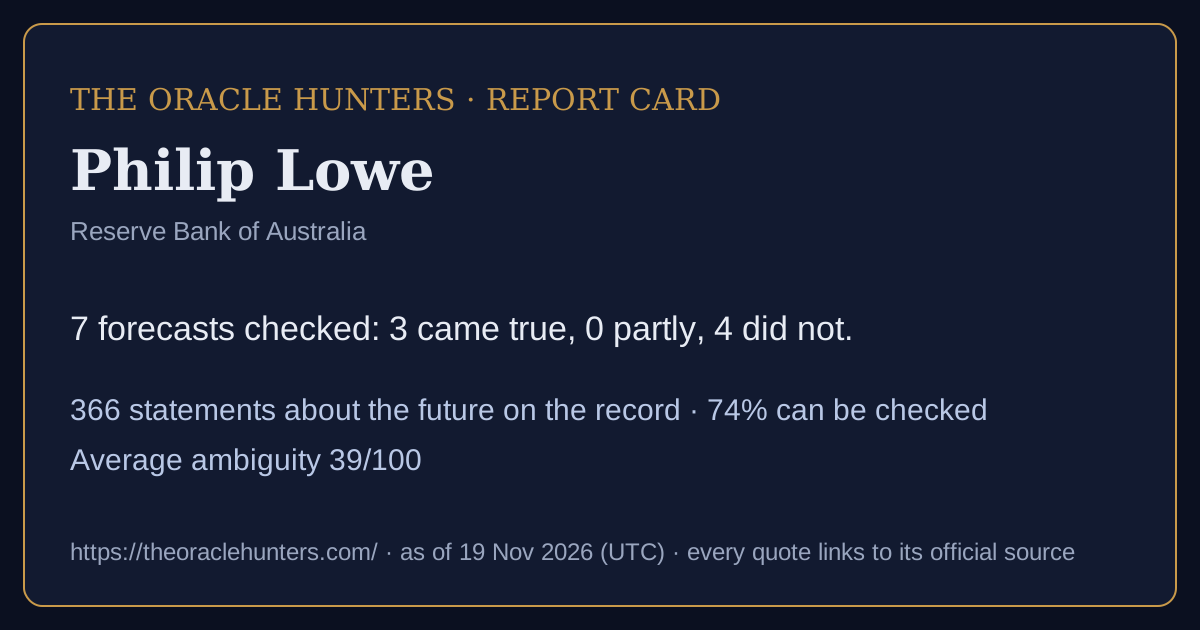
Track record: 7 forecasts checked: 3 came true, 0 partly, 4 did not.
366forecasts & commitments on the record
74%can be checked as stated
39average ambiguity (0-100)
0goalpost moves recorded
0confirmed U-turns
Timeline
came true partly did not not due / being checked / too vague
Calibration score: shown after 10 checked forecasts with a stated likelihood (now 5).
How they speak about the future: based on data 241, stated on authority 66, educated guess 59.
Kinds of claim: forecast 262, scenario (if… then) 47, mixed claim 38, commitment 19. · Download this report card as a picture
In the nine words
πρόγνωσιςInference from evidence228 · 62%μαντείαInspired knowledge56 · 15%πρόνοιαPreparing for the future47 · 13%προαναγγελίαPublic pre-announcement19 · 5%εἰκασίαConjecture15 · 4%φρόνησιςPractical wisdom1 · 0%
How to read this
Each box is one sentence a public figure or institution said about the future, word for word, with a link to the official text. Can be checked means it names what will happen, by when, and how likely - so it can be compared with official figures later. Too vague to check means it does not. Ambiguity (0-100) is how many different ways the sentence can be read. When the date passes, the forecast is compared with official data and marked came true, partly or did not come true. Labels judge the sentence, never the person. Full guide and glossary.Checked
We estimate that GDP increased by around 5 per cent over 2021 and are expecting GDP growth of around 4¼ per cent over 2022 and 2 per cent over 2023.
Did not come true. Said: economic growth around 2% in 2023. Official figure for Australia: 3.6% (World Bank open data). Missed. Off by 1.6 points. official data · checked 14 Nov 2026 · automatic check against official data (rules v3)
Our central forecast is for the economy to grow by 4¼ per cent this year and around 2 per cent over 2023 (Graph 1).
Did not come true. Said: economic growth around 2% in 2023. Official figure for Australia: 3.6% (World Bank open data). Missed. Off by 1.6 points. official data · checked 14 Nov 2026 · automatic check against official data (rules v3)
Our central scenario is that the economy will return to strong growth in 2022, with GDP increasing by a little over 4 per cent, to be followed by growth of around 2½ per cent in 2023.
Came true. Said: economic growth above 4% in 2022. Official figure for Australia: 4.3% (World Bank open data). On target. official data · checked 14 Nov 2026 · automatic check against official data (rules v3)
And then, next year, our central scenario is for the economy to grow by 5 per cent and then 4 per cent over 2022.
Came true. Said: economic growth around 4% in 2022. Official figure for Australia: 4.3% (World Bank open data). On target. Off by 0.2 points. official data · checked 14 Nov 2026 · automatic check against official data (rules v3)
Over 2020, inflation is forecast to be a little under 2 per cent and over 2021 it is expected to be a little above 2 per cent.
Came true. Said: inflation below 2% in 2020. Official figure for Australia: 0.8% (World Bank open data). On target. official data · checked 14 Nov 2026 · automatic check against official data (rules v3)
By the end of 2020, inflation is forecast to reach 2¼ per cent.
Did not come true. Said: inflation at the end of the year around 2.25% in 2020. Official figure for Australia: 0.9% (BIS consumer prices (December, year on year)). Missed. Off by 1.4 points. official data · checked 17 Nov 2026 · automatic check against official data (rules v4)
We expect GDP growth to pick up to average a bit above 3 per cent over 2018 and 2019 (Graph 3).
Did not come true. Said: economic growth above 3% in 2018. Official figure for Australia: 2.9% (World Bank open data). Missed. Off by 0.1 points. official data · checked 14 Nov 2026 · automatic check against official data (rules v3)
On the record (366)
While recent data provide some comfort on this front, we need to remain alert to this risk for if it were to materialise, inflation would become sticky, which would require tighter monetary policy and more economic pain later on.
From next year, there will be eight interest-rate decisions a year, rather than the current 11.
And dwelling investment is expected to increase again next year, after the recent difficulties in that sector.
Looking forward, the Bank's central scenario is that economic growth remains subdued for the rest of this year before gradually picking up to around 2… per cent by end 2025.
As a result, the unemployment rate is forecast to rise gradually to reach around 4‰ per cent late next year.
Our central forecast is for CPI inflation to be around 3… per cent by the end of next year and to be back within the 2-3 per cent target range by late 2025.
It is for these reasons that the Reserve Bank Board remains resolute in its determination to return inflation to the 2-3 per cent target range within a reasonable timeframe and will do what is necessary to achieve that outcome.
The decision to hold interest rates steady this month follows a cumulative increase of 4 percentage points since May last year.
We are currently working through the appropriate span of control and reporting lines of the Chief Operating Officer and will begin the search process for this role later this year.
The new Statement is expected to be finalised later this year.
The exact dates for 2024 will be published soon and the dates for future years will be published well in advance.
From 2024, the Board will meet eight times a year, rather than 11 times as is currently the case.
Our most recent set of forecasts, which were prepared in early May, have inflation returning to the top of the target band in mid-2025.
If inflation stays high, this will damage the economy and all Australians will feel the effects.
And if inflation stays high for too long, it will become ingrained in people's expectations and high inflation will then be self-perpetuating.
The path back to 2-3 per cent inflation is likely to involve a couple of years of relatively slow growth in the economy.
It remains resolute in its determination to return inflation to target and will do what is necessary to achieve that.
On the other hand, real incomes have declined and required mortgage payments as a share of household disposable income will reach a record high later this year.
Working in the other direction, services price inflation in Australia remains high, rents are increasing quickly and there will be further large increases in electricity prices this year (Graph 6).
If people think inflation is going to remain high then, understandably, they will adjust their behaviour.
If we are to stay on that path, Australians need to have confidence that inflation will come down and return to target.
We will publish a detailed response later this year after the necessary work has been completed.
And the 35 per cent of households with a mortgage are experiencing, or will experience, a significant increase in their required payments.
Our current forecast is that inflation returns to the top of the target range, but only by mid-2025.
The price of electricity, as measured in the CPI, increased by 12 per cent last year and we are expecting a further increase of around 15 per cent this year.
It is for these reasons that the Board remains resolute in its determination to return inflation to target and will do what is necessary to achieve that.
Our central view remains that economic growth will be below trend for a while, that unemployment will increase later this year and that inflation will decline gradually over time.
This increase in mortgage rates has had a significant effect on household budgets and we anticipate that required mortgage payments will reach a new record high of almost 10 per cent of household disposable income by the end of next year.
If we don't get inflation down fairly soon, the end result will be even higher interest rates and more unemployment.
Inflation is still too high and it will be some time yet before we are back within the 2-3 per cent target range.
On the other side, though, interest payments are increasing quickly at a time when inflation is also high; based on the interest rate increases that have already occurred (including yesterday's), total required mortgage payments are expected to reach 9½ per cent of household disposable income later this year, which will be around a record high (Graph 11).
Overall, we expect that inflation will trend lower this year and next, but there is still uncertainty about the exact path.
If we don't get on top of inflation and bring it down in a timely way, the end result will be even higher interest rates and more unemployment in the future.
The central forecast is that the unemployment rate gradually increases from here due to slower growth to reach 4‰ per cent by mid-2025.
In terms of economic growth, our central forecast is for GDP growth to slow to around 1‰ per cent this year and next.
The central forecast is for CPI inflation to decline to 4¾ per cent over 2023 and to around 3 per cent by mid-2025.
Testing will commence soon and we look forward to publishing the results next year.
While there are some payment service providers that are running behind, most of these will have least-cost routing for online transactions up and running in the first half of 2023.
In terms of online payments, the Payments System Board expects least-cost routing to be available by the end of this year.
To provide greater transparency on how individual institutions are progressing, the RBA will, next year, start publishing institution-level data on LCR availability and take-up.
The industry committed to providing this new service by 1 December 2023 in the NPP Roadmap released last month. We expect this deadline to be met by all the banks participating in the NPP .
If so, we could expect higher and more volatile energy prices during the transition to a more renewables-based energy supply.
- Of note is the Productivity Commission's five-yearly review of Australia's productivity performance, which has received public submissions, provided interim reports and will provide a final report to the government in February 2023.
This meant that when we did lift interest rates in May this year, many people saw us as going back on this commitment and this has hurt our reputation.
The reasons for this are complex, but if supply does not respond to higher prices, we will likely have more supply constraints in the future.
Our central forecast is that inflation will peak later this year at around 8 per cent, and then decline gradually over the next couple of years to be a little above 3 per cent by the end of 2024 (Graph 3).
This is the highest rate in more than three decades and we are expecting inflation to increase further to reach around 8 per cent later this year.
If we need to step up to larger increases again to secure the return of inflation to target, we will do that.
In the short term, the east coast floods are adding to the upwards pressure on food prices, and next year there are likely to be very large increases in the prices that households pay for gas and electricity.
Inflation is expected to start declining early next year and then take a couple of years to return to the 2 to 3 per cent range.
Showing the newest 50 - the ledger has all 366.
Also said - not checkable as stated (12 newest)
Remarks about the future with no date, figure or likelihood that could be checked. They are kept on the record and shown here, but not scored.
In addition to these points, there are many other points that have been attributed to me, including: a promise that interest rates would not go up until 2024; everybody needs to get a flatmate; people need to work more hours to make ends meet; and young adults should stay at home because of the rental crisis.
that we will get better outcomes if the public square is filled with facts and nuanced and informed debate, rather than vitriol, personal attacks and clickbait.
My view is that it will be difficult to return to the earlier world in which inflation tracked in a very narrow range.
While this doesn't mean that the inflation target can't be achieved on average, it does mean that inflation is likely to be more variable around that target.
As you know, interest rates started being increased in May 2022 and there has been much criticism since, especially by those who borrowed during the pandemic based on our guidance.
Once again, we will do what is necessary to bring inflation back to target.
Remarks by Mr Philip Lowe, Governor of the Reserve Bank of Australia, at the Reserve Bank Board Dinner, Perth, 2 May 2023.
We also received confirmation that the peak in inflation in Australia is now behind us, but that has not changed our view that it will be some time yet before inflation is back in the target range.
But services and energy price inflation is still high and likely to remain so for some time.
We will work constructively with the Government and Parliament with the aim of ensuring that any changes to legislation are effective in achieving their objectives.
We will now develop an implementation plan under the leadership of a small team of experienced people.
The recommendations will help us deal with this more complex world and will strengthen the monetary policy process and governance of the RBA.