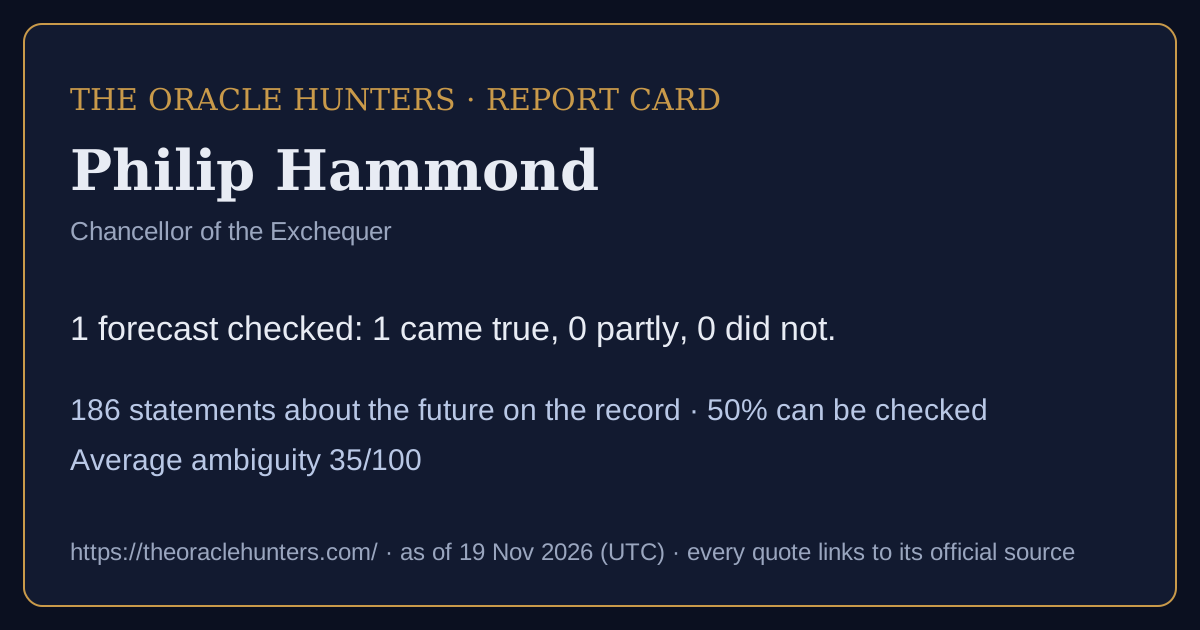
Philip Hammond
Chancellor of the Exchequer · GBR
Track record: 1 forecast checked: 1 came true, 0 partly, 0 did not.
186forecasts & commitments on the record
50%can be checked as stated
35average ambiguity (0-100)
0goalpost moves recorded
0confirmed U-turns
Timeline
came true partly did not not due / being checked / too vague
Calibration score: shown after 10 checked forecasts with a stated likelihood (now 1).
How they speak about the future: based on data 132, stated on authority 44, educated guess 10.
Kinds of claim: forecast 105, mixed claim 50, commitment 24, scenario (if… then) 7. · Download this report card as a picture
In the nine words
πρόγνωσιςInference from evidence123 · 66%μαντείαInspired knowledge27 · 15%προαναγγελίαPublic pre-announcement24 · 13%πρόνοιαPreparing for the future7 · 4%εἰκασίαConjecture4 · 2%πρόβλεψιςSeeing the signs1 · 1%
How to read this
Each box is one sentence a public figure or institution said about the future, word for word, with a link to the official text. Can be checked means it names what will happen, by when, and how likely - so it can be compared with official figures later. Too vague to check means it does not. Ambiguity (0-100) is how many different ways the sentence can be read. When the date passes, the forecast is compared with official data and marked came true, partly or did not come true. Labels judge the sentence, never the person. Full guide and glossary.Checked
…and inflation forecast to average 2% next year…
Came true. Said: inflation around 2% in 2019. Official figure for United Kingdom: 1.7% (World Bank open data). On target. Off by 0.3 points. official data · checked 14 Nov 2026 · automatic check against official data (rules v3)
On the record (186)
As I said at the Spring Statement, if we leave the EU in a smooth and orderly way, the fiscal headroom I have built up means an incoming Prime Minister will have scope for additional spending or tax cuts.
…and are just as relevant to the ones we will face in 2020.
So if we are going to meet our ambition of making the economy work for everyone, one of the best levers we have is to deliver carefully considered increases to the National Living Wage.
In 2016, we set a target for the National Living Wage to reach 60% of median earnings by 2020 – and we will deliver on that, giving a pay rise to millions of workers.
And there’s good news on pay, too – with the OBR forecasting wages to rise by 3% or more in each of the next five years…
…while inflation is forecast to remain at, or very close to, the target of 2% throughout the forecast period.
Thirdly, we are committed to building the most pro-growth and pro-innovation regulatory environment in the financial services world.
…or UK challenger bank Starling, who raised £75m to invest in new products and will launch in Europe later this year.
From this Autumn we will completely exempt PhD-level roles from visa caps, alongside the new Startup and Innovator Visas we launched earlier this year.
By 2023 the OBR expect to see 600,000 more new jobs in our economy.
And finally, we will introduce a Future Homes Standard, mandating the end of fossil-fuel heating systems in all new houses from 2025.
But later this year we will need to set a new remit beyond 2020.
Less borrowing means less debt - now lower in every year than forecast at the Budget, falling to 82.2% of GDP next year, then 79%, 74.9%, 74%, and finally 73% in 2023-24.
Borrowing this year will be just 1.1% of GDP – £3 billion lower than forecast at the Autumn Budget. [Political content redacted]
Then 1.4% in 2020, as forecast at the budget…
Later this year, India will overtake the UK to become the world’s fifth largest economy.
…and we are cutting taxes on the wages people earn and on the businesses that employ them, with 32 million people receiving a tax cut from next month, and business enjoying the lowest rate of Corporation Tax in the G20.
And we are supporting industry to make the transition to a low-carbon economy, with £315 million for a new Industrial Energy Transformation Fund, which will help businesses with high energy use – like those in your sector – to cut their bills and reduce their emissions…
…good for developing countries, with the IMF and World Bank estimating that liberalising services trade could raise manufacturing productivity in these economies by over 22%…
…good for the global economy as a whole – IMF analysis shows that reducing trading costs for services by 15% could boost total GDP of G20 countries by more than $350 billion this year…
…and £50 million for the new Turing Artificial Intelligence Fellowships, which will attract and retain the best researchers from around the world.
…we will commit £100 million to establish 1,000 new PhD places in centres across the UK…
Artificial intelligence could add $15.7 trillion to the global economy by 2030.
And we will provide an additional £200m of funding to the British Business Bank to replace access to the
To support British exports we will increase UKEF’s direct lending facility by up to £2bn;
From next year it will be +1.2% annual average real growth.
Next year we will conduct a full Spending Review
…and inflation forecast to average 2% next year…
Came true. Said: inflation around 2% in 2019. Official figure for United Kingdom: 1.7% (World Bank open data). On target. Off by 0.3 points. official data · checked 14 Nov 2026 · automatic check against official data (rules v3)
From October next year, I can confirm that we will increase Remote Gaming Duty on online games of chance, to 21%…
We are no longer borrowing at all to finance current spending, and today the OBR confirms that our national debt peaked in 2016-17 at 85.2% of GDP, and then falls in every year of the forecast from 83.7% this year to 74.1% in 2023-24.
Borrowing this year will be £11.6 billion lower than forecast at the spring statement—just 1.2% of GDP —and is then set to fall from £31.8 billion in 2019-20 to £26.7 billion in 2020-21, £23.8 billion in 2021-22, £20.8 billion in 2022-23 and £19.8 billion in 2023-24, its lowest level in over 20 years.
Today’s forecast, taking into account all announcements made since the spring statement, including measures I shall announce today, shows the deficit down from almost 10% under Labour to less than 1.4% next year under this Conservative Government, and falling to just 0.8% by 2023-24.
The OBR expects growth to be resilient across the forecast period, improving next year from the 1.3% forecast at the spring statement to 1.6%; then 1.4% in 2020 and 2021; 1.5% in 2022; and 1.6% in 2023.
Next year, we will conduct a full spending review, setting our priorities for public spending within a sustainable funding envelope, deciding on the right balance between investing in Britain’s future and current consumption of public services.
But now we need to focus on pay, and with the proportion of low-paid jobs at its lowest since 1997, with regular pay growth at 3.1%—its strongest in almost a decade—and inflation forecast to average 2% next year, the OBR is forecasting sustained real wage growth in each of the next five years, which is a far cry from the …
…and specifically the untapped firepower of defined contribution pension schemes which we expect to hold over £1 trillion of assets by 2025…
And if the UK is going to keep up – and if we are going to continue to grow, create jobs, and raise the living standards of our people – our economy will need to continually adapt and to remain competitive.
…and I am therefore pleased that during Green Great Britain Week I can announce that the Government will launch a Strategy on Green Finance next year…
As part of our plan to unlock £20 billion of new finance for UK growth companies over the next decade.
This week, the PM announced a 5-year NHS funding package that will boost spending on health by over £20 billion a year in real terms in England alone.
Today I have announced that we will further strengthen the Bank of England, with reforms to its financial framework.
And the OBR forecasting debt will begin falling as a percentage of GDP this year on a sustained basis for the first time since 2001.
But if we are collectively to meet our global climate goals, we will need to mobilise $90 trillion by 2030.
Tomorrow, I will chair a roundtable of heads of government and senior business leaders to reflect on key themes of this year’s summit.
First, we are committed to building the most pro-growth and pro-innovation regulatory environment in the world for fintech.
So alongside changes to tax relief, the British Business Bank will launch a new £500m programme in May that will invest in a series of funds to encourage co-investment by leading institutional investors in those businesses.
Next month NatWest will launch new fintech accelerators in London, Edinburgh, Bristol and Manchester.
…and we will keep the financing needs of high growth businesses under continuous review as we leave the EU, and if necessary, we will use the British Business Bank to provide an alternative to the EIF, which has done great work in supporting the industry.
Later this year, the British Business Bank will launch a new ‘British Patient Capital’ investment fund– which will co-invest with the private sector to unlock £7.5 billion of public and private investment.
In the longer term, I can confirm that, at this year’s Budget I will set an overall path for public spending for 2020 and beyond.
Showing the newest 50 - the ledger has all 186.
Also said - not checkable as stated (12 newest)
Remarks about the future with no date, figure or likelihood that could be checked. They are kept on the record and shown here, but not scored.
And we will use the Government’s “Smart Data Function”, working with the FCA and Treasury, to build on the fantastic success of our Open Banking initiative with a new agenda for Open Finance – giving small businesses, as well as consumers, power over all of their financial data, so that SMEs will have access to financial tools hitherto only accessible …
So, the next Prime Minister will need to complete the post-crash recovery process…
Ten years on from the crisis, and in the midst of the Brexit debate, we need to articulate a vision for the future of our Financial Services industry and a plan for delivering it that will boost London’s position as the world’s leading international financial centre.
…and that recognises that the EU will continue to be one of our major trading partners…
Of course, over the medium term, sustainable real wage growth is only possible through productivity growth.
And bold, decisive action on the National Living Wage, sustainably delivered, will be an important demonstration of the power of that argument…
And finally, the unparalleled scale of the technological revolution on which we are embarked – a revolution that will profoundly change our lives, our jobs, our economy and our politics.
That’s why we embarked on an unprecedented year-long consultation on the post-Brexit migration regime: we said we want to hear the views of business, and I am sure you are not going to disappoint us!
Because we must not undo a decade of hard work by the British people by making unfunded commitments that would send our national debt soaring; leave the economy vulnerable to future shocks; burden future generations; and waste billions on interest payments.
…and that we will, one way or another, reach a resolution, that will enable the deal to get through Parliament…
Even as free movement ends, Britain will remain open to talent from around the world.
So we will still draw talent from across the EU – but from beyond it as well.