Philip Dunne
Ministry of Defence · GBR
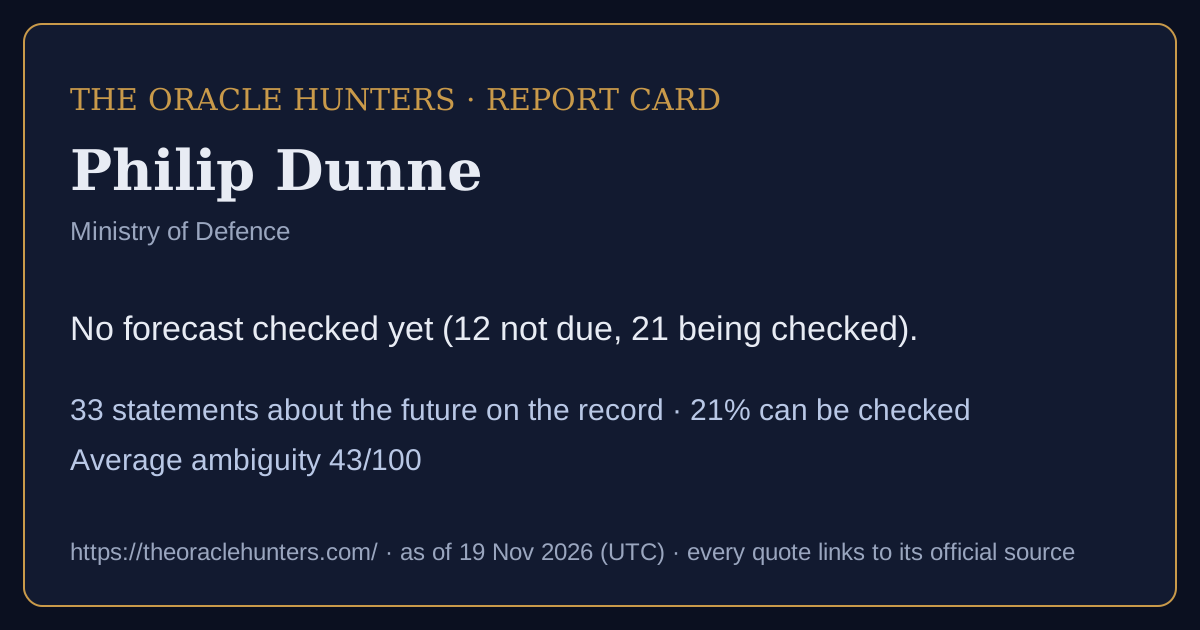
Track record: No forecast checked yet (12 not due, 21 being checked).
33forecasts & commitments on the record
21%can be checked as stated
43average ambiguity (0-100)
0goalpost moves recorded
0confirmed U-turns
Timeline
came true partly did not not due / being checked / too vague
Calibration score: shown after 10 checked forecasts with a stated likelihood (now 0).
How they speak about the future: based on data 25, stated on authority 8.
Kinds of claim: forecast 31, commitment 1, mixed claim 1. · Download this report card as a picture
In the nine words
πρόγνωσιςInference from evidence25 · 76%μαντείαInspired knowledge7 · 21%προαναγγελίαPublic pre-announcement1 · 3%
How to read this
Each box is one sentence a public figure or institution said about the future, word for word, with a link to the official text. Can be checked means it names what will happen, by when, and how likely - so it can be compared with official figures later. Too vague to check means it does not. Ambiguity (0-100) is how many different ways the sentence can be read. When the date passes, the forecast is compared with official data and marked came true, partly or did not come true. Labels judge the sentence, never the person. Full guide and glossary.On the record (33)
Official Statistics from UKTI DSO cite 12% of UK defence exports going to north America last year,
Contrast this with last month’s NAO ‘Major projects report’ which confirmed the top 11 defence projects are £397 million under budget and in aggregate only 14 months over time.
So to illustrate how far we have transformed defence acquisition, you can do no better than look at the position we inherited from the NAO’s report on 2009, where the top 15 defence projects were a staggering £4.5 billion over budget in year and 336 months overdue.
Next year, we hope to increase that to £60 million.
By the end of next month there will be 25,000 fewer civil servants supporting our armed forces, 2 times the proportionate head count reduction of the frontline.
The Royal Air Force received the first A400M Atlas transport aircraft, which will become the backbone of one of the most modern air mobility military fleets in the world.
This year we spent 10% of our science and technology budget researching disruptive technologies …and next year, we plan to increase that by 50%.
And the proof that defence has been transformed is in the latest NAO report on Major Projects for 2014, published earlier this month where the 11 top defence projects are £397 million under budget and a total of only 14 months over time.
…to illustrate how bad it was, the NAO Major Projects report for 2009 reviewed the in year performance of the top 17 defence projects which were a staggering £4.5 billion over budget and 339 months overdue.
…and $470 million on cutting edge projects such as the European spallation source, a powerful neutron microscope that will allow us to observe the universe better…bringing with it the potential to discover materials for faster planes, new and better computer chips and feather lightweight kit for our military.
It’s also why I’m such an advocate of the Defence Growth Partnership coming together at Farnborough next month…
By the time we reach Main Gate in 2016 we will have committed around £3 billion to the “successor” programme.
The first production vehicles are expected to appear in a 2017 timeframe ready to start army user trials.
Our 2010 SDSR confirmed the funding for a number of key armoured vehicle development and upgrade programmes which will support Army 2020.
Deliveries will begin this year to allow UK based units to start training on these vehicles.
Think of the A400M military transport aircraft programme, that we expect to be in service here next year and is already in service in France, which is being procured by six countries through OCCAR.
The MOD has now set a £160 billion budget envelope for equipment and support spending over the next decade.
The final decision between the two options, the GOCO and DE&S, will be made at the end of the assessment phase, scheduled for summer 2014.
The solution arrived at was Future Force 2020: the adaptable, deployable, powerful and, crucially, sustainable forces our country will need in the future.
In January, for the first time we published a 10 year equipment plan which sets out how much will be spent, by sector, by year on equipment and separately support, to enable delivery of Future Force 2020, allowing the department, our armed forces and the defence sector to plan for the future with much greater confidence.
We expect to order a further aircraft this year in the next JSF annual production contract and, subject to approval at ‘Main Gate 4’, later this year we intend to start procuring the aircraft for our first operational squadron.
The final decision between the two options on the future operating model will be made at the end of the assessment phase, scheduled for summer 2014.
The recent announcement of the sale of 12 Typhoons and 8 Hawk trainer aircraft to the Kingdom of Oman is a good example, cementing our already close defence ties with this important Gulf ally, facilitating closer interoperability, generating some £2.5 billion of defence exports over the next few years and supporting British jobs.
And this government has set itself the target of placing 25% of its own procurement spend with SMEs by the end of this Parliament, a challenge for defence to do so directly given the pattern of our procurement.
I can now confirm that there will be further marketplaces, incorporating all of this excellent feedback, starting later this year.
Earlier this year the Secretary of State, Philip Hammond, was in Australia and Indonesia, and my colleague, Dr Andrew Murrison, Minister for International Security Strategy, will be visiting Brazil next month.
So we understand the significance of defence and security exports and we are determined to do what we can to encourage your business growth through responsible exports.
The recent announcement of the sale of 12 Typhoons and 8 Hawk trainer aircraft to the Kingdom of Oman is a good example, cementing our already close defence ties with this important Gulf ally, generating some £2.5 billion of defence exports over the next few years and supporting British jobs.
Last week I was in Bangalore, next week I will be at IDEX in Abu Dhabi and next month I am visiting Malaysia.
This year, wearing my defence exports hat, I will be leading regular delegations to overseas expos and defence trade shows.
They are so flexible and capable that they will form the backbone of Army 2020, the blueprint for our future army.
This will contribute to the overall approach set out earlier this year in our National security through technology white paper, working to enable UK-based industry to be competitive and provide the best value for money in meeting our defence and security needs, as well as helping you to export successfully.
By eliminating the black hole in the defence budget, and putting the equipment programme on a sustainable basis, we are providing industry with the confidence that we can deliver the programme that will underpin Future Force 2020.
Also said - not checkable as stated (12 newest)
Remarks about the future with no date, figure or likelihood that could be checked. They are kept on the record and shown here, but not scored.
I’m not saying it will be easy to break into the American defence market place.
…that will allow us discover materials for faster planes, new and better computer chips and feather lightweight kit for our military
…and we’ve rewritten our policy to ensure ‘exportability’ must be actively considered from the very beginning of our own acquisition cycle
But before I do, I must emphasise that while creating and sustaining armed forces fit for the 21st century will not be plain sailing…for any nation…
As a nation, working closely in concert with our international allies, we will find opportunity in adversity…
Gone are the days of Cold War certainty…and in this new world order…just as Churchill foresaw…now more than ever…it will be our attitude to innovation that determines whether we sink or swim on the tide of progress.
Just as it will be innovation that delivers the value for money…and the military productivity…that are the key to raising military outcomes in a world of challenging defence budgets.
Just as it will be innovation that delivers greater bang for our military buck, as defence budgets in Western economies are squeezed tighter.
And I’m looking forward to the imminent opening of the Defence Solutions Centre in Farnborough, which I have high hopes will become a UK centre of excellence, recognised as such by defence customers and other defence supply chains around the world.
Second, industry will reap the rewards of a virtuous circle of innovation, exporting and productivity.
And third, UK PLC will benefit from greater security and prosperity.
As we approach our strategic defence and security review, next year, it goes without saying that innovation is at the front and centre of our thinking…