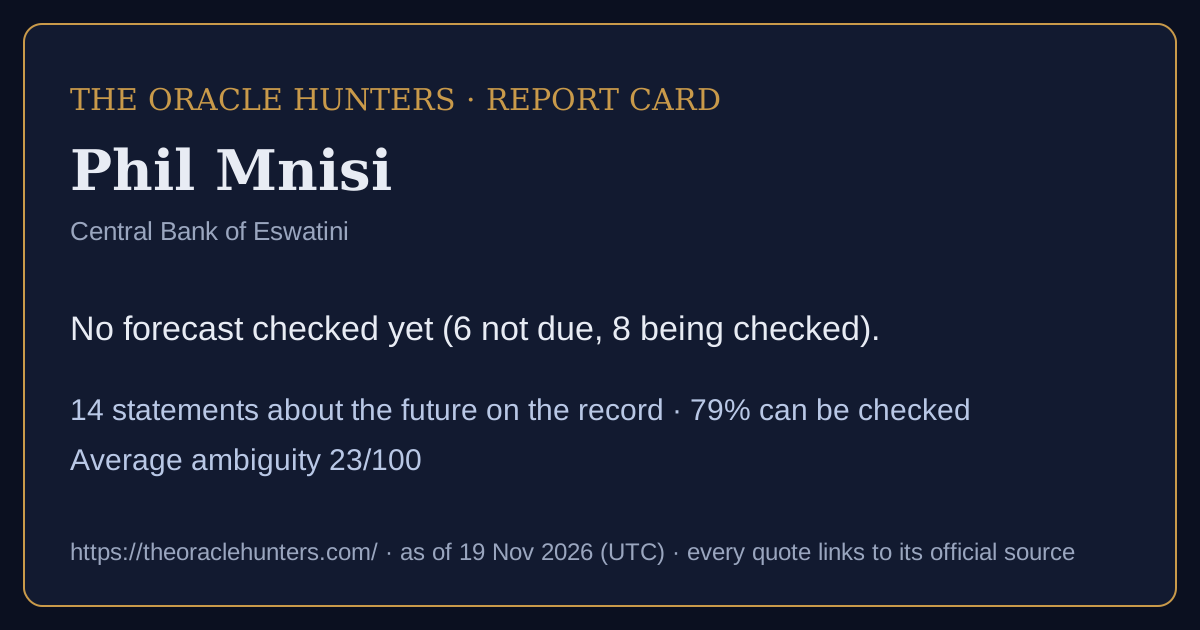
Phil Mnisi
Central Bank of Eswatini
Track record: No forecast checked yet (6 not due, 8 being checked).
14forecasts & commitments on the record
79%can be checked as stated
23average ambiguity (0-100)
0goalpost moves recorded
0confirmed U-turns
Timeline
came true partly did not not due / being checked / too vague
Calibration score: shown after 10 checked forecasts with a stated likelihood (now 0).
How they speak about the future: based on data 14.
Kinds of claim: forecast 13, mixed claim 1. · Download this report card as a picture
In the nine words
How to read this
Each box is one sentence a public figure or institution said about the future, word for word, with a link to the official text. Can be checked means it names what will happen, by when, and how likely - so it can be compared with official figures later. Too vague to check means it does not. Ambiguity (0-100) is how many different ways the sentence can be read. When the date passes, the forecast is compared with official data and marked came true, partly or did not come true. Labels judge the sentence, never the person. Full guide and glossary.On the record (14)
The IMF has lowered its global growth forecast for 2026 to 3.1%, mainly because of the continuing conflict in the Middle East.
However, in the short to medium term, the reserves position is expected to improve, largely supported by a projected 12.5% increase in Southern African Customs Union (SACU) receipts for the 2026/2027 fiscal year.
Inflation is now projected to average 3.31% in 2026, and 3.74% for 2027.
Global inflation is projected to rise to 4.4% in 2026 before easing to 3.7% in 2027.
Growth is expected to improve slightly to 3.2% in 2027.
The remaining participants are expected to offer Fast Payment Services by the end of January 2025.
- 4.1 Distinguished guests, in line with the Bank's mandate to educate consumers, an extended campaign is scheduled to take place after the stabilization period and will commence in the first week of February 2025.
Our meeting today will look into the activities of CMI and CCH as well as consider their financials and budgets for 2025.
The first issuance under this programme was undertaken in May 2024 and a total of R400 million was raised for a period of 3 years at a yield of 11.875% per annum maturing on 8 May 2027.
The IMF forecasts a slow and steady climb for the South African economy, with a 0.9% growth rate in 2024 before edging up to 1.2% in 2025.
In May 2024, the Bank revised down the annual average inflation forecasts to 4.50 % (from 4.91%) for 2024, 5.13% (from 5.21%) for 2025 and 4.92% (from 5.37%) for 2026.
In 2025, global inflation is expected to fall further to 4.5%, noting that across the global economy, inflation is projected to fall at different speeds.
The IMF's World Economic Outlook published in April 2024 estimates global growth at 3.2% for 2023 and it is projected to be steady at the same level in 2024 and 2025.
The SARB forecasts inflation to urge lower to 5.1% in 2024 and 4.5% in 2025.
Also said - not checkable as stated (12 newest)
Remarks about the future with no date, figure or likelihood that could be checked. They are kept on the record and shown here, but not scored.
The programme demonstrated that municipalities with sound governance and credible revenue streams could successfully access capital markets without relying solely on intergovernmental transfers.
For these centres to realise their full potential, local authorities must possess both the financial capacity and institutional capability to invest in infrastructure that supports growth.
And we must continue developing our domestic capital markets.
Importantly, we must ensure that any future municipal borrowing is undertaken responsibly, sustainably and in a manner that safeguards fiscal stability.
Supervisors must build the necessary skills, data, and examination methods to hold institutions accountable, which will require long-term effort.
While implementation paces for Basel standards, IFRS 9 expected credit loss frameworks, and risk-based supervisory approaches vary regionally, inconsistent implementation in an ever-increasing interconnected banking ecosystem, creates gaps that can introduce vulnerabilities into the financial system.
Let me also emphasise at the outset that the work of this Subcommittee does not stand alone: it forms part of the broader regional strategy approved by the SADC Committee of Central Bank Governors, and it is against that strategy that your deliberations over the next two days should be measured.
Supervisors must ensure these collaborative efforts yield practical results-producing actionable judgments, timely information sharing, and cross-border lessons that directly improve how institutions are supervised.
First, institutions must acknowledge their supervisory blind spots-such as unexamined outsourced services and unexplainable AI models-and modernize their skills, data, and methods to supervise today's digital financial system rather than relying on outdated traditional tools.
Second, with cross-border crisis management guidelines finalized, the Subcommittee must quickly move to simulate and test these frameworks before a real crisis hits.
As part of the agenda, we will also receive an update on the Balance of Payments Harmonisation Project, a key regional initiative that will improve the consistency and comparability of our external sector statistics.
Encouragingly, crude oil prices have remained below US$80 per barrel, suggesting that markets expect the current tensions to be temporary rather than the beginning of a prolonged disruption.