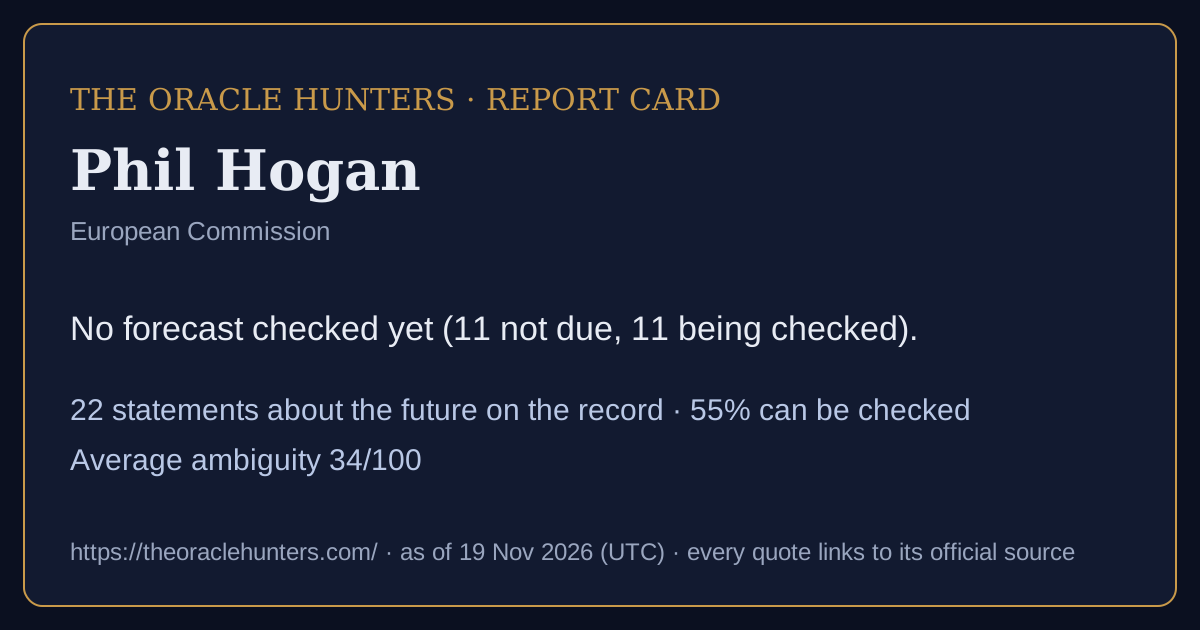
Phil Hogan
European Commission · EU
Track record: No forecast checked yet (11 not due, 11 being checked).
22forecasts & commitments on the record
55%can be checked as stated
34average ambiguity (0-100)
0goalpost moves recorded
0confirmed U-turns
Timeline
came true partly did not not due / being checked / too vague
Calibration score: shown after 10 checked forecasts with a stated likelihood (now 0).
How they speak about the future: based on data 15, stated on authority 6, educated guess 1.
Kinds of claim: forecast 18, scenario (if… then) 2, commitment 1, mixed claim 1. · Download this report card as a picture
In the nine words
πρόγνωσιςInference from evidence14 · 64%μαντείαInspired knowledge5 · 23%πρόνοιαPreparing for the future2 · 9%προαναγγελίαPublic pre-announcement1 · 5%
How to read this
Each box is one sentence a public figure or institution said about the future, word for word, with a link to the official text. Can be checked means it names what will happen, by when, and how likely - so it can be compared with official figures later. Too vague to check means it does not. Ambiguity (0-100) is how many different ways the sentence can be read. When the date passes, the forecast is compared with official data and marked came true, partly or did not come true. Labels judge the sentence, never the person. Full guide and glossary.On the record (22)
No product will enter the EU market unless it complies 100 per cent with our standards.
The agreement will enable Belgian companies to make significant tariff savings by eliminating customs duties on 91% of tariff lines.
The public consultation is open until September 15th, and its results will feed into the adoption of a new Trade Policy Communication before the end of the year.
Once we have gathered and collated all the input, this will feed into a Commission Communication to be published at the end of the year.
The EU economy is expected to contract by 7.4 per cent in 2020, while global GDP will fall by 3.5 per cent and global trade by between 10-16 per cent.
The EU economy is expected to contract by 7.4% in 2020, while global GDP will fall by 3.5% and global trade by between 10%-16%.
If this remains the case, the EU will little choice but to exercise its retaliation rights and impose our own sanctions in the Boeing case, once we have the WTO-award.
The objective will be to conclude this review with the adoption of a new Communication towards the end of the year.
For the EU27, the estimated decrease in EU27 exports would be around 9 and 15 per cent (€282-€470 billion), while EU-27 imports could expectedly decrease by between 11 and 14 per cent (€313-€398 billion).
According to the updated Commission estimates, the COVID-19 crisis could result in a decrease in global trade for 2020 of somewhere between 10 and 16 per cent.
We will also see a legislative proposal for the revised Non-Financial Reporting Directive early 2021.
The Conflict Minerals Regulation largely takes into account the requirements of the OECD Due Diligence Guidance and will be implemented early next year.
He indicated that subject to the results of consultations with stakeholders, the Commission would table legislative proposals in 2021 and I will work closely with him on this, given the strong trade dimension involved.
Therefore, as we will stress tomorrow at the WTO General Council, fair, open and rules-based trade remains our best bet for building more competitive, dynamic and sustainable economies.
This is vital for our future economic prospects, given that 85% of global growth will take place outside Europe in the next 10 years.
This year will be particularly important as we engage directly with China through a series of high-level events.
Next year I will launch a diplomatic offensive across the emerging economies to improve our trade.
It is estimated that that an additional $267 billion per year will be needed for investment in rural and urban areas and in social protection to eradicate world hunger sustainably by 2030.
In addition to this, Rural Development Programmes will provide more than €16 billion between now and 2020 to commit an area the size of Germany and Bulgaria combined into agri-environment-climate action contracts.
Over the full programming period 2014-2020, it is expected that €2.7 billion will be invested in renewable energy production and a further €2.8 billion in energy efficiency.
This year, some €16.3 billion of the CAP budget will be climate relevant, which includes the greening practices, ensuring, amongst others, the maintenance of permanent grassland in Europe as an important carbon sink.
In addition to population growth, we see clear evidence of changing dietary habits as disposable incomes increase, with the so-called 'middle class' expected to more than double in size from 2 billion today to close to 5 billion in 2030.
Also said - not checkable as stated (12 newest)
Remarks about the future with no date, figure or likelihood that could be checked. They are kept on the record and shown here, but not scored.
This was a step in the right direction; but for our future agreements, we will go even further, tying in the Paris Agreement as an essential element.
This increase in export performance will be essential to drive your economic recovery from Covid-19.
In this way, I am sure you will agree that trade is doing a fine job of providing for our people.
First, we need to see how trade policy can contribute to a swift and sustainable socio-economic recovery, reinforcing competitiveness in the post-Covid 19 environment, addressing the challenges the EU will face, and helping to promote our values and standards.
We should continue to reflect how trade policy could further facilitate the transition to a greener, fairer and more responsible economy at home and abroad.
We are supporters of global trade and committed multilateralists, but fair global trade requires proper global rules and, without a functioning WTO, we will all end up worse off.
The European Green Deal is supporting the transition to a climate-neutral and more sustainable economy and sustainability in supply chains will make them more resilient.
We are facing a deep and sudden recession because of the Covid-19 pandemic, so we will need our trade and commercial engines to be firing on all cylinders if we are to recover as quickly, as fairly, and as sustainably as possible.
In this context, the review will need to tackle the key issues facing trade policy, such as
The best proof of this is the fact that we will soon appoint an EU Chief Trade Enforcement Officer (or “CTEO”) for the first time.
The impact of the pandemic could have been much, much worse without this approach.
The CTEO will help our exporters to gain more value from our partner markets, and will also strengthen the enforcement of sustainable development commitments, notably on the climate action agenda or labour rights.