Peter Praet
Central bank (via BIS)
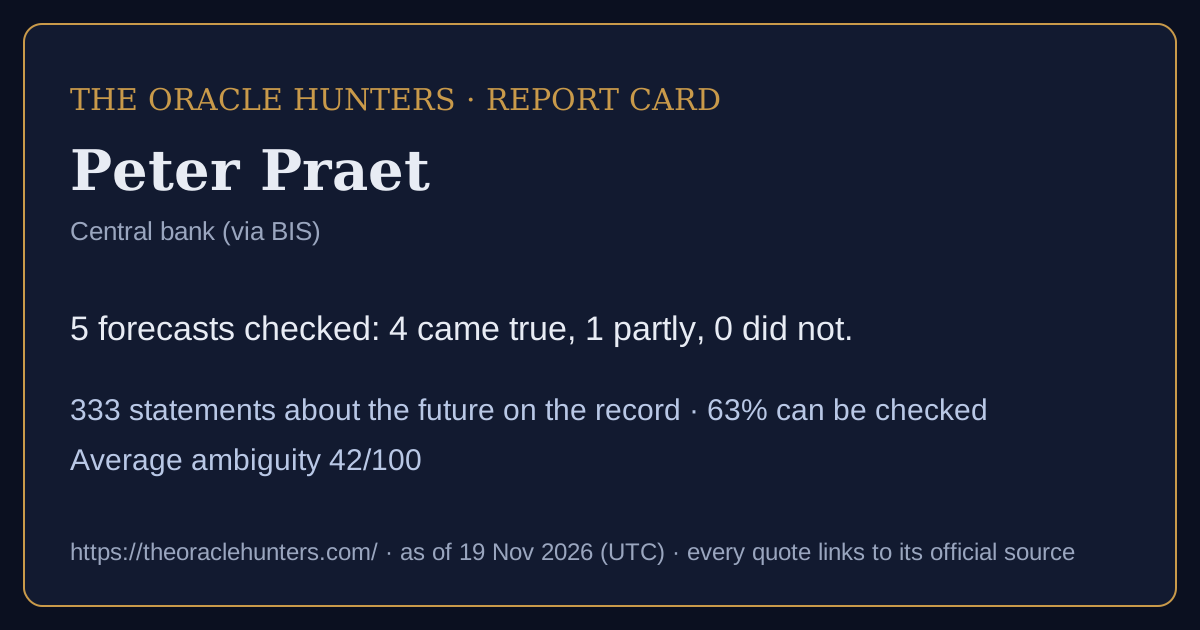
Track record: 5 forecasts checked: 4 came true, 1 partly, 0 did not.
333forecasts & commitments on the record
63%can be checked as stated
42average ambiguity (0-100)
0goalpost moves recorded
0confirmed U-turns
Timeline
came true partly did not not due / being checked / too vague
Calibration score: shown after 10 checked forecasts with a stated likelihood (now 5).
How they speak about the future: based on data 265, stated on authority 37, educated guess 31.
Kinds of claim: forecast 256, mixed claim 44, scenario (if… then) 23, commitment 10. · Download this report card as a picture
In the nine words
πρόγνωσιςInference from evidence256 · 77%μαντείαInspired knowledge27 · 8%πρόνοιαPreparing for the future23 · 7%προαναγγελίαPublic pre-announcement10 · 3%εἰκασίαConjecture10 · 3%πρόβλεψιςSeeing the signs5 · 2%φρόνησιςPractical wisdom2 · 1%
How to read this
Each box is one sentence a public figure or institution said about the future, word for word, with a link to the official text. Can be checked means it names what will happen, by when, and how likely - so it can be compared with official figures later. Too vague to check means it does not. Ambiguity (0-100) is how many different ways the sentence can be read. When the date passes, the forecast is compared with official data and marked came true, partly or did not come true. Labels judge the sentence, never the person. Full guide and glossary.Checked
Looking further ahead, as reflected in the latest ECB staff projections, headline inflation is expected to remain notably below a level that is consistent with our inflation aim over the next two years, averaging 1.5% in 2019.
Came true. Said: inflation around 1.5% in 2019. Official figure for Euro area: 1.4% (World Bank open data). On target. Off by 0.1 points. official data · checked 14 Nov 2026 · automatic check against official data (rules v3)
Inflation stripped of the most volatile price components is also expected to follow an upward path which should bring it to levels comparable with those of headline inflation by 2019, but the trajectory is expected to remain slow.
Came true. Said: inflation would fall in 2019. Official figures for Euro area: 1.7% in 2018, 1.4% in 2019 (World Bank open data). official data · checked 14 Nov 2026 · automatic check against official data (rules v3)
Moreover, we expect that as the recovery continues and economic slack falls, inflation will gradually accelerate further to 1.6% in 2018.
Came true. Said: inflation around 1.6% in 2018. Official figure for Euro area: 1.7% (World Bank open data). On target. Off by 0.1 points. official data · checked 14 Nov 2026 · automatic check against official data (rules v3)
In yearly averages, HICP inflation is projected to reach 1.4% in 2013, 1.1% in 2014 and 1.3% in 2015.
Partly came true. Said: inflation around 1.1% in 2014. Official figure for Euro area: 0.2% (World Bank open data). Close: outside the margin, but within one more half point. Off by 0.9 points. official data · checked 14 Nov 2026 · automatic check against official data (rules v3)
In the euro area as a whole, real GDP is projected to still contract this year by 0.4%, but then to increase by 1.1% in 2014 and 1.5% in 2015.
Came true. Said: economic growth around 1.1% in 2014. Official figure for Euro area: 1.5% (World Bank open data). On target. Off by 0.3 points. official data · checked 14 Nov 2026 · automatic check against official data (rules v3)
On the record (333)
Without such institutions, incentives will remain for national authorities to ring-fence capital and liquidity within subsidiaries, and we will not achieve the cross-border integration and private risk-sharing that are necessary for EMU to thrive.
## If the conversation has started, does it mean that interest rates will stay low for even longer?
It basically responds to the concerns that we have about congestion on the bond market, linked to two cliff effects; one cliff effect will be in June of next year, the other, March of the following year.
We have this forward guidance which basically says that the rates are going to stay at the present level until through the end of the year.
Of course the central bank pre-emptively has to look how the situation potentially will evolve and with the weakening of the economic growth you must be ready to act the instruments needed if you want to support lending.
Praet: The first allotment will be in September of this year so you have to do it before.
Counterparties will be entitled to borrow up to 30% of the stock of eligible loans as at 28 February 2019 at a rate indexed to the interest rate on the main refinancing operations over the life of each operation, with further details on the precise terms of the new operations to be communicated in due course.
It says that the policy rates won’t be raised until we are sufficiently confident that inflation will reach levels below, but close to, 2% over the medium term.
In any case, we stand ready to adjust all of our instruments, as appropriate, to ensure sustained inflation convergence towards levels below, but close to, 2% over the medium term.
Starting in September 2019, banks will be able to borrow funds with a two-year maturity on a quarterly basis until March 2021.
Therefore, we decided to communicate that we now expect to keep our policy rates unchanged “at least through the end of 2019”.
According to ECB staff estimates, after taking into account excess liquidity holdings, banks in the euro area face combined refinancing needs of around EUR 800 billion from June 2020 to May 2021, amounting to around 20% of the currently outstanding stock of debt securities issued by banks in the euro area.
If the euro area economy were to slow more sharply, we could adapt our forward guidance on interest rates and this could be complemented by other measures.
How will the banks behave if the economic slowdown continues?
And as far as their path is concerned, we continue to expect them to remain at their present levels at least through the summer of 2019, and in any case for as long as necessary to ensure the continued sustained convergence of inflation to levels that are below, but close to, 2% over the medium term.
At our last monetary policy meeting, we upheld the assessment that inflation will converge to levels that are below, but close to, 2% over the medium term.
As a result of the weaker economic data, market participants have shifted their expectations for a first interest rate hike from autumn 2019 to, in some cases, well into 2020 - despite the Governing Council's unchanged outlook that interest rates will remain at their current levels 'at least through the sum m er of 2019'.
The December projections for 2019 to 2021 forecast growth of 1.7%, 1.7% and 1.5% and a gradual rise in inflation to 1.8% in 2021 - so approaching the ECB's target rate of below , but close to, 2%.
The ongoing rotation from net asset purchases towards enhanced forward guidance on key ECB interest rates has preserved the ample degree of monetary policy accommodation that is necessary to ensure the continued sustained convergence of inflation to levels that are below, but close to, 2% over the medium term.
The latest surveys of market participants’ expectations regarding the most likely date for a first rate increase indicate that the “at least through the summer of 2019” formulation has been solidly internalised by market participants.
In addition, there is a state-contingent element that rates will remain unchanged “in any case for as long as necessary to ensure the continued sustained convergence of inflation to levels that are below, but close to, 2% over the medium term”.
Our policy will remain predictable, and we will proceed at a gradual pace that is most appropriate for inflation convergence to consolidate.
There is the date-based element that interest rates are expected to remain at their present levels “at least through the summer of 2019”.
And we updated and enhanced our forward guidance on the path for interest rates, which is now expressed in terms of the expectation that key ECB interest rates will remain at their present levels “at least through the summer of 2019 and, in any case, for as long as necessary to ensure the continued sustained convergence of inflation to levels …
I am confident that the sustained convergence of inflation to a level below, but close to, 2% over the medium term will proceed.
Will the first step be to increase the interest rate on the ECB's deposit facility from 0.40% or the interest rate on the main refinancing operations from 0.00% - or both at the same time?
This will start to have effects on the net stable funding ratio as of mid-2019.
You have said that forward guidance on monetary policy will become the ECB's most important instrument in 2019.
It is of the utmost importance to implement the rules for bank resolution which stipulate that at least 8% of banks' liabilities should be made up of instruments that could absorb losses in the event of bank failure.
We expect the key ECB interest rates to remain at their present levels at least through the summer of 2019, and in any case for as long as necessary to ensure the continued sustained convergence of inflation to levels that are below, but close to, 2% over the medium term.
The European Commission’s 2018 Ageing Report projects the public age-related costs in the euro area to increase by 1.1 percentage points of GDP between now and 2070.
Second, the policy rate is likely to hit the lower bound much more frequently than thought possible in the past – a direct consequence of the fact that current estimates of the real equilibrium interest rate are much lower than the 2% estimate customary before the great financial crisis.
In constructing the curves, the arbitrary assumption was made that reinvestments will be carried out until December 2020 and securities will be rolled over into a mix of securities in line with market neutrality.
The first is why we anticipate that it is likely to be appropriate to terminate net asset purchases by the end of December this year.
Our projections currently foresee that inflation will rise gradually but consistently towards levels below, but close to, 2% over the medium term.
In terms of convergence, the June 2018 Eurosystem staff projections foresaw inflation at a level of 1.7% in 2018, 2019 and 2020.
Second, we updated and enhanced our forward guidance on the path for interest rates, which is now expressed in terms of the expectation that our key ECB interest rates will remain at their present levels “at least through the summer of 2019, and in any case for as long as necessary to ensure the continued sustained convergence of inflation to …
Headline inflation increased significantly in May, primarily due to higher oil prices, and stood at 2.0% in June according to Eurostat’s flash estimate.
It lowered its main refinancing rate to 1% in May 2009 and, in order to facilitate banks’ borrowing of central bank funds, it expanded the range of eligible collateral for its refinancing operations.
The expectation is that policy rates will remain at their present levels at least through the summer of 2019 and, in any case, for as long as necessary to ensure that the evolution of inflation remains aligned with the Governing Council’s current expectations of a sustained adjustment path.
The significant stimulus that is still needed for the continued sustained convergence of inflation will be provided by the additional net asset purchases until the end of the year, by the sizeable stock of acquired assets and associated reinvestments, and by the enhanced forward guidance on key ECB interest rates.
As for convergence, the June 2018 Eurosystem staff macroeconomic projections foresee headline and core inflation reaching 1.7% and 1.9%, respectively, in 2020.
Eurosystem staff expect headline inflation to stand at 1.7% in each year over the period from 2018 to 2020, supported by the continuing economic expansion, high levels of capacity utilisation, labour market tightness and rising wage growth.
At our last Governing Council meeting we said that we expect our key ECB interest rates to remain at their present levels at least through the summer of 2019.
## Ultimately , if risks m aterialise, could one of the options be a further extension of the programme into 2019?
## Is the asset purchase programme (A PP) really going to conclude at the end of this year?
## Regarding a change in interest rates, the ECB guaranteed that it will not take place until 'through the summer of 2019".
This includes, first, our enhanced forward guidance on interest rates, which we expect will remain at their present levels at least through the summer of 2019 and in any case for as long as necessary, and, second, our very large stock of assets for which we intend to reinvest the principal payments from maturing securities.
## Is the ECB comfortable with the recent projection pointing to annual inflation of 1.7% over the period to 2020, clearly below the 2% aim for these three years?
As you know, since the programme’s inception in 2015, the Governing Council of the ECB has made net asset purchases under the APP conditional on progress towards a sustained adjustment in the path of inflation to levels below, but close to, 2% over the medium term.
Showing the newest 50 - the ledger has all 333.
Also said - not checkable as stated (12 newest)
Remarks about the future with no date, figure or likelihood that could be checked. They are kept on the record and shown here, but not scored.
For trade to flourish, businesses need to be certain that contracts will be honoured, competition rules will be fairly enforced, property rights respected and standards adhered to.
Debating concepts such as ‘secular stagnation’ may be fashionable now, but we should remember only a decade ago it was fashionable to debate the ‘Great Moderation’.
On the importance of institutions as provider of stability and protection in an uncertain world Speech by Peter Praet, Member of the Executive Board of the ECB, Steptoe Brussels Open Conference Series, Brussels, 15 May 2019 Uncertainty and economic developments The economic literature – both theoretical and empirical – finds a link between heightened uncertainty and lower economic activity in …
Similarly, if households fear unemployment or lower income from employment in the future they may reduce consumption today. Chart 1: Measures of euro-area uncertainty Sources: Baker, Bloom and Davis, and ECB calculations.
Others have expressed concern that these innovations may polarise societies still further and may even have negative effects on employment.
The incidence of natural disasters such as droughts, floods and earthquakes, the doubt of whether contractual promises will be honoured and the fear of your possessions being taken by force are all factors that can affect economic activity.
It is now established that leaving the EU presents a trade-off: countries either have to follow the rules they could once set; or they have accept a diminished level of market access, and ultimately lower welfare for their people.
The long run solution most likely involves deeper fiscal integration, and it is important that the debate is moving forward in this area.
This will lead to greater private risk-sharing and lessen the need for fiscal risk-sharing.
It is now plain to see that the rules and norms which have governed international relations since the Second World War are being challenged – replaced by a new power politics where large economies try to impose their will on smaller ones.
As we know with the weakening economy it may happen in the future so you have to be ready and to look at the possible instruments or decisions you may need to take in case.
They could affect investment and the pricing behaviour of firms, but also productivity growth and, therefore, the natural rate of interest.