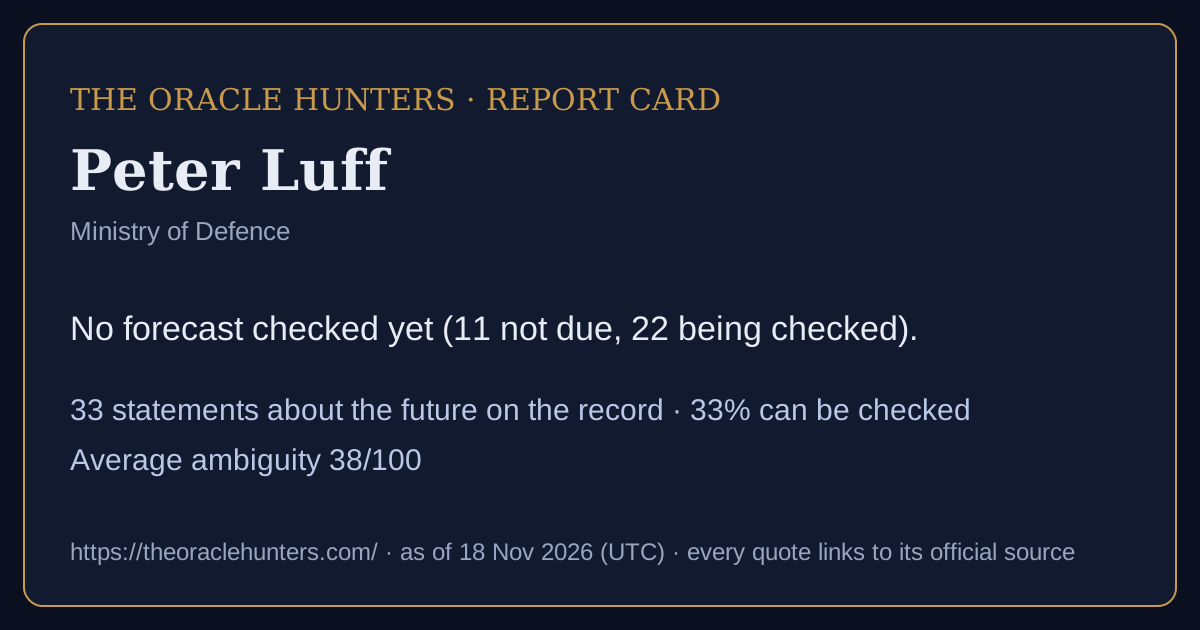
Peter Luff
Ministry of Defence · GBR
Track record: No forecast checked yet (11 not due, 22 being checked).
33forecasts & commitments on the record
33%can be checked as stated
38average ambiguity (0-100)
0goalpost moves recorded
0confirmed U-turns
Timeline
came true partly did not not due / being checked / too vague
Calibration score: shown after 10 checked forecasts with a stated likelihood (now 0).
How they speak about the future: based on data 20, stated on authority 12, educated guess 1.
Kinds of claim: forecast 24, mixed claim 6, commitment 3. · Download this report card as a picture
In the nine words
πρόγνωσιςInference from evidence19 · 58%μαντείαInspired knowledge10 · 30%προαναγγελίαPublic pre-announcement3 · 9%εἰκασίαConjecture1 · 3%
How to read this
Each box is one sentence a public figure or institution said about the future, word for word, with a link to the official text. Can be checked means it names what will happen, by when, and how likely - so it can be compared with official figures later. Too vague to check means it does not. Ambiguity (0-100) is how many different ways the sentence can be read. When the date passes, the forecast is compared with official data and marked came true, partly or did not come true. Labels judge the sentence, never the person. Full guide and glossary.On the record (33)
They will also be supporting the record attempts themselves in 2013 and 2014 in South Africa.
Often our needs will mean buying British from single sources; 40 percent of our defence equipment and support budget is spent that way.
And at the heart of this armoured vehicle programme will be the development of a land open systems architecture, or LOSA, which I’m delighted to see is the central theme of this year’s conference.
We expect to roll out these changes gradually with an initial operating capability for this model in place for the 2013/14 financial year.
Last year BIS announced £32 million of government investment in helicopter production, research and development which will provide an important boost to Agusta Westland, for instance in the introduction of the civil AW169 aircraft.
This funding will be up to a maximum of £2 million a year, to be used to progress successful projects which show the most potential for defence purposes.
Later this year CDE will be launching a series of market place events.
We hope the CJEF will be up and running by 2016.
Initial deliveries to France are expected in early 2013, with the first UK delivery due in September 2014.
Looking ahead to when Rafale and Typhoon come out of service in the 2030+ timeframe, both the UK and France will have a requirement to examine the options for the next generation of combat air systems.
An integrated support contract will be negotiated with Airbus Military before the arrival of the first French operational aircraft next year.
We may have inherited an equipment programme in freefall and a gaping deficit exceeding £38 billion.
I can confirm however that across the board we will be investing more than £150 billion in military equipment over the next decade.
This year’s Olympic and Paralympic Games will be a busy time for defence to say the least.
I was very glad when, just last month, the government allocated an additional £50 million for a new research and technology hub to exploit the commercial possibilities around the exciting new material graphene, which certainly will have defence and aerospace applications.
The technology industry is a vital part of our economy, and we will do all we can in government to encourage its growth.
and clarity and honesty which the white paper, which I told the House of Commons today we will publish next month, is designed to bring, and I’ll come on to that at the end
The first of the 200 on order will start to roll off the lines and into training later this month, ready for deployment early in 2012.
The ‘Army 2020 review’, initiated by the Chief of the General Staff, will build on the SDSR to deliver this.
By 2020, once the TA has developed in the way we intend, we envisage a total trained army of 112,000 by 2020, of which roughly 70% will be regular and 30% reserves.
Foxhound will arrive in Afghanistan next year.
An Assessment Phase will be launched later this year with total funding available of up to 50 million euros, with delivery anticipated between 2015 and 2020.
Later this year we will also be publishing our White Paper on equipment, support, and technology.
As the Secretary of State, Liam Fox, said last week, “Those who advocate this course need to tell us which taxes they will raise, what services they will cut more, or indeed if they would countenance yet more borrowing”.
In turn, the MoD’s R&D Board will weigh what it needs for use now against the longer-term requirements of Future Force 2020.
That’s why the Government will invest over £200 million, through the Technology Strategy Board, to establish an elite network of Technology and Innovation Centres over the next four years.
Earlier this month, I announced plans to publish a Green Paper by the end of the year which will set out our intended approach to Defence and Security industry and technology policy.
And the Prime Minister’s strong view, with which I naturally agree, is that this clear vision for the structure of our Armed Forces will, and I quote, “require year-on-year real terms growth in the Defence budget in the years beyond 2015.”
There will be another Defence Review in 2015, which I trust will be held in a more benign financial environment.
So I am pleased to confirm probably the worst kept secret and the reason that you are all here today - that we will publish a Green Paper by the end of this year, which will set out our intended approach to industrial policy and the closely related issue of technology policy.
There will then be a wider consultation process with industry, academia, and Parliament before we bring forward a White Paper in spring 2011 - and I mean spring.
So we will aim to grow the UK’s already significant share of the global Defence market.
After the SDSR has reported in the autumn, and before the end of the year, we will publish a Green Paper on our defence industry and technology policy.
Also said - not checkable as stated (12 newest)
Remarks about the future with no date, figure or likelihood that could be checked. They are kept on the record and shown here, but not scored.
The money you pledge tonight will ensure SSAFA Forces Help has the money it needs to continue this work.
You will have heard what the Prime Minister said on Monday about the Aerospace Growth Partnership and the beginning of a similar dialogue with the defence industries.
This is a really important area for us and the UK needs to demonstrate leadership.
You will forgive me for reminding you that, as a former chairman of the Business, Innovation and Skills Committee, I published a report that recognised your industry as one of national importance and a crown jewel of UK manufacturing.
Shared access to leading edge, high performance engineering will, I have no doubt, bring direct benefit back into defence.
And there are industries that may not yet be on our radar which should be, and which must be encouraged to make their contribution to defence.
It is important, however, that you recognise and understand that we’re not going back to producing a long list of specific sovereign capabilities, effectively owned by specific companies, that we will protect.
However, we need to recognise that defence spending is in competition with all the other things that taxpayers’ expect the government to spend their money on.
We will only be able to export something if it is competitive.
And I think I may need to bang the drum a bit louder.
On Scout, we will first need to reset the programme in order to remain within the pipeline profile.
We will then drive hard to a main gate 2, at which point production numbers will be finalised.