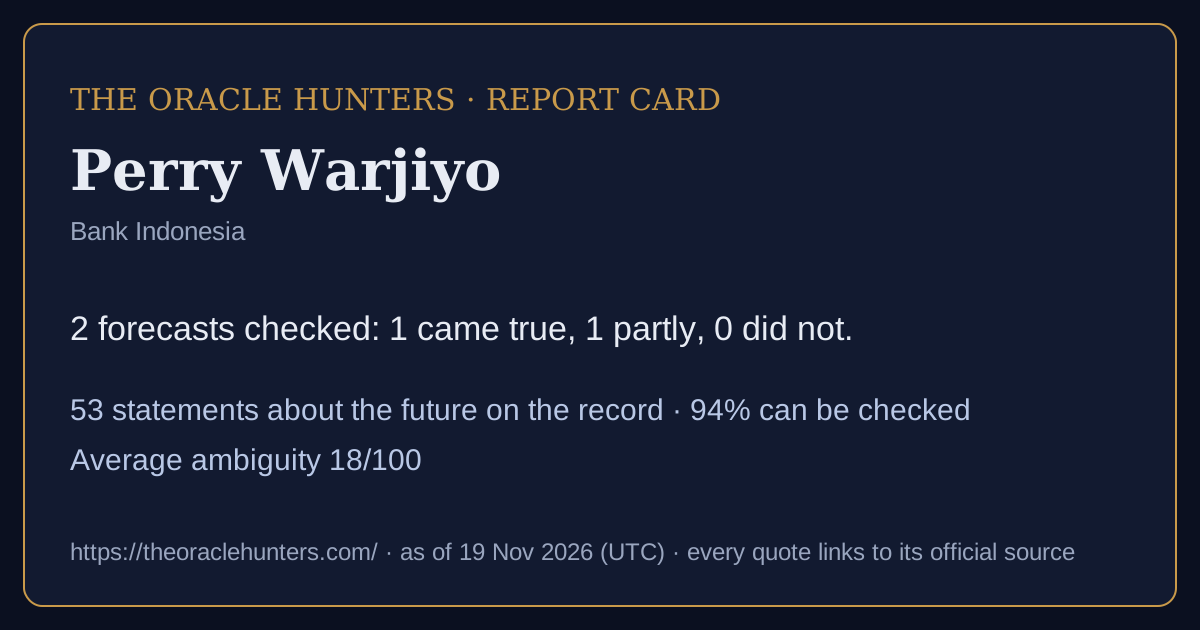
Perry Warjiyo
Bank Indonesia
Track record: 2 forecasts checked: 1 came true, 1 partly, 0 did not.
53forecasts & commitments on the record
94%can be checked as stated
18average ambiguity (0-100)
0goalpost moves recorded
0confirmed U-turns
Timeline
came true partly did not not due / being checked / too vague
Calibration score: shown after 10 checked forecasts with a stated likelihood (now 2).
How they speak about the future: based on data 49, stated on authority 4.
Kinds of claim: forecast 47, mixed claim 5, commitment 1. · Download this report card as a picture
In the nine words
πρόγνωσιςInference from evidence49 · 92%μαντείαInspired knowledge3 · 6%προαναγγελίαPublic pre-announcement1 · 2%
How to read this
Each box is one sentence a public figure or institution said about the future, word for word, with a link to the official text. Can be checked means it names what will happen, by when, and how likely - so it can be compared with official figures later. Too vague to check means it does not. Ambiguity (0-100) is how many different ways the sentence can be read. When the date passes, the forecast is compared with official data and marked came true, partly or did not come true. Labels judge the sentence, never the person. Full guide and glossary.Checked
As stated, national economic growth in 2022 is projected to reach around 4.7%-5.5%, beyond projected growth of approximately 3.2%-4.0% in 2021.
Came true. Said: economic growth between 4.7% and 5.5% in 2022. Official figure for Indonesia: 5.3% (World Bank open data). On target. official data · checked 14 Nov 2026 · automatic check against official data (rules v3)
With that, our economic growth forecast for this year will be around 5.2-5.6%.
Partly came true. Said: economic growth between 5.2% and 5.6% in 2016. Official figure for Indonesia: 5.0% (World Bank open data). Close: outside the margin, but within one more half point. Off by 0.2 points. official data · checked 14 Nov 2026 · automatic check against official data (rules v3)
On the record (53)
China's economic growth slowed from 5.0% in 2024 to 4.8% in 2025 and is projected to fall further to 4.2% and 4.0% in 2026 and 2027.
In Japan, economic growth is projected to strengthen to 1.0% in 2025, supported by sustained wage improvements, before moderating to 0.5% in 2026 and 2027 due to structural challenges from an aging population, persistently high inflation, and weaker exports as a result of US tariff policy.
Meanwhile, the Euro Area recovery continues, with growth projected to rise from 0.9% in 2024 to 1.3% in 2025 and 2026, and further to 1.4% in 2027, supported by improving private consumption in line with monetary policy easing, fiscal stimulus, and frontloading of exports in anticipation of trade agreements with the US.
The tariff policy has also slowed disinflation process, with inflation projected at 2.9% in 2025 and 3.0% in 2026, thereby constraining the extent of Federal Funds Rate (FFR) reductions from 4.5% in 2024 to 4.0% currently.
US economic growth is projected to slow from 2.8% in 2024 to 2.0% in both 2025 and 2026, before edging up slightly to 2.1% in 2027, assuming no additional tariff increases.
Consequently, global disinflation progressed more slowly than the previous projection, with inflation projected at 4.3% and 4.1% in 2025 and 2026.
be imposed on imports of machinery/electronic growth in 2024 is expected to moderate to 3.2%,
is expected to fall to 4.4% at the end of 2024 and moving forwards.
The inflation trend has Economic easing in 2025 will also stem from the
moderation in China with the possible imposition of GDP in 2024 and 2025 is projected to remain
forecasted to rebound in 2025, although the risk of 2025, yet is projected to rise to 4.8% in 2026 amidst
of iron, aluminium, and motor vehicles from the projected to 3.1% in 2025 and 3.0% in 2026
Korea, for example, will increase to 6.40% and 3.50% quarter of 2023 for a 10-year tenor.
and will be maintained at this level throughout 2023 to 3.0% and 4.25% respectively, and maintained in
Global inflation is expected to 2024 as predicted above.
projected to grow by 1.2% and 6.2% respectively in declining to 5.2% in the fourth quarter of 2023.
stable growth of 5.0% in 2022 and 2023 and then Inflation in the US and the Euro Area is expected
recession and high inflation needs to be watched in mid-2023, inflation will decrease in China, India,
RPIM implementation will be incremental to achieve a target portion of MSMEs and other inclusions in bank loans of at least 30% (thirty percent) by the end of June 2024.
Meanwhile, inflation is expected to remain under control and within the target corridor of 3%±1%, with sufficient national production capacity to meet the increase in aggregate demand until the end of 2022, although the impact of rising global energy prices demands vigilance.
As stated, national economic growth in 2022 is projected to reach around 4.7%-5.5%, beyond projected growth of approximately 3.2%-4.0% in 2021.
Came true. Said: economic growth between 4.7% and 5.5% in 2022. Official figure for Indonesia: 5.3% (World Bank open data). On target. official data · checked 14 Nov 2026 · automatic check against official data (rules v3)
Source: Bank Indonesia of 0.3% of GDP surplus to 0.5% of GDP deficit in 2021, and will remain low within a manageable deficit of 1.1% to 1.9% of GDP in 2022, thus supporting external sector resilience in Indonesia.
Overall, in 2021 economic growth will remain within the range of Bank Indonesia's 3.2%-4.0%projection, before accelerating in 2022 to 4.7%-5.5%.
Data as of 12 November 2021 Source: Bloomberg, calculated with deficits starting to reduce from 2021, although the pace is much faster in AEs to around 3.6% in 2023 , while in EMDEs it will be more gradual to around 4.8% in 2024 (Graph 10).
During 2020, Bank Indonesia relaxed the regulation on Macroprudential Intermediation Ratio (RIM / RIM Sharia), which is the ratio between financing and bank funding, without imposing penalties on banks that have RIM or RIM Sharia outside the target range, that has been set at 84% - 94%, for the next year starting from 1 May 2020 (Graph 26).
We predict that in the medium term, Indonesia's economic growth will continue to pick up to be in the range of 5.5% - 6.1% with inflation maintained at a low level of 1.5% - 3.5% and a current account deficit in the range of 1.5% - 2.5% of GDP in 2025.
Source: BPS and Bank Indonesia projections at the end of 2020 will be lower than 2% and in 2021 will be controlled within the target of 3.0±1% (Graph 17).
The current account deficit is projected to be below 1.5% of GDP in 2020 and around 1.0%-2.0% of GDP in 2021, supporting the resilience of Indonesia's external economic sector.
The improvement in regional economic growth is expected to continue in 2021, in which the regions of Java, Sumatra, Kalimantan, Bali and Nusa Tenggara (Balinusra), and Sulampua will grow respectively by 5.2%-5.6%; 4.0%-4.4%; 2.4%-2.8%; 5.2%-5.6%; and 7.8%-8.2%.
Overall, Indonesia's economic growth will start to be positive in the fourth quarter of 2020 and is estimated to reach 4.8% -5.8% in 2021.
| Bank Indonesia will Maintain an Accommodative Monetary Policy Stance in 2020 | 21 |
Inflation will be maintained within the range of 2.0-4.0% until 2024.
Therefore, Bank Indonesia projects credit growth to reach around 8% in 2019 and 10-12% in 2020, with deposit growth expected to reach around 8% in 2019 and 8-10% in 2020.
Moving forward, the current account deficit is expected to decline to around 2.7% of GDP in 2019 and then remain manageable in 2020 in the range of 2.5-3.0% of GDP, while the capital and financial account surplus remains large, thereby supporting external resilience.
Moving forward, the policy mix instituted by Bank Indonesia and the Government is expected to maintain national economic growth momentum, which Bank Indonesia predicts around 5.1% in 2019 before increasing toward 5.1-5.5% range in 2020 (Table 2).
Going forward, we will continue our accommodative macroprudential policy in 2020 with a focus on MSME and priority sector development, including exports and tourism.
The bank intermediation function and economic financing through the capital market will continue to Bank Indonesia projects credit growth in 2019 to reach 10-12%, with deposit growth expected in the 8-10% range and adequate liquidity maintained. increase.
The current account deficit will decrease to around 2.5% of GDP in 2019 as a result of measures to control imports as well as stimulate exports and tourism.
Despite the flagging global economy, national economic growth in Indonesia is predicted to achieve 5.0-5.4% in 2019, backed by strong domestic demand, including consumption and investment, while the contribution of net exports is forecast to improve as exports increase and imports moderate.
After hiking the Federal Funds Rate (FFR) (which is predicted to be) four times this year by a total of 100 basis points, the US Federal Reserve is expected to raise its reference rate another three times in 2019 by a further 75 bps.
First, global economic growth, which is projected at 3.73% in 2018, could moderate to 3.70% in 2019.
Surrounded by inauspicious global economic dynamics, we will therefore strengthen Bank Indonesia's policy mix in 2018 for 2019.
This is the dynamic of the stimulus to economic growth that we will be seeing to the future.
This means that the commodity prices will reach at the bottom this year, and will start rising next year.
This year, with the economic recovery gains momentum, CAD will be expected to widened but still within our long term sustainable CAD norm of 2.5-3% of GDP.
With that, our economic growth forecast for this year will be around 5.2-5.6%.
Partly came true. Said: economic growth between 5.2% and 5.6% in 2016. Official figure for Indonesia: 5.0% (World Bank open data). Close: outside the margin, but within one more half point. Off by 0.2 points. official data · checked 14 Nov 2026 · automatic check against official data (rules v3)
Compared to early of last year, where the government must deal with the administrative procedures, this year fiscal stimulus through the acceleration of government projects already started to kick-in in the first quarter.
With stimulus from both fiscal and monetary fronts, as well as accelerated structural reforms in many key areas, we will be seeing significant improvements on Indonesia economy this year and beyond.
GDP growth recorded at 5.8% in 2013 and it is forecasted to moderate to 5.1%-5.5% in 2014 following the stabilization policies (Graph 9).
Trade balance turns into surplus and current account deficit is falling much faster than expected from 4.4% of GDP in Q2-2013 to 1.9% of GDP in Q4-2013 and 2.0% of GDP in Q1-2014 (Graph 7-8).
Showing the newest 50 - the ledger has all 53.
Also said - not checkable as stated (1 newest)
Remarks about the future with no date, figure or likelihood that could be checked. They are kept on the record and shown here, but not scored.
The aggressive and bold measures of monetary and macroprudential policy mix since June 2013 have resulted in streams of positive news of benign inflation, faster than expected decline in current account deficit, and better than expected GDP growth to the markets.