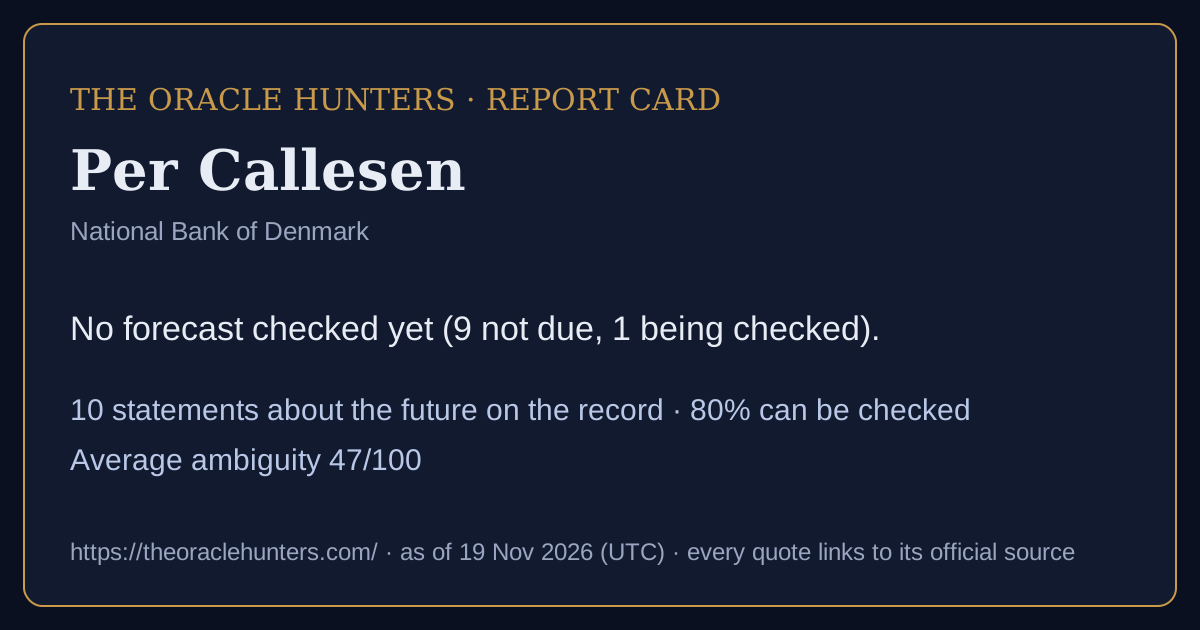
Per Callesen
National Bank of Denmark
Track record: No forecast checked yet (9 not due, 1 being checked).
10forecasts & commitments on the record
80%can be checked as stated
47average ambiguity (0-100)
0goalpost moves recorded
0confirmed U-turns
Timeline
came true partly did not not due / being checked / too vague
Calibration score: shown after 10 checked forecasts with a stated likelihood (now 0).
How they speak about the future: based on data 8, educated guess 2.
Kinds of claim: forecast 8, scenario (if… then) 2. · Download this report card as a picture
In the nine words
How to read this
Each box is one sentence a public figure or institution said about the future, word for word, with a link to the official text. Can be checked means it names what will happen, by when, and how likely - so it can be compared with official figures later. Too vague to check means it does not. Ambiguity (0-100) is how many different ways the sentence can be read. When the date passes, the forecast is compared with official data and marked came true, partly or did not come true. Labels judge the sentence, never the person. Full guide and glossary.On the record (10)
Second, in addition to the cost implied by physical effects of climate change - such as flooding and droughts - the economic cost of mitigation will be substantially higher than if driven by price incentives.
Furthermore, contributions from the SRF may not exceed 5 per cent of the bank's liabilities, and it is a receivable claim, not an income transfer.
If the marginal tax rate would be reduced to provide an incentive to work more, and this would be done by way of fiscal easing, i.e. not fully financed, it is very unlikely that the capacity-enhancing effects would balance the additional increase in demand.
The OECD's long-run projections operate with annual GDP growth rates of around 1.5 per cent in western countries over the next 50 years.
In that case, the annual growth rate will gradually decline from 2 per cent today to around 0.7 per cent in 2116 - and kr. 40 billion per year for 100 years in a row (with the resultant declining growth rate) will still treble GDP to approximately kr. 6,000 billion at present value.
## A GDP growth rate of e.g. 2 per cent will 7-double The growth rate depends on the level of GDP
To compare, 100 years growth by 3 per cent per annum will 19-double GDP to just below kr. 40,000 billion.
For example, the expected increase in GDP is approximately kr. 40 billion in 2017.
In such a case, the bonds will be extended for a year with an interest rate equal to the interest rate at the latest refinancing plus an add-on of 5 percentage points.
The LCR will become binding for financial institutions across the EU from January 1, 2015.
Also said - not checkable as stated (12 newest)
Remarks about the future with no date, figure or likelihood that could be checked. They are kept on the record and shown here, but not scored.
You should imagine that when you log into your regular online banking service, an additional account, similar to your other accounts, will be displayed, with a threshold of 3,000 euro and giving you a direct claim on the ECB (rather than being covered by a deposit guarantee scheme and the solvency of the private bank).
Sweden has done some testing. 6 A token-based product doesn't change the need for all individuals' receivables to be recorded centrally. 7 A number of security issues will have to be addressed, for instance what happens if you lose your mobile phone or your computer crashes?
It is not obvious why a product of this nature should be operated by a central bank rather than private banks, but it would probably stimulate innovation in this area.
It should be noted that when it comes to the wish for a stronger prevalence of the euro's international role, limitations in the form of account thresholds and restrictions on non-residents will, in practice, have no major impact.
You should imagine that two individuals may exchange a certificate offline, while the entry into accounts takes place later when they are online -a potentially interesting innovation.
This would hardly be a problem at present, but potentially greater capital movements must be expected, for instance during periods of pressure on the Danish krone.
The climate challenge is so large that all players in our economies, all areas of policy, and all countries in the world will have to deliver and push in the same direction.
First, it will be significantly more difficult to cut emissions in the absence of spectacular technological advances, which we yet have to see.
Likely, the net impact of taxes and subsidies is close to zero.
This may well have been the case in recent years as the costs of renewable energy and energy savings have come down substantially and are now competitive.
We are in particular aiming to improve our understanding of how climate-related risks may impact the financial system and the wider economy.
In the field of economics, the IMF, the World Bank, the WTO, the OECD, the EU and the euro project should be highlighted.