Penny Mordaunt
Ministry of Housing, Communities & Local Government (2018 to 2021) · GBR
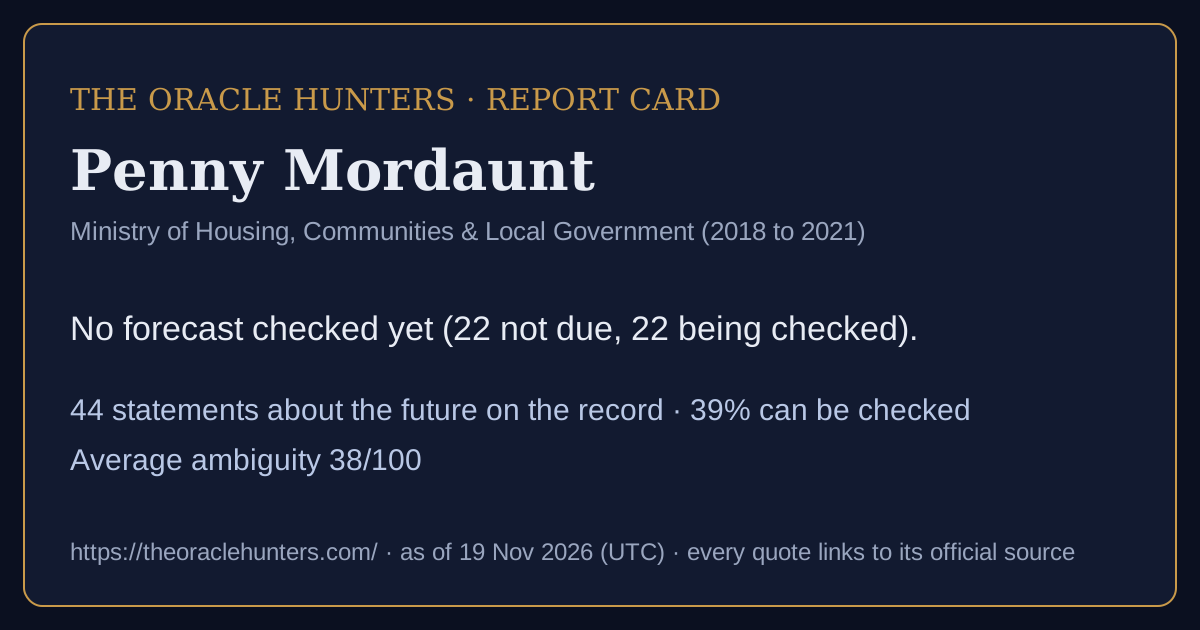
Track record: No forecast checked yet (22 not due, 22 being checked).
44forecasts & commitments on the record
39%can be checked as stated
38average ambiguity (0-100)
0goalpost moves recorded
0confirmed U-turns
Timeline
came true partly did not not due / being checked / too vague
Calibration score: shown after 10 checked forecasts with a stated likelihood (now 0).
How they speak about the future: based on data 25, stated on authority 18, educated guess 1.
Kinds of claim: forecast 23, mixed claim 11, commitment 9, scenario (if… then) 1. · Download this report card as a picture
In the nine words
πρόγνωσιςInference from evidence21 · 48%μαντείαInspired knowledge13 · 30%προαναγγελίαPublic pre-announcement9 · 20%πρόνοιαPreparing for the future1 · 2%
How to read this
Each box is one sentence a public figure or institution said about the future, word for word, with a link to the official text. Can be checked means it names what will happen, by when, and how likely - so it can be compared with official figures later. Too vague to check means it does not. Ambiguity (0-100) is how many different ways the sentence can be read. When the date passes, the forecast is compared with official data and marked came true, partly or did not come true. Labels judge the sentence, never the person. Full guide and glossary.On the record (44)
An opportunity that, if we get it right, could make a massive contribution to ending poverty, to quickening the delivery of the SDGs, to strengthening our national security and bringing peace and prosperity.
The Private sector solutions that helped deliver the increased climate ambition agreed at COP will only be delivered through trade, meantime generating a global market for low-carbon goods worth up to £1.8tn by 2030.
We will work to strengthen relationships which may be challenging, for example, continue to pursue a positive trade and investment relationship with China.
The Prime Minister envisions that by 2030, “we will have built back better from COVID-19, with a strong economic recovery and greater national resilience to threats and hazards in the physical and digital worlds”.
And this year we might see the first routine tourist flights into space.
So this summer, this government will consult on increased transparency of organisations’ parental leave and pay policies, and on the availability of flexible working being set out in job adverts.
Reducing the gender pay gap in labour market participation, STEM qualifications, and wages, could increase the UK economy by £55 billion by 2030.
That is what I will be arguing for in the decisions on this year’s pay review, and it will be a spending priority for me.
This year it will be returning to the Eastern seaboard to conduct flight trials with our own F35b future fighter.
This year, the UK will be reporting on our progress towards implementing them, as part of our Voluntary National Review.
But thanks to the generous donations made by the British public, we are upping that amount and we will match their funds to the tune of £3 million because it is a really popular appeal.
We look forward to a productive day ahead, and to seeing the strides that we are going to take to achieve Global Goal 3.3: to end AIDS by 2030.
And later this year the UK will host the UK-Africa Investment Summit, which will bring together key government and business people from the UK and Africa to strengthen our links and make the most of the fantastic opportunities that are there.
We will continue to scale up our work with the Bank of England throughout the course of this year.
And we will provide 2 million pounds for Elrha’s Humanitarian Innovation Fund to support innovation in gender based violence programming.
While we recognise that great strides have been made this year, we need to be honest that this is going to be a journey.
If we could work with developing countries to help them grow their share of global trade by the equivalent of that 1% that would equate to £130 billion extra to deliver the Global Goals.
And we are developing a new partnership, with the City of London Corporation, in designing new financing mechanisms that will help mobilise more investment for poorer countries and support the creation of the 18 million new jobs a year which Africa needs.
During her Africa trip the Prime Minister announced that Britain will host a UK-Africa Investment Summit in 2019.
This will support a doubling of investment in sub-Saharan Africa to between $10 and 12 billion a year by 2030.
And earlier this year, the UK played a leading role in encouraging the World Bank Group’s International Finance Corporation to boost the share of its support going to the poorest countries in its planned capital increase.
As we leave the EU, in time we will have more flexibility to consider how we use our aid budget and the £1.5 billion we currently channel through the EU on an annual basis.
To demonstrate our collective will to deliver on our agenda and the 2030 commitment.
This will be alongside a £5 million to support the Government of Bangladesh fulfil its ambitious commitment to end hazardous Child Labour by 2021.
Over the next year, progress against the commitments will be monitored and a progress report will be published in 2019 to show how far we have come.
In Tanzania, we will support important reforms in primary and lower secondary schools to improve learning outcomes for all children particularly for girls and children with disabilities.
Our ambition is that 500m people globally will be being reached by essential assistive technology by 2030.
We are also committed to a DFID scale up on disability inclusion over the next 5 years and we will be publishing a new disability framework later this year, setting out how we would put disability at the heart of our work.
In Ethiopia, we will transform and develop 687 Inclusive Education Resource Centres (IERCs) nationwide by 2022 to promote the inclusion of 24,000 children with disabilities.
Next year NHS England will be deciding how gender identity services for adults can be modernised, to allow higher quality outcomes and greater flexibility.
By the end of this year we will have invested £5 million in programmes aimed at reducing these kinds of bullying.
We expect the programme to commence next year at the point when Libor funding for those individuals ceases.
And that is why the UK will host an international conference with Jordan in London later this year: to showcase Jordan’s economic reform plans, its aspiration to build and enable a thriving private sector, and to mobilise support from international investors and donors.
And today we will commit to spend four hundred and fifty million (pounds) in 2018 and three hundred million (pounds) in 2019.
And we will continue to press for further reforms to the global aid rules which prevent 0.7 per cent being spent effectively and flexibly.
And we know that without diplomacy and the 0.7% on aid we are going to need an even bigger stick.
We will call on the international community to enshrine a new approach later this year in the UN Global Compacts on Refugees and Migration.
I know that the spring rains will be critical in determining how severe the situation becomes this year.
We set ourselves the task that by 2030 every child will have the chance of a decent education, but we are 85 years adrift on current projections – not set to achieve that until 2115.
Over the next three years, scientists working here in Edinburgh will be transforming the lives of dairy and poultry farmers in Africa.
This is why DFID is committed to investing 3% of our budget to research that will continue to drive global progress.
We will increase our infrastructure development funds, building the crucial pathways for trade and investment and removing obstacles to the economic expansion we all want to see.
We will continue to invest and scale up our trade initiatives like Trade Mark East Africa, to tackle barriers and to increase the potential for trade success across the region.
The Home Office is providing £9.2 million of funding to support 12 locally-led emergency services collaboration projects in 2013 to 2014 and 2014 to 2015.
Also said - not checkable as stated (12 newest)
Remarks about the future with no date, figure or likelihood that could be checked. They are kept on the record and shown here, but not scored.
Then there is the growth in media, especially social media that commercially is dependent on conflict – we may have many shared values, but when did consensus ever sell popcorn?
We will benchmark ourselves, in the first instance, against our equivalents in the G7.
We will be working with all MPs to rebuild our offer to them, and we are going to do it swiftly.
That trust won’t be won when people understand how our legislation or budget will improve their lives.
Belgium and the UK are world leaders in this regard with you committing to increasing offshore wind generation to 8 Gigawatts by 2030 and the UK setting an ambitious target to quadruple our solar and wind power generation over the next decade.
By operating in the UK, Belgian businesses will be able to benefit from the network of Free Trade Agreements we are now signing outside of the EU.
All these agreements will benefit Belgian businesses who invest in, and trade with, the UK.
We are both founding members of NATO, and now more than ever we must be united in our commitment to European security.
As economic competition intensifies worldwide, we must clear the path to trade between our nations.
We must remove unnecessary obstacles to growth and ensure we provide our businesses with the necessary tools to succeed.
And we will stand with our allies to tackle unfair trade practices that threaten the livelihoods of our citizens, harm our businesses and erode trust in the functioning of the global trading system.
We will work to tackle the systematic use of market-distorting practices, such as harmful state subsidies and more other pernicious government interventions which damage competition.