Paul Jenkins
Bank of Canada
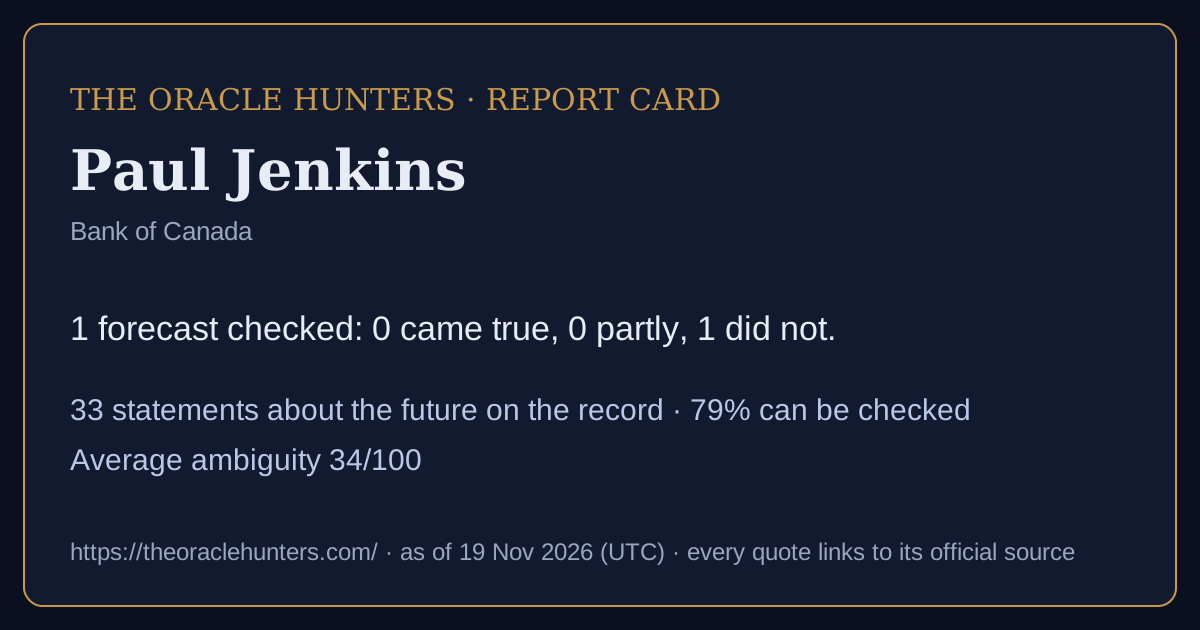
Track record: 1 forecast checked: 0 came true, 0 partly, 1 did not.
33forecasts & commitments on the record
79%can be checked as stated
34average ambiguity (0-100)
0goalpost moves recorded
0confirmed U-turns
Timeline
came true partly did not not due / being checked / too vague
Calibration score: shown after 10 checked forecasts with a stated likelihood (now 1).
How they speak about the future: based on data 29, stated on authority 2, educated guess 2.
Kinds of claim: forecast 28, scenario (if… then) 2, mixed claim 2, commitment 1. · Download this report card as a picture
In the nine words
πρόγνωσιςInference from evidence28 · 85%πρόνοιαPreparing for the future2 · 6%εἰκασίαConjecture1 · 3%μαντείαInspired knowledge1 · 3%προαναγγελίαPublic pre-announcement1 · 3%
How to read this
Each box is one sentence a public figure or institution said about the future, word for word, with a link to the official text. Can be checked means it names what will happen, by when, and how likely - so it can be compared with official figures later. Too vague to check means it does not. Ambiguity (0-100) is how many different ways the sentence can be read. When the date passes, the forecast is compared with official data and marked came true, partly or did not come true. Labels judge the sentence, never the person. Full guide and glossary.Checked
On an average annual basis, the economy is projected to expand by 1.8 per cent in 2008 and 2.8 per cent in 2009.
Did not come true. Said: economic growth around 2.8% in 2009. Official figure for Canada: -2.9% (World Bank open data). Missed. Off by 5.7 points. official data · checked 14 Nov 2026 · automatic check against official data (rules v3)
On the record (33)
The IMF estimates that 'government debt for advanced G-20 countries [will] reach 118 per cent of GDP on average by 2014', compared with a pre-crisis level of about 78 per cent. 4 For 2010, the combined fiscal deficits of these countries is estimated at nearly 9 per cent of GDP.
While it's not possible to be precise, and it depends on whether one uses market or purchasing-power-parity exchange rates, major emerging-market economies will likely account for over 55 per cent of global output by 2020, compared with about 45 per cent today. 3
Under price-level targeting, if inflation has been below trend, causing the price level to fall below target, monetary policy would need to generate above-trend inflation for a while to return the price level to target.
Turning to the outlook for inflation, we see inflation returning to our 2 per cent target in the second quarter of 2011, with both upside and downside risks around this projection.
Winter Olympics, it's expected that major public sector spending on transportation and other infrastructure projects will contribute to growth this year and in 2010.
In our September press release, we also reiterated that, conditional on the outlook for inflation, the target overnight rate can be expected to remain at its current level until the end of the second quarter of 2010 in order to achieve the inflation target.
As we signalled in our September interest rate decision, GDP growth in the second half of 2009 will likely be stronger than projected in our July Monetary Policy Report.
Also in April, we stated that, conditional on the projection for inflation, we will keep the policy rate at that level until the end of the second quarter of 2010.
We also said that further monetary stimulus is likely to be required in the near term to keep aggregate supply and demand in balance and to achieve the 2 per cent inflation target over the medium term.
The Bank projects that economic growth in 2008 will be weaker than was expected in October, averaging a little over 1 per cent in the first half of this year and a little over 2 per cent in the second half.
On an average annual basis, the economy is projected to expand by 1.8 per cent in 2008 and 2.8 per cent in 2009.
Did not come true. Said: economic growth around 2.8% in 2009. Official figure for Canada: -2.9% (World Bank open data). Missed. Off by 5.7 points. official data · checked 14 Nov 2026 · automatic check against official data (rules v3)
Both core and total CPI inflation are projected to fall below 1 1/2 per cent by the middle of this year before returning to 2 per cent by the end of 2009.
The main downside risk is that output and inflation could be lower if the average level of the Canadian dollar were to be persistently higher than the 98 cents U.S. level that we assumed in the Report , for reasons not associated with demand for Canadian products.
4 The projection for total CPI excludes the impact of the recently announced one-percentage-point cut in the federal GST, which would be effective 1 January 2008.
We now project Canada's gross domestic product to grow by 2.6 per cent in 2007, 2.3 per cent in 2008, and 2.5 per cent in 2009.
In the Bank's latest Monetary Policy Report , we noted that our base-case economic projection for the United States incorporates a 15 per cent decline in residential investment this year, and a further 11 per cent drop next year.
Total CPI inflation is expected to peak at about 3 per cent later this year and then move back down to the 2 per cent target in the second half of 2008. 4
With the economy moving back towards balance, and with the direct effect of the stronger Canadian dollar on consumer prices, core inflation is projected to gradually decline to 2 per cent in the second half of 2008.
We continue to expect that the economy will operate at about capacity through 2008, with total CPI inflation returning to the 2 per cent inflation target in the second half of 2007.
And so we take action to lower, or raise, our policy interest rate to bring inflation back up, or bring it down, to 2 per cent over the medium term.
With our economy operating at capacity and expected to grow roughly at potential through the projection period, on 24 January we raised the policy interest rate by another 25 basis points to 3 1/2 per cent.
And we expect it to keep on growing roughly in line with its production potential through 2007.
But through 2007 and beyond, the risks are tilted to the downside as the unwinding of global imbalances could involve a slowdown in world economic activity.
Specifically, we project annual average growth of 3.1 per cent this year and 2.9 per cent in 2007.
As I said at the beginning, world economic growth will remain robust-around 4 per cent this year and next.
World economic growth has been remarkably strong over the past three years, averaging close to 4 1/4 per cent, and it is expected to stay around 4 per cent this year and next.
Our communication focus is therefore on presenting and updating our macroeconomic 'base-case' projection consistent with eliminating any output gap - positive or negative - and achieving the 2 per cent inflation target over the policy horizon of roughly 1 1/2 to 2 years.
Thanks in part to effective communication, Canadians are now more confident that inflation will be kept near the 2 per cent target, and this expectation is feeding into their day-to-day decision-making.
That Report will also extend our economic projections into 2006.
Canada's economic growth in the first half of this year was somewhat stronger than the Bank had been expecting.
Despite this volatility, we continue to project that core inflation will gradually move up to the 2 per cent target in 2005.
If consumers, investors, workers, businesses, and governments believe that action will be taken to ensure that inflation remains close to the target, then they are more likely to make economic and financial decisions accordingly.
To conclude, I want to emphasize that the Bank will continue to look at ways to build on the progress we have made in increasing the openness and transparency of monetary policy.
Also said - not checkable as stated (12 newest)
Remarks about the future with no date, figure or likelihood that could be checked. They are kept on the record and shown here, but not scored.
China, on the other hand, will need to rely more on domestic demand as the engine of growth.
It must also play an important role in ensuring that the conditions are in place for sustained and balanced growth over the coming decade.
In many countries, however, large output gaps remain and, given the need to repair the balance sheets of households and financial institutions in these countries, the return to full resource utilization will be protracted.
Then I'll look at several important areas of public policy that will help to shape that outcome and promote sustained economic growth.
With global economic growth slowing, it is unlikely that the higher prices of food and energy will spill over into prices and costs more generally, but this
For our part, we at the Bank are taking steps to support the functioning of markets by expanding the list of eligible collateral that we will accept in our Standing Liquidity Facility, by examining types of term operations and term lending, and by modernizing our legislative authority to support the stability of the financial system.
To draw a comparison to the national situation, one could say that there has been an adverse movement in Ontario's terms of trade.
First, those countries with large surpluses need to rely more on domestic demand as a source of growth, and those with deficits (mainly the United States) need to increase their national savings rate.
At the same time, policy-makers need to be wary of barriers to adjustment, such as labour regulations that inhibit the movement of workers from one type of job, or from one sector or region, to another.
The Bank of Canada Act calls on us to mitigate "fluctuations in the general level of production, trade, prices and employment, so far as may be possible within the scope of monetary action, and generally to promote the economic and financial welfare of Canada." Over time, we have learned that the best way to fulfill this mandate is to keep …
In line with the Bank's outlook, further monetary stimulus is likely to be required in the near term to keep aggregate supply and demand in balance, and to return inflation to target over the medium term.
We must then incorporate this information with our assessments of other data, and set a course for monetary policy that works to keep total demand and supply in balance, and inflation on target.