Patrick Njoroge
Central Bank of Kenya
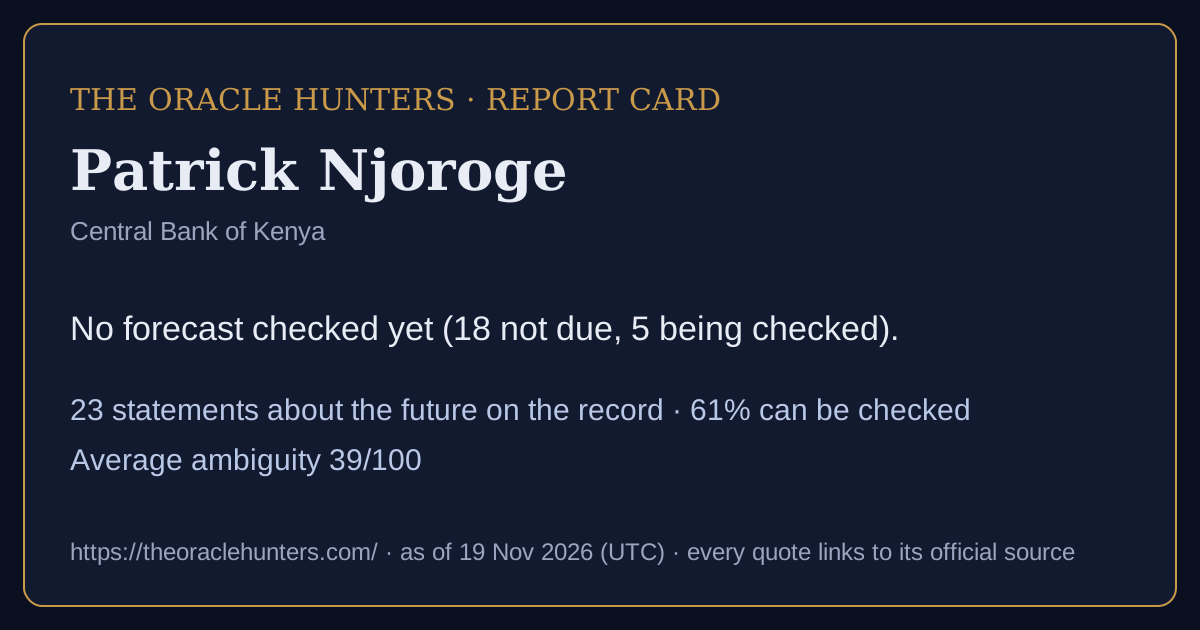
Track record: No forecast checked yet (18 not due, 5 being checked).
23forecasts & commitments on the record
61%can be checked as stated
39average ambiguity (0-100)
0goalpost moves recorded
0confirmed U-turns
Timeline
came true partly did not not due / being checked / too vague
Calibration score: shown after 10 checked forecasts with a stated likelihood (now 0).
How they speak about the future: based on data 20, stated on authority 2, educated guess 1.
Kinds of claim: forecast 19, mixed claim 3, scenario (if… then) 1. · Download this report card as a picture
In the nine words
πρόγνωσιςInference from evidence20 · 87%μαντείαInspired knowledge2 · 9%πρόνοιαPreparing for the future1 · 4%
How to read this
Each box is one sentence a public figure or institution said about the future, word for word, with a link to the official text. Can be checked means it names what will happen, by when, and how likely - so it can be compared with official figures later. Too vague to check means it does not. Ambiguity (0-100) is how many different ways the sentence can be read. When the date passes, the forecast is compared with official data and marked came true, partly or did not come true. Labels judge the sentence, never the person. Full guide and glossary.On the record (23)
A UNDP report indicated that by 2050, more than half of Africa's population will be under 25.
According to World Bank estimates, over 100 million people will be pushed into extreme poverty by 2030, by the pandemic, exacerbated by climate change and armed conflict particularly in the Middle East and Africa.
The report also notes that by 2030, up to 118 million extremely poor people will be exposed to drought, floods and extreme heat in Africa, if response measures are inadequate.
Additionally, climate change could further lower gross domestic product (GDP) in Sub-Saharan Africa by up to 3 percent by 2050.
By World Bank estimates, over 130 million people could be pushed into extreme poverty by 2030.
Recently, the World Bank estimated that the pandemic could push up to 100 million people globally into extreme poverty.
General (UNSG) António Guterres pointed out in a recent speech that the pandemic has put 70-100 million people at risk of extreme poverty.
There are 61 percent of you, in Kenya, who are below the age of 24, and that means that the coming years and decades are when you will reach the peak of your energy, knowledge and abilities.
The next ten years may present as much revolutionary change as the last thirty, and where we will be in January 2030 is almost unimaginable today.
By end May 2019, all banks had submitted to CBK their time-bound plans approved by their boards, to comply with the Charter on the four pillars.
This year, for the first time, we have created and made available a tool that will enable you interrogate these datasets.
The war against corruption, money laundering and terrorism financing will be significantly impaired if requirements for cash deposits and withdrawals are weakened.
The current account deficit has been narrowing, and is projected at 5.5 percent of GDP in 2016 from 6.8 percent in 2015 and 9.8 percent in 2014.
The performance of the economy has remained strong, with growth expected at 6.0 percent in 2016 from 5.6 percent in 2015.
The current account deficit is expected to narrow to 5.5 percent of GDP in 2016 from 6.8 percent in 2015 largely reflecting a decline in the value of imports of petroleum products and machinery and equipment.
The growth averaged 6.1 percent in the first half of 2016 and is projected at 6.0 percent in 2016, up from 5.6 percent in 2015.
In particular, SSA growth is projected to decelerate to 1.4 percent in 2016 from 3.4 percent in 2015, and from an average of 5.3 percent in the period 2010-2014.
Consequently, global growth is now projected at a worrisome 3.1 percent in 2016.The fact that central banks in advanced economies are maintaining an accommodative stance is a clear indication that the global economy has not yet recovered to sustainable levels.
In 2016, FDI flows are expected to decline by between 10 and 15 percent against the backdrop of weak global growth which has had a direct impact on the profitability of enterprises.
This year's FIS theme improving the quality of cross-border financial flows for better decision making is quite relevant to our circumstance and in the context of the current global developments, which I will shortly turn to.
Looking ahead, we expect that our level of foreign exchange reserves - currently equivalent to 5.0 months of import cover - and the new IMF precautionary arrangements amounting to US$1.5 billion, will provide adequate buffers against short-term shocks.
Before I finish, I would be remiss if I did not mention that the Central Bank of Kenya (CBK) will this year mark its 50th anniversary.
In this regard, we shall be inviting you to the launch of the top-line findings early next year around February 2016.
Also said - not checkable as stated (12 newest)
Remarks about the future with no date, figure or likelihood that could be checked. They are kept on the record and shown here, but not scored.
This is an appropriate time for deepening the conversations on how the diaspora can contribute to economic growth and progress especially in Africa where significant opportunities exist, and significant resources will be required to put our citizens on the path of shared prosperity.
More importantly, the CSD provides a new and easy way to invest in Government securities and will therefore be beneficial to the Diaspora.
The Kenyans abroad will be able to register CSD accounts online, from wherever they are, thereby mitigating the current inconvenience of having to come physically to the Central Bank.
These are the stories of migrants that need to be told.
The diaspora should be an important bridge between the host and the home countries.
We have ways to go but I am confident we will get there.
I fear as, Simon Sinek explains in his book "Start With Why," we get caught up too often with the "what will we do and how will we do it" (for instance, this campaign) and ignore the all important question of why we are doing this.
In doing this, I will draw substantially from the Kenya Banking Sector Charter ( the Charter) issued to the banking sector by the Central Bank of Kenya (CBK) in 2019.
All players including regulators, financial service providers, customers must come to the table to strengthen the financial health of our populace.
It should be about enhancing the financial health of Kenyans.
Over time as the financial inclusion landscape changes, priorities for some of the partners may change, but the core partners must remain focused on the vision.
We will be with you, to ensure a smooth landing.