Patrick McLoughlin
Department for Transport · GBR
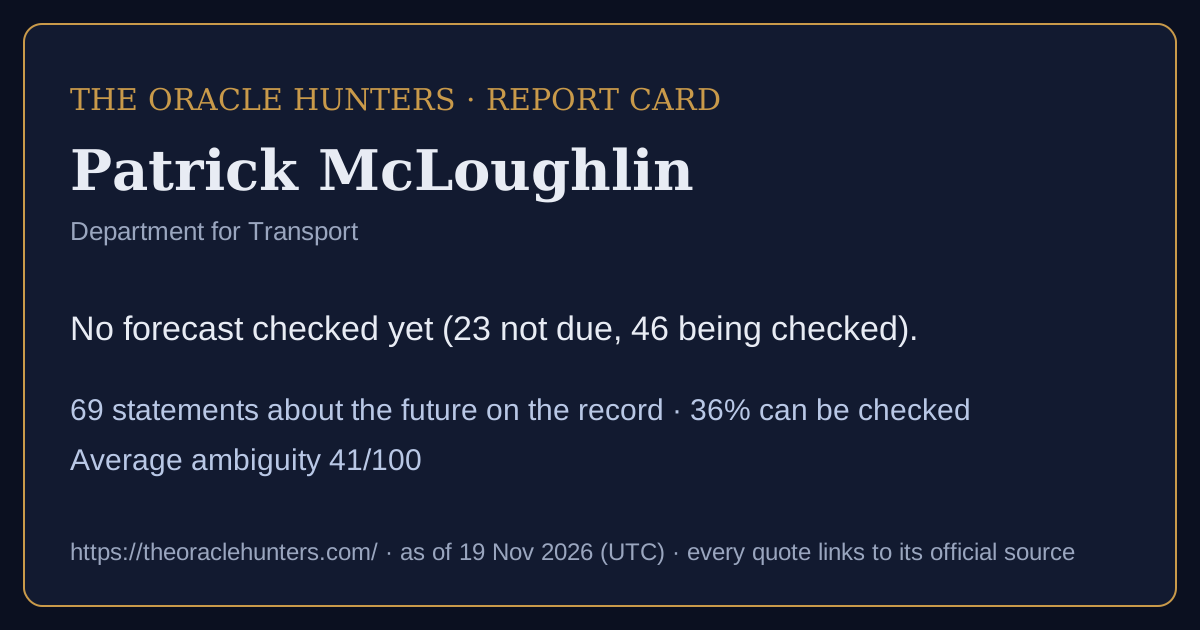
Track record: No forecast checked yet (23 not due, 46 being checked).
69forecasts & commitments on the record
36%can be checked as stated
41average ambiguity (0-100)
0goalpost moves recorded
0confirmed U-turns
Timeline
came true partly did not not due / being checked / too vague
Calibration score: shown after 10 checked forecasts with a stated likelihood (now 0).
How they speak about the future: based on data 56, stated on authority 13.
Kinds of claim: forecast 47, commitment 13, mixed claim 9. · Download this report card as a picture
In the nine words
πρόγνωσιςInference from evidence46 · 67%προαναγγελίαPublic pre-announcement13 · 19%μαντείαInspired knowledge10 · 14%
How to read this
Each box is one sentence a public figure or institution said about the future, word for word, with a link to the official text. Can be checked means it names what will happen, by when, and how likely - so it can be compared with official figures later. Too vague to check means it does not. Ambiguity (0-100) is how many different ways the sentence can be read. When the date passes, the forecast is compared with official data and marked came true, partly or did not come true. Labels judge the sentence, never the person. Full guide and glossary.On the record (69)
Which will allow local authorities to retain 100% of local taxes to spend on local services by the end of this Parliament.
And the OBR forecasts that it will be eliminated by 2019-20.
This will form part of wider government support for the UK space sector, aimed at raising revenues from almost £12 billion to £40 billion by 2030.
And which some experts have said could be worth up to £900 billion worldwide by 2025.
Through this bill, we will strengthen our position as a leader in the intelligent mobility sector, which is currently growing by an estimated 16% a year.
So when HS2 construction begins next year, we will be building something much bigger than a new railway.
And next year it will carry even more people still.
And in 2018, to coincide with the finishing of Crossrail, we’re going to have a period of celebrating engineering, to excite a new generation of brilliant minds.
Our skills strategy will help create 30,000 apprenticeships in the road and rail sector by 2020, through requiring contractors to either hire 1 apprentice for every £3 to £5 million spent on the contract, or to ensure that for every 200 people employed 5 apprenticeships will be created each year.
A plan for how, by 2025, the industry will more than double exports, attract new talent, develop new technology, harness the energy, drive and innovation of the sector’s SMEs, and become a global leader in high speed rail.
Nothing will change the fact that without action, London’s aviation network will be full by 2040.
From 2027, it will transform travel to and from North Wales.
The remainder of Phase Two will see the full Y-route built to Manchester and Leeds by 2033, and today I have set out my plans for the rest of the Y-route, ahead of a route decision next year.
And that is how we will make the Midlands an engine for growth.
And in 2017, the National College for High Speed Rail will give a thousand graduates a year a fantastic grounding in modern engineering and construction.
Overall, by the end of 2019, there will be an increase in peak capacity into the big cities of the north of over one third.
From 2018, new InterCity Express trains will replace the existing trains on the East Coast Mainline.
We are determined to see maritime growth continue.
They also voted for £70 billion of capital investment in transport that we will deliver over the next 5 years.
And next month it will be rolled out to the rest of Merseyside.
Next month we’ll launch a £30 million scheme to boost the market for low emission buses.
I welcome the Rail Delivery Group’s report last June, which showed how cost savings of 20% by 2019 are achievable, through better planning of maintenance and renewal projects, and more collaborative working.
Which will be worth £73 billion between 2015 and 2021 alone.
To lead a programme that will ultimately create 14,000 jobs, 2,000 new homes, and contribute up to £1.3 billion a year to the local economy.
If operators can deliver smart ticketing, as promised, by 2015, this will be a real game changer for the industry and the passenger.
This year, we will fund nearly £1 billion of spending on Concessionary Travel.
McKinsey estimate that, by 2025, London will be one of the four largest city economies in the world.
From autumn next year the weekends will see a night tube service, helping to grow London’s night time economy
That’s why, for example, we are cutting corporation tax to the lowest in the G20 from April next year.
We’ve backed TfL with over £10 billion during this Parliament and access to a further £10 billion between 2015 and 2021 and we will work closely with the Mayor and Transport for London to ensure London has the transport network it needs to grow.
From 2017, it will teach some of the brightest engineering and construction students in Britain, providing them with the specialised training and qualifications that’s needed to build HS2 and to be in the race to build and maintain the 51,000 kilometres of high speed rail that are planned to be in operation around the world by 2025.
Malaysia will be spending over £4 billion a year between now and 2020 expanding their Mass Rapid Transport system.
The first thing to remember is, as I have said, we will be spending £38 billion upgrading Britain’s railways over the next 5 years.
That’s why we will also be investing £38 billion to improve and expand our railways.
And from next year it will be just 20% - the joint lowest in the G20.
And by 2021 we will be spending £3 billion each year on improvements and maintenance.
As our economy recovers, we will be ready to meet rising demand for air travel, with a sustainable plan for growth.
And it’s expected to save almost £250 million by the end of 2019.
By 2020, it’s predicted that these changes will save around £200 million in fuel, reduce CO₂ emissions and minimise delays.
And next year the Davies Commission will propose options on future airport capacity.
From 2017, the college will teach some of the brightest engineering and construction students in Britain.
In total HS2 will create at least 1,600 jobs in the region directly and it will boost productivity by £2.2 billion a year within five years of the railway opening.
We will build the new line for £42.6 billion, including £14.4 billion of contingency, and not a penny more.
So we are investing £150 million to widen the road, speed up journeys and improve safety and the work will be completed by summer next year.
We have cut corporation tax again and again, and from next year it will be the lowest in the G20 and one of the lowest in the world.
We will electrify the line from London to Derby and Nottingham by 2019/ That will cut journey times further still.
The Bank of England has raised its forecast for growth this year to 3.4%.
Network Rail will invest £38 billion between 2014 and 2019.
HS2 will generate approximately 20,000 additional jobs for Greater Manchester and add £1.2 billion to the regional economy over the long term.
It will unlock capacity between Manchester, Glasgow, Leeds and Sheffield and finally bring back non-stop services to Liverpool from May this year.
Showing the newest 50 - the ledger has all 69.
Also said - not checkable as stated (12 newest)
Remarks about the future with no date, figure or likelihood that could be checked. They are kept on the record and shown here, but not scored.
Mine is this: as we make decisions about our future in the coming weeks and months, it is vital that the UK is seen to be open for business and building the infrastructure it needs to compete.
HS2 will rebalance our economy and generate colossal benefits for the supply chain.
Yes, we could have used the Crossrail funding to pay down our debt.
As has been said earlier on – and it’s important to remember this – we’re not talking about a railway for next year, we’re talking about a railway for 20 years time.
And we will be building something much bigger than a new railway.
And I echo the advice that cities with HS2 stations need to show leadership, so each of them grasps the unprecedented opportunities that this extraordinary project offers.
But most of all it reinforces the message, that when HS2 construction begins – and that is next year, actual construction by the way.
I welcome the emphasis it puts on close engagement and collaboration, the importance of improving transport connectivity around HS2 stations, and the need to be responsive to change.
And between now and where we will be in a decade’s time.
But if the railways are to make the most of this they will have to use technology better too.
It’s a massive, transformational opportunity but to make the most of it we are going to need new ways of working.
So whatever Nicola returns with when she reports, the future will need to create more opportunity for private investment alongside public funding.