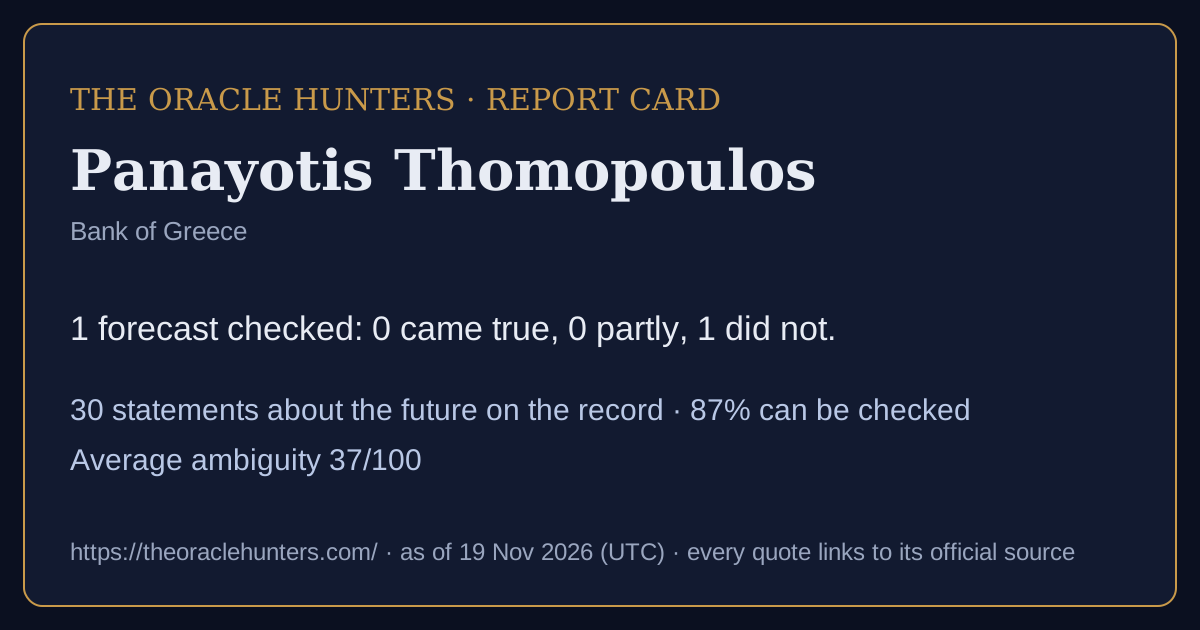
Panayotis Thomopoulos
Bank of Greece
Track record: 1 forecast checked: 0 came true, 0 partly, 1 did not.
30forecasts & commitments on the record
87%can be checked as stated
37average ambiguity (0-100)
0goalpost moves recorded
0confirmed U-turns
Timeline
came true partly did not not due / being checked / too vague
Calibration score: shown after 10 checked forecasts with a stated likelihood (now 1).
How they speak about the future: based on data 28, stated on authority 1, educated guess 1.
Kinds of claim: forecast 22, mixed claim 6, scenario (if… then) 2. · Download this report card as a picture
In the nine words
πρόγνωσιςInference from evidence26 · 87%πρόνοιαPreparing for the future2 · 7%πρόβλεψιςSeeing the signs1 · 3%μαντείαInspired knowledge1 · 3%
How to read this
Each box is one sentence a public figure or institution said about the future, word for word, with a link to the official text. Can be checked means it names what will happen, by when, and how likely - so it can be compared with official figures later. Too vague to check means it does not. Ambiguity (0-100) is how many different ways the sentence can be read. When the date passes, the forecast is compared with official data and marked came true, partly or did not come true. Labels judge the sentence, never the person. Full guide and glossary.Checked
Real GDP growth is not expected to accelerate in 2005, while the downside risks loom larger.
Did not come true. Said: economic growth would rise in 2005. Official figures for Greece: 5.4% in 2004, 1.2% in 2005 (World Bank open data). official data · checked 14 Nov 2026 · automatic check against official data (rules v3)
On the record (30)
These shares will pay a fixed annual return of 10% and they will be eligible as Tier I capital, allowing credit institutions to enhance their capital base.
Credit institutions may benefit, on a voluntary basis, from the purchase by the Greek State of preference redeemable shares, up to an aggregate amount of €5 billion.
I will not cite the numerous and detailed Acts of the Bank of Greece (and individual consultations), which called the banks to strengthen internal control systems and risk management, built high capital ratios exceeding 11% and maintain high liquidity ratios.
European countries is less than 9% of total assets, the total impact on Greek banks will be relatively limited.
To restore medium-term liquidity, the guarantee of the Greek State, will be provided to credit institutions for the issuance of new medium-term loans, as well as for notes that will be issued or refinanced up to the end of 2009 and for a maturity of up to 3 years.
Nonetheless, because the aim is for Greek banks to have sufficient capital and liquidity buffers as well as to minimise any negative spill-over effects on the Greek economy from the global financial crisis, the € 28 billion state banking support package has been arranged, thus ensuring that, even under the very bad scenario, Tier 1 capital will remain between 8-10% …
Lately we have been seeing the first signs of a change in labour behaviour and, although, over the next couple of years wage growth will probably continue to be about 2% in most developed economies, this cannot be taken for granted over the medium to longer run.
Even if there is no immediate risk and though the household debt to GDP ratio at 38% is much below the euro area average of close to 60%, a Central bank has to err on the side of caution and address all longer term issues that might undermine the soundness of the banking system.
Likewise, agricultural employment still represents 8% of the labour force, 4 times as high as the EU average and, to the extent that it diminishes, the outflow of rural labour will continue to inflate total unemployment.
As far as the Bank of Greece is concerned, our supervisory role obliges us to ask banks to increase provisions, to tighten credit standards and in general to introduce efficient credit control mechanisms, including state-of-the-art risk management units so that even if non-performing-loans increase their CAR will still remain well above 10%: today it is almost 14%.
These factors are all reflected in their high profitability: This year the return on equity is expected to exceed 20%.
Only this year has it been budgeted to fall below 3% of GDP, while continuous efforts will have to be maintained to reach a balanced position, as required by the EU.
Generally the capital requirements for loans to corporate are likely to fall significantly (up to 80% in some cases) for excellent credit quality with credit risk mitigants, such as eligible collaterals.
However, since then Greek big banks (with a market share of 70%) are gradually introducing IRB methods, so that when the new framework will be introduced, they will be able to reduce their credit risk charges.
In total, for the EU banks using the standardised approach, mainly small banks, even after allowing for the 10.3% reduction, their capital adequacy ratio will remain well above 10% and only a few, with a share in total banking sector assets of 0.2% may experience some difficulties.
I would like to diverge from the pessimists and I will use my time to explain why Greece can continue on a path of strong growth if we can address the forthcoming challenges by adopting sound and market-friendly policies.
The Greek agricultural sector has followed the international trend and has now shrunk to less than 7% of GDP, and will probably further decline close to the European average.
Of course, if the international economic environment improves, especially EU growth turns out to be much higher than 2% Greece will also reach a higher growth path.
Of course, we cannot continue to grow for extended periods at rates above 4%, so some deceleration is to be expected and may do us some good by helping contain inflationary pressures.
In particular, the ongoing reforms of the Common Agricultural Policy and the final liberalisation of textiles trade next year will put further pressure on these sectors.
Year 2005 will be a difficult one, as the necessary fiscal adjustment and high oil prices will constrain growth.
The world is finally getting accustomed to the idea that a structural deficit of around 3% of GDP over the medium term can be sustained, and this should be the goal.
Real GDP growth is not expected to accelerate in 2005, while the downside risks loom larger.
Did not come true. Said: economic growth would rise in 2005. Official figures for Greece: 5.4% in 2004, 1.2% in 2005 (World Bank open data). official data · checked 14 Nov 2026 · automatic check against official data (rules v3)
The Greek economy has succeeded in absorbing this negative shock without strains and the probable further decline in net E.U. funds, after 2007, which is related to E.U. enlargement, does not pose a serious threat to growth.
Although all European economies have now emerged from recession, the three main economies, Germany, France and Italy, will see very modest growth of less than 1 ½ percent in total this year.
Unlike our partners in the EU, we are now enjoying strong growth that will stay close to 4 percent this year as in the last five years.
World output is expected to increase by 4.6 percent this year, 50% faster than in the previous two years, while world trade, which practically stagnated in 2001 and 2002, will increase by nearly 8 percent this year.
In addition to targeting the exchange rate, the Bank of Greece always kept a close watch on the growth of M3 and domestic credit expansion and through open market operations absorbed any excess liquidity, which, if it had been allowed to reach the real economy, could have aggravated inflationary pressures.
Of course, this has to some extent caused delocation of greek companies, with a negative impact on investment and employment in Greece over the short to medium-term, but for an economy growing at almost 4% p.a. since 1997 and with an investment GDP ratio of 24% delocation does not pose a serious threat to its long term performance.
Growth in the eurozone should accelerate slowly, and within the next year the growth rate should gradually approach its potential, estimated at around 2 ? % per annum.
Also said - not checkable as stated (12 newest)
Remarks about the future with no date, figure or likelihood that could be checked. They are kept on the record and shown here, but not scored.
In addition, in some countries in the region one suspects that a process of real appreciation is taking place, a process that will have to be corrected sooner or later.
In particular in the field of mortgage lending the effects of today's decisions will be felt during the next 25 or even 35 years, when the last installment of a 25 or 35-year loan is repaid.
Another area of concern is that the benign inflation trends of the last few years, which are almost exclusively due to moderate wage claims in the developed countries and which have more than offset the impact of the rise in energy and raw material prices, may not continue for ever.
Indeed, over the last 5 years average real wages have been stagnant, and probably more than one-half of wage earners have experienced real income losses, while profit margins have been rising strongly.
Focusing more on the specific subject of interest today, I am afraid that, in addition to financial assets, some countries' real assets, including housing are overvalued today, and a disorderly adjustment of asset values could have important effects.
of you probably know any acquisition of a credit or financial institution abroad and any expansion of branch network has to be approved by the Bank of Greece after a thorough assessment of its capital base and its internal control and risk management system.
Gradually a common supervisory culture will have to be established.
Greece, at present, is primarily a retail banking market; but, gradually, as Greek banks' networks abroad increase, Greek banks will also serve the growing number of Greek multinational firms both in their domestic activities and abroad.
Thus the shift towards wholesale and investment banking is expected to gather strength.
In addition, it should be noted that the provision coverage ratio, which stood at 61.5% in 2005, is quite satisfactory, and given the long tradition of collateralized lending, as banks ask for real estate security, the loss-given-default rate is relatively low.
This development has been particularly noticeable in the banking sector, as I shall refer below.
Although Greek manufacturing firms, with the exception of the declining sectors such as textiles, show healthy profitability - with profit rates above most other European counterparts- and we see new firms being set up in dynamic sectors, the contribution of manufacturing to GDP will continue to be much smaller than in the rest of the EU.