Owen Paterson
Northern Ireland Office · GBR
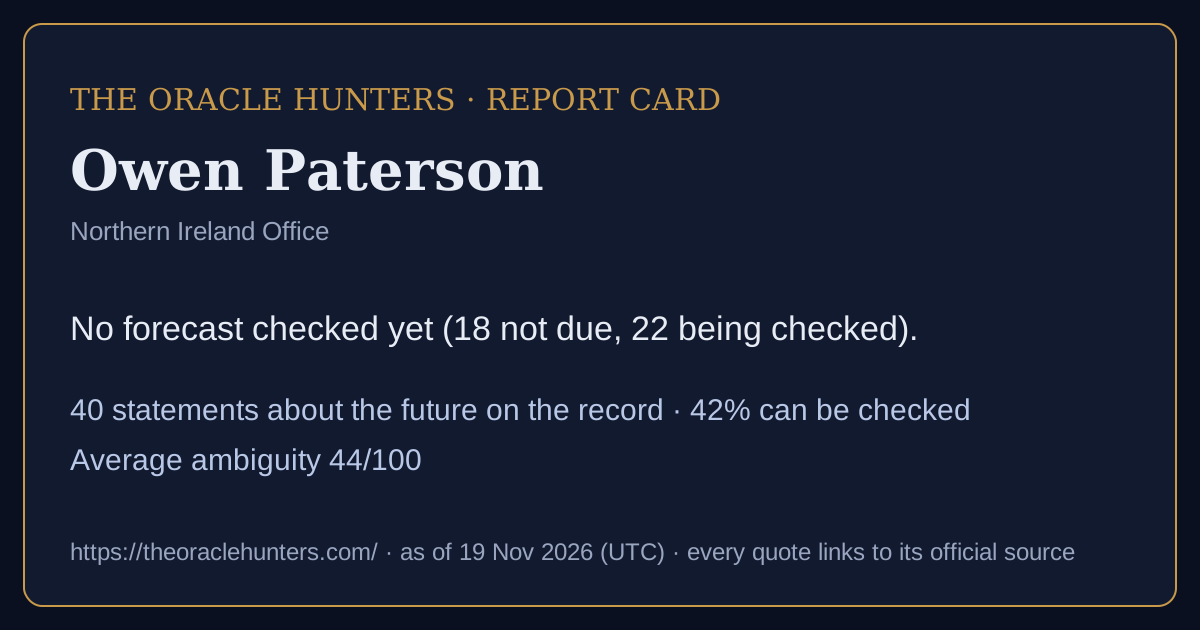
Track record: No forecast checked yet (18 not due, 22 being checked).
40forecasts & commitments on the record
42%can be checked as stated
44average ambiguity (0-100)
0goalpost moves recorded
0confirmed U-turns
Timeline
came true partly did not not due / being checked / too vague
Calibration score: shown after 10 checked forecasts with a stated likelihood (now 0).
How they speak about the future: based on data 35, stated on authority 4, educated guess 1.
Kinds of claim: forecast 24, commitment 7, mixed claim 6, scenario (if… then) 3. · Download this report card as a picture
In the nine words
πρόγνωσιςInference from evidence28 · 70%προαναγγελίαPublic pre-announcement7 · 18%πρόνοιαPreparing for the future3 · 8%μαντείαInspired knowledge2 · 5%
How to read this
Each box is one sentence a public figure or institution said about the future, word for word, with a link to the official text. Can be checked means it names what will happen, by when, and how likely - so it can be compared with official figures later. Too vague to check means it does not. Ambiguity (0-100) is how many different ways the sentence can be read. When the date passes, the forecast is compared with official data and marked came true, partly or did not come true. Labels judge the sentence, never the person. Full guide and glossary.On the record (40)
The Prime Minister announced on Monday that through the Red Tape Challenge we will save businesses over £850 million by scrapping or improving over 3000 regulations.
It will cost taxpayers £1 billion over the next 10 years if we don’t take action.
These changes will be made during 2016 and 2017.
That’s why despite wanting to move as quickly as possible on Livestock Identification and movement controls I will not make any changes that jeopardise the successful delivery of CAP reform in 2015.
As British farmers and food producers you know that we grow some of the best food in the world here – so why is 24% of the food eaten in the UK imported when it could be produced here?
That’s why over the next 5 years we will reduce costs to all businesses by at least £1 billion through cutting red tape.
And the environment will benefit from over £3 billion of rural development investment from 2014 to 2020.
These pilots will help us develop a new, more flexible consenting system for river maintenance by 2015.
And from 2015 there will be a further £250 million to connect even more properties.
This is not only because it’s the right thing to do but because it’s the only way in which we will secure growth that is both environmentally and economically sustainable.
In line with Cabinet Office regulations on advisory bodies the Board’s lifespan is time limited and it will be wound up in March 2014.
Over the next 5 years we will reduce costs to businesses by at least £1 billion.
We will be consulting formally next month and look forward to hearing your views.
As well as promoting exports, we need to make a significant dent in the 22 per cent of food that’s imported but could be produced here.
They have set up the UK’s first Food Engineering degree course at Sheffield Hallam University, which will be ready for its first intake in September 2014.
Although, this will not happen in this CAP round that runs to 2020.
The UK’s first Food Engineering degree course, which you’ve collaborated on with Sheffield Hallam and the National Skills Academy for Food and Drink, will be ready for its first intake in September 2014.
And yet, 22 per cent of the food that we import, could be produced here.
Nine flood defence schemes, including Leeds, Sheffield, Ipswich, Exeter and Derby, will receive a share of the £120 million extra funding announced in last year’s Autumn Statement.
We currently import 22 per cent of food that could be produced here.
When it comes to better regulation, Defra has saved business £143 million per year under the Government’s One-in, One-out system and we will continue to build on this by One-in, Two-out.
Ofcom recently ran a successful auction of the 4G spectrum and national rollout will start this year aiming to provide coverage to at least 98% of the UK population by 2017.
In the four years to 2015 we will be investing £2.3 billion to reduce flooding, providing better protection to 165,000 households.
We’re also reducing Corporation Tax so that in April 2015 we will have the lowest rate in the G20.
This will rise to an estimated £1billion over the next decade if the disease is left unchecked.
Pillar 1 direct payments will continue until 2020, but the Commission will insist on a greening element.
We don’t yet have a UK CAP allocation, but we do know that the overall CAP budget will be around €52 billion a year, the equivalent of around €1650 per second.
It is clear that in this round, due to run until 2020, Pillar 1 will continue.
By doing this, we will have a flourishing, outward-looking industry boosting growth in the economy while improving the environment: a confident industry delivering for society.
The first report will be presented to the Chancellor and the Economic Affairs Committee in Spring 2013.
The new Regulations we are putting in place will provide improved welfare protection from January 2013 until primary legislation can be enacted.
The first State of Natural Capital report will be presented to the Chancellor and the Economic Affairs Committee in Spring 2013.
The recent OECD-FAO Agricultural Outlook for 2012 to 2021 concluded that agricultural production needs to increase by 60 per cent over the next 40 years to meet the rising demand for food.
And if you take steps with us to find and stay in employment you will receive our support in return.
We estimate that the introduction of the Universal Credit will pull around 550,000 adults and 350,000 children out of poverty…and 80 per cent of the gains from this reform will go to those in the bottom 40 per cent of the income distribution.
In fact the money being paid out in interest on our debt this year alone could pay for… 48,600 MRI scanners, 1.5 million nurses, 1.2 million teachers, 1.1 million police officer, or 399,000 doctors.
Here in Northern Ireland we will spend almost £1.5 billion on out of work benefits this year.
And while it is up to the Executive to decide how it manages its budget, a CBI report in September showed how more than £1 billion could be saved by running services more efficiently and realising assets.
While the reduction in one of the capital spending streams is higher, having discussed in detail with the Treasury we are confident that - using the same assumptions and calculations as Gordon Brown in 2007 - we will deliver the £18 billion promised after St Andrews.
By the end of the year, the Treasury working with the Executive will have produced a paper on rebalancing the Northern Ireland economy.
Also said - not checkable as stated (12 newest)
Remarks about the future with no date, figure or likelihood that could be checked. They are kept on the record and shown here, but not scored.
We will do whatever we can to get payments to you on time.
But if we are going to make this work, I will need you to work with us.
If you want to include hedges in your Ecological Focus Area, we’ll need to work with you to get the mapping of hedges right, you will need to accept that the verification process could take longer and there is a risk that you may get your payment later.
Let me be clear, we will do everything we can to make payments as early as possible in the payment window.
If we are going to make a success of it, it will need to be a team effort.
We will report back to you with that outcome but meanwhile I hope that current difficulties with the registration of the Scotch Whisky Geographical Indication will be resolved.
Future economic wins will rely on the activity of our substantial and long-experienced negotiating teams, who are very actively involved on behalf of the whole UK in forthcoming EU / Indian and South American trade talks.
I will be making early contact with the new Indian government following today’s conclusion of the Indian elections and I am looking forward to resuming negotiations on the EU-India Free Trade Agreement.
The question of tariffs will certainly be at the front of my mind.
This will be an important step towards better access to the Brazilian market, where I know consumer demand for Scotch whisky is growing fast.
Scotch whisky already benefits from a zero tariff in the USA, so the immediate commercial benefits are likely to be modest.
At the same time we will save energy, water and use less virgin materials, keeping valuable resources from ending up in landfill.