Norman T L Chan
Hong Kong Monetary Authority
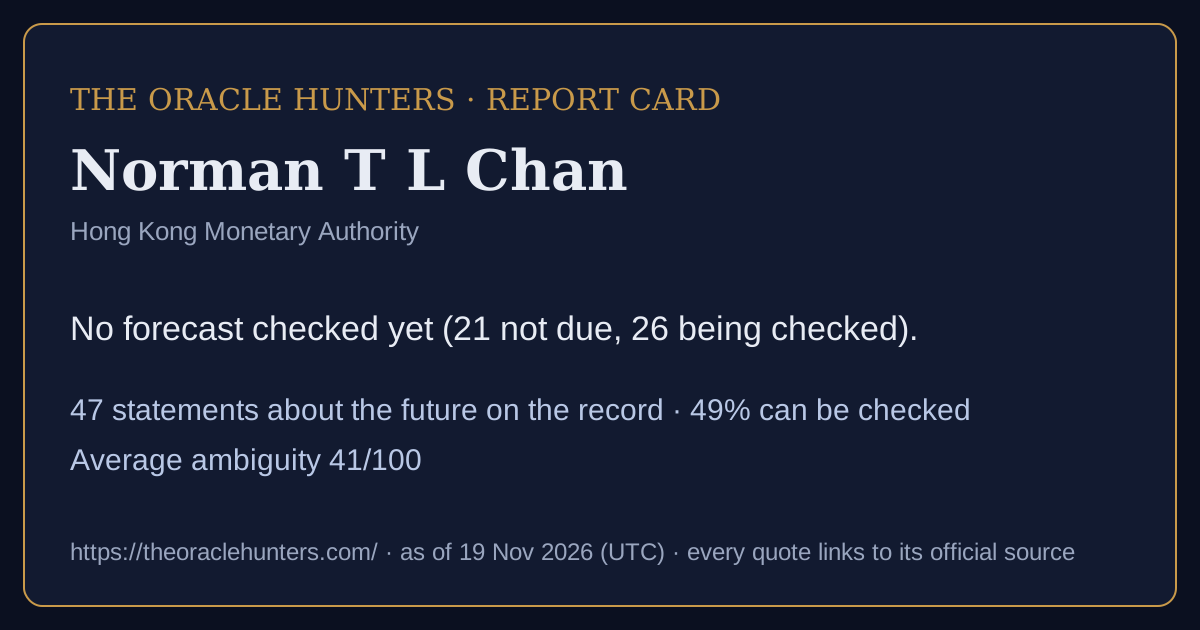
Track record: No forecast checked yet (21 not due, 26 being checked).
47forecasts & commitments on the record
49%can be checked as stated
41average ambiguity (0-100)
0goalpost moves recorded
0confirmed U-turns
Timeline
came true partly did not not due / being checked / too vague
Calibration score: shown after 10 checked forecasts with a stated likelihood (now 0).
How they speak about the future: based on data 28, stated on authority 15, educated guess 4.
Kinds of claim: forecast 35, scenario (if… then) 6, mixed claim 6. · Download this report card as a picture
In the nine words
πρόγνωσιςInference from evidence25 · 53%μαντείαInspired knowledge15 · 32%πρόνοιαPreparing for the future6 · 13%εἰκασίαConjecture1 · 2%
How to read this
Each box is one sentence a public figure or institution said about the future, word for word, with a link to the official text. Can be checked means it names what will happen, by when, and how likely - so it can be compared with official figures later. Too vague to check means it does not. Ambiguity (0-100) is how many different ways the sentence can be read. When the date passes, the forecast is compared with official data and marked came true, partly or did not come true. Labels judge the sentence, never the person. Full guide and glossary.On the record (47)
Furthermore, I would like to mention that the CGF , together with the IFC, will coorganise the next Climate Business Forum in Hong Kong in early 2020.
This new interface is expected to be launched sometime next year.
If they each subscribe for HK$1 million Life Annuity, then they will get another HK$11,100 ($5,800 + $5,300) per month.
By end-October or early November this year, the first annuitants will be receiving their first monthly annuity payments.
Banks involved in selling those PPI products have, between 2011 and May 2017, reached settlements with millions of affected customers totaling 27 billion pounds, and three of the largest banks involved have been fined by the UK authorities a total of 117 million pounds.
This year's annual meeting of the Forum will be held in Hong Kong in December, and is expected to be attended by high level government and private sector representatives from both sides to discuss a whole range of financial collaboration issues.
The centerpiece of an efficient retail payment system will be our Faster Payment System (FPS), scheduled for implementation in September 2018.
In case you do not know already, the size of Hong Kong's banking sector, as measured in the amount of banking assets, has exceeded HK$20 trillion by end of 2016.
The programme will be rolled out next month as planned.
The computer platform will be in operation and available to the banking sector next month as planned.
T aking into account the comments received, the FFO is finalising the Assessment Programme and will announce the detailed framework next month for implementation by banks in Hong Kong.
The IMF's forecast is that China's GDP will further expand to US$16 trillion by 2020.
A more advanced level for practitioners with at least 3 years of relevant experience will be launched in June 2017.
We are making good progress and I am pleased to announce that the Cybersecurity ECF will also be launched in December this year.
- (d) we will work with the HKAB and ASTRI to set up the Cyber Intelligence Sharing Platform by the end of this year.
- (c) we will work with the HKIB and ASTRI to roll out the first training courses for cybersecurity practitioners by the end of this year; and
With total deposits of about HK$10 trillion currently in our banking system, you may wish to think about the potential loss to savers.
Even if a heavily indebted country manages to survive a debt crisis with debt restructuring, just like Mexico in the 1980s and more recently Greece, the debt overhang will still impede its economic growth and inflict huge costs and pain on its people in the form of rising unemployment and sharp drop in living standards.
- (a) In addition to what the BoC HK, as the RMB Clearing Bank, is providing to the Participating Banks through intraday overdraft, the HKMA will provide an intraday Repo facility of up to RMB10 bn to banks in Hong Kong.
The scheme, which is to be launched later this year, will allow Hong Kong and international investors to invest in shares listed on the Shanghai Stock Exchange through Hong Kong.
This is not because the advanced economies need to be kind to the EMEs but because there is a feedback loop that could possibly transmit negative shocks from the EMEs to the advanced economies. 2014 is very different from the time of the Asian Financial Crisis in 1997 when Emerging Asia only accounted for 18% of global trade and 17% …
The risk of a 'new normal' causing a rise in interest rates, re-pricing of assets and a slow down of economic growth would be a big challenge for Asia in the next year or two.
Another striking example was Japan where the public-debt-toGDP ratio surged from an already precarious level of around 190% in 2008 to almost 240% in 2012, and is expected to rise even further to over 250% by 2020 along with still more fiscal stimulus under 'Abenomics'.
It will be even worse, according to the banks advocating this level playing argument, if their national supervisor imposes capital or liquidity requirements that exceed the international standards.
If the applicant's income is mainly derived from outside Hong Kong, the maximum LTV ratio will be lowered from the current 40% to 30%.
And, even if the low interest rate environment were to remain until 2015 as anticipated by the US Federal Reserve, the US interest rates are bound to head back to more normal levels.
For example, for mortgage applicants with income mainly derived from Hong Kong, the maximum LTV ratio will be lowered from 50% to 40%.
Under these circumstances, if asset price inflation is driven by excessive leveraging, in theory, asset prices might drop first in search for a new equilibrium, and then stabilise at that point.
If implemented, the European countries concerned will have to pursue rigorous deficit reduction plans and lower their total sovereign debt to GDP ratio to 60% or below within years.
Basel III will take effect in January 2013, and a more stringent Liquidity Coverage Ratio and Leverage Ratio will be put in place.
As you may recall, I pointed out that during the period between mid-1950s and early 1980s, the total debts of households, businesses other than financial institutions and the government in major industrialised countries remained relatively stable at about 150% of GDP.
The list of wonders that borrowed money can bring goes on, but we almost forget there is a catch, that is, debts must be repaid somehow some day; and the higher the interest rates, the more we will have to pay back over time.
It will have to keep on reducing its government debt by an amount equal to 3% of GDP annually for the next twenty years so as to reduce its current debt-to-GDP ratio of 120% to the target of 60%.
In addition, purchasers who meet the eligibility requirements will be able to apply for mortgage loans of up to 90% LTV ratio under the mortgage insurance arrangements.
Third: for mortgage applicants whose principal income is derived from outside Hong Kong, the applicable maximum LTV ratio shall be lowered by 20 percentage points, instead of the current 10 percentage points.
Second: for mortgage loans assessed based on the net worth of a mortgage applicant, the maximum loan-to-value (LTV) ratio shall be lowered from the current 40% by 10 percentage points to 30%.
First: for mortgage loans assessed based on the debt servicing ability of a mortgage applicant, the maximum debt servicing ratio (DSR) shall be lowered from the current 50% by 10 percentage points to 40%.
By 2020, the estimated number of millionaires in Mainland China and Hong Kong together will be 3.7 million, with an accumulated wealth of US$14 trillion. 2
It is estimated that global wealth will rise 50% further by 2016. 1 This is hardly surprising in that the International Monetary Fund forecasts that, emerging Asia, led by China, will contribute almost 60% of the world's GDP growth by 2016.
Even though property prices have already fallen significantly, more than 50% in some places according to anecdotal reports, potential buyers still prefer to wait as they fear that prices may fall further once the huge stock of foreclosed properties are put back to the market or when interest rates return to more normal levels.
I believe that next year will be a crucial year for the development of offshore RMB business in Hong Kong.
In order to further promote the steady development of the RMB market in Hong Kong, the following refinement measures will take effect from January next year:
To promote the launch of this new Scheme, the HKMC will offer a special discount for applications filed on or before 30 June 2011.
In mid-November, the HKMC announced that it will launch the SME Financing Guarantee Scheme on 1 January next year.
With the recovery of the local economy and the improved financing and cash flows for SMEs, the Special Loan Guarantee Scheme will cease to receive applications from early next year.
Since May this year, many SMEs and think-tanks suggested that Hong Kong should develop a market-oriented platform to guarantee SME loans upon the phasing out of the Special Loan Guarantee Scheme.
If the reform failed, not only would economic growth slow down, the entire system of reform and opening up may also collapse.
Also said - not checkable as stated (12 newest)
Remarks about the future with no date, figure or likelihood that could be checked. They are kept on the record and shown here, but not scored.
I believe that, more than ever, we will need a basic sense of purpose to help us keep everything in perspective.
As with mortgage caps, this might not please everyone - but it serves the wider public interest.
So overall, I am pleased to say that our banking sector today is safe and resilient - probably more so than at any time in Hong Kong's history.
needs, and the reality is that they will not provide banks with much fee or interest income.
However, the community expects banks to provide them with basic services, essentially on a pro-bono basis.
The future could be one where physical bank branches are just a memory - like public telephones on the street.
What it means is that the regulators should articulate the risks or problems that they seek to address while the industry should consider how proper risk management could be achieved without over-interpreting the regulations or imposing rigid processes that drive away customers.
The Academy is a new venture and we will work closely with all the stakeholders, including the TMA, to upgrade the soft power of Hong Kong as the premier financial centre in Asia.
Many of you may recall that, in the 1990s and prior to the Asian Financial Crisis, many Japanese (regional) banks used Hong Kong to conduct the socalled euro yen businesses, through which the banks would book in Hong Kong their yen loans to borrowers in Japan, presumably to benefit from more favorable tax treatment.
While this kind of booking businesses may inflate the size of Hong Kong's banking system in terms of total assets, it does not, as we have learnt from the experience of the euro yen booking in the 1990s, bring about much real benefits to Hong Kong in terms of job creation or enhancement of the credit underwriting skills of the …
Our position is that, in booking any loans or other assets in Hong Kong, the banks must demonstrate that they have the necessary capability and control process to prudently manage the risks of these assets, both at origination and on an ongoing basis.
Here I should mention several important developments in the last decade that are highly relevant and instrumental to Hong Kong's rise to become the risk management hub in Asia.