Norman Lamb
Department of Health and Social Care · GBR
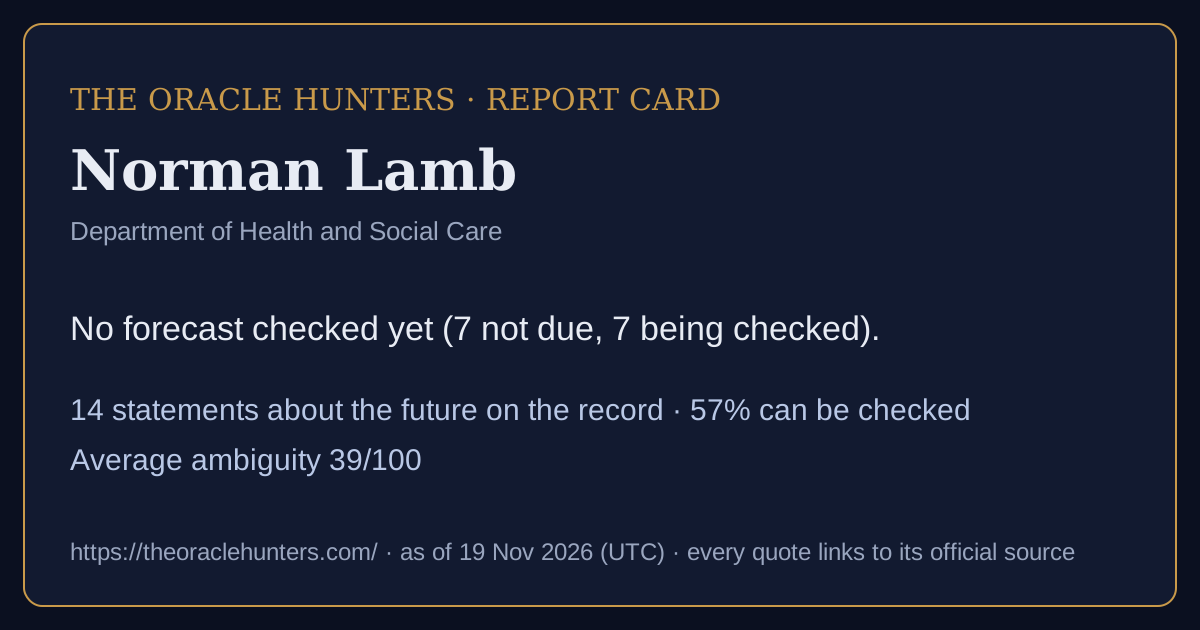
Track record: No forecast checked yet (7 not due, 7 being checked).
14forecasts & commitments on the record
57%can be checked as stated
39average ambiguity (0-100)
0goalpost moves recorded
0confirmed U-turns
Timeline
came true partly did not not due / being checked / too vague
Calibration score: shown after 10 checked forecasts with a stated likelihood (now 0).
How they speak about the future: based on data 10, stated on authority 4.
Kinds of claim: forecast 11, mixed claim 3. · Download this report card as a picture
In the nine words
How to read this
Each box is one sentence a public figure or institution said about the future, word for word, with a link to the official text. Can be checked means it names what will happen, by when, and how likely - so it can be compared with official figures later. Too vague to check means it does not. Ambiguity (0-100) is how many different ways the sentence can be read. When the date passes, the forecast is compared with official data and marked came true, partly or did not come true. Labels judge the sentence, never the person. Full guide and glossary.On the record (14)
My Department will continue to fund Time to Change in 2015-16 so that they can continue to push out their message.
By the end of March next year, IAPT services will be reaching at least 900,000 people.
Research published in the medical journal The Lancet earlier this year has shown that the campaign is having a positive effect on public attitudes and that stigma and discrimination in relation to mental health would probably be more common without the campaign.
Some local authorities will spend little or nothing on preventing mental health problems this year.
By 2026, it is projected to be £12.2 billion.
An increase of 2.1% might not sound like a lot, but we are talking about over a million more people being affected by a mental health condition.
Between now and 2030, the number of people over 85 will double.
By 2026, 3 million people will have three long-term conditions.
It is outlined in the Health and Social Care Act that there needs to be equal importance given to mental health with physical health, and we will be able to hold them to account for the quality of services.
And if ‘whole place’ community budgets happened everywhere, the savings could run as high as £5bn.
By the end of this year, we will have a new measure of people’s experiences – so we can see whether people with all sorts of different needs are actually seeing those changes.
At the moment, we spend £1.9bn per year and this will break £2bn by 2015.
And there will be an extra £200 million over the next five years spend on better housing options for older and disabled people.
As announced in the Care and Support White Paper Caring for our future, over the two years from 2013/14, an extra £300 million will go from the NHS to local authorities to get health and social care services working better together.
Also said - not checkable as stated (12 newest)
Remarks about the future with no date, figure or likelihood that could be checked. They are kept on the record and shown here, but not scored.
They might not find the right job straight away, and they might need to ease themselves into working, perhaps only doing just a few hours a week initially.
So, when the Taskforce reports back in the next few months, we will have examples of good care and the views of young people, their families and the professionals which support them and we will be making progress toward getting better data.
You may have heard last week from Simon Stevens and his Five Year Forward Look that we need to seriously think about the way the health service works.
Most of you will have heard Jeremy Hunt talk yesterday about how we will achieve this through our integration work.
We will have something we have needed for years: an accurate picture.
Since the coalition government came to power, we have supported the health and care service wherever we could.
Many of the people you care for will be deeply affected by mental ill-health.
The health makeup of our society is changing, and we need to change with it if we’re going to rise to the challenge of an aging population with more complex health needs.
But we will also be working alongside a number of pioneering organisations that have really exciting ideas for integrating health and care.
We’re now working on how we will assure ourselves of NHS England’s progress, and I will make sure that mental health features very prominently in those discussions.
Mental health is a matter for all health professionals and HEE should develop training programmes that will enable employers to ensure that staff have an awareness of mental health problems and how they may affect their patients.
Only then will we change how people behave, how they prioritise, how they spend their time, their energy and their money, so that mental health is truly ‘on a par’ with physical health.