Nor Shamsiah Mohd Yunus
Central Bank of Malaysia (Bank Negara Malaysia)
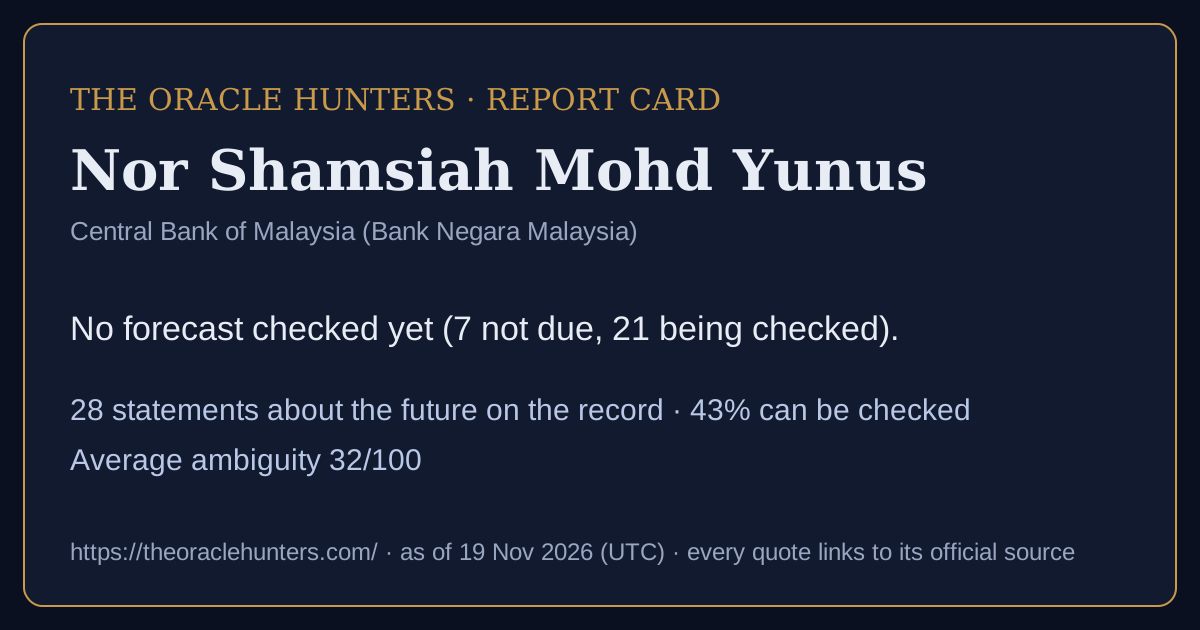
Track record: No forecast checked yet (7 not due, 21 being checked).
28forecasts & commitments on the record
43%can be checked as stated
32average ambiguity (0-100)
0goalpost moves recorded
0confirmed U-turns
Timeline
came true partly did not not due / being checked / too vague
Calibration score: shown after 10 checked forecasts with a stated likelihood (now 0).
How they speak about the future: stated on authority 15, based on data 13.
Kinds of claim: forecast 24, mixed claim 4. · Download this report card as a picture
In the nine words
How to read this
Each box is one sentence a public figure or institution said about the future, word for word, with a link to the official text. Can be checked means it names what will happen, by when, and how likely - so it can be compared with official figures later. Too vague to check means it does not. Ambiguity (0-100) is how many different ways the sentence can be read. When the date passes, the forecast is compared with official data and marked came true, partly or did not come true. Labels judge the sentence, never the person. Full guide and glossary.On the record (28)
The B40 and vulnerable groups are the ones who will be the most affected if we let inflation get out of hand, and we will not be able to preserve sustainable growth over the longer term.
I would also like to congratulate in advance the winners of the Emerging Leader Prize and Impact Challenge Prize - two additional new prizes introduced this year in conjunction with RAIF - that will be awarded later today.
According to AIBIM"s VBI report which will be launched later today, RM146.6 billion in financing, investments and deposits were intermediated by Islamic banks in VBI-related or VBIaligned initiatives between 2020 and 2021.
Next year, global growth is expected to moderate.
Given this, the Monetary Policy Committee MPC decided to recalibrate the level of monetary accommodation, gradually adjusting the overnight policy rate OPR in May, July and September this year.
All these will lead to slower growth next year.
No doubt, the outlook next year will be more challenging due to a confluence of factors -rising geopolitical tensions and conflict, global inflationary pressures and extremely volatile financial markets.
That said, we project that inflation will peak in the third quarter this year.
These positive developments will continue to provide support for growth in 2023.
This year, growth is expected to be strong.
Today, we will be launching the Financial Sector Blueprint 2022-2026.
To this end, Bank Negara will finalise plans this year for mandatory climate-risk disclosures by financial institutions in consultation with the financial industry.
efficiency activities have already been issued, and will be followed by Guides for the manufacturing, construction and infrastructure, as well as oil and gas sectors by the end of this year.
- Malaysia will transition to an 'aged nation' status, with the old-age dependency ratio expected to increase to 16.6% by 2040.
And so, I was heartened to read in the World Bank's Aiming High report that Malaysia is likely to transition to a high-income economy between 2024 and 2028.
Today, with the COVID-19 pandemic still raging, we see a potential reversal of decades' worth of progress in poverty reduction, with an estimated 71 million people expected to be pushed back into extreme poverty - the first rise in global poverty since 1998 .
This afternoon, I would like to briefly expand on some of the ideas that I put forward last year, which will build on this year's conference theme.
We will consult the industry and other relevant parties through the publication of an exposure draft early December this year.
If this trend continues, our mangroves would completely sink by 2040 and industrial zones will be affected by 2060.
Concurrently, the Bank also intends to align, where relevant, the reporting requirements for climate-related risks with the Value-Based Impact Assessment Framework (VBIAF), which will be finalised by October this year, as well as its corresponding VBIAF Sectoral Guide, which is currently being developed.
The Bank expects to issue the first draft of the taxonomy by the end of this year for industry feedback prior to its adoption.
We expect to operationalise the platform before the year end.
In this regard, we would like to announce that we will be lowering the daily cash threshold report to RM25,000 effective 1 January 2019.
Today, the Bank will communicate its intention to extend the observation period for the Net Stable Funding Ratio, or NSFR, in Malaysia for another year to 2020.
And of course, there are cyberthreats with the global cost of cybercrime projected to reach $2 trillion in 2019.
At around 225% of global GDP, global debt is at a record high level and may leave a heavy burden for future generations to bear.
In the next two years, the Bank will be reviewing the valuation and capital standards for solvency reporting.
The Bank trusts that the industry will continue to ramp up its preparation towards full implementation of the IFRS 17 in 2021.
Also said - not checkable as stated (12 newest)
Remarks about the future with no date, figure or likelihood that could be checked. They are kept on the record and shown here, but not scored.
Very shortly, we will also be launching Malaysia's cross-border QR payment linkages with Indonesia, Thailand, and Singapore.
We will continue to simplify our messages to make them more relatable and easier to understand.
And we must enhance our capacity to adapt and change in order to manage risks and exploit opportunities that we may not yet see today.
Speakers will explore the opportunities that Malaysia has to grow in these areas and the obstacles in our way.
However, given that the OPR is by design a blunt tool to deliver price stability, more targeted measures are in place to help those who may be facing difficulties in meeting their monthly loan repayments.
For example, in deploying blended finance to extend impactful solutions for underserved segments of society, investors and consumers must appreciate that the return on capital invested might not be immediately realised, and that the "return" should not be solely measured against a financial yardstick.
We are confident that with stronger industry stewardship, we will be able to foster greater market dynamism.
In an environment of high household leverage, taking on more debt-based borrowing may not be the best solution for micro-businesses and low-income segments.
We will also continue to take effective preventive measures against ever-evolving financial scams.
They should ensure that their devices are secure, free from suspicious apps which might carry malware and spyware.
Customers will be immediately alerted when any such activity involving their banking accounts is detected.
Third, a cooling-off period will be observed for the first-time enrolment of online banking services or secure devices.