Njuguna Ndung'u
Central Bank of Kenya
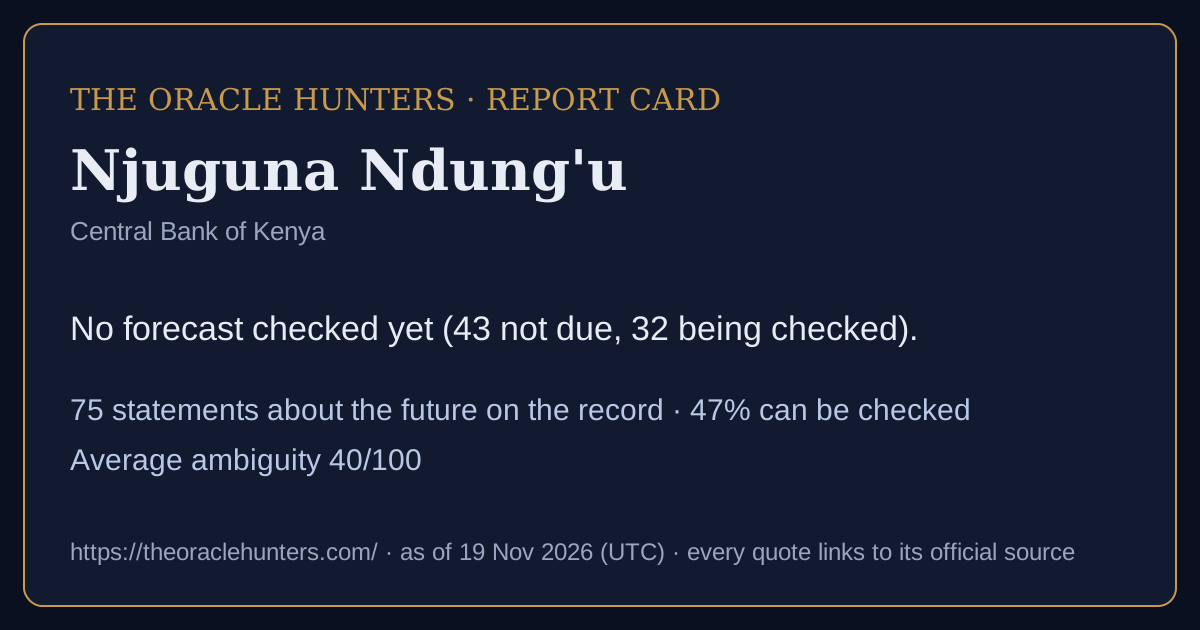
Track record: No forecast checked yet (43 not due, 32 being checked).
75forecasts & commitments on the record
47%can be checked as stated
40average ambiguity (0-100)
0goalpost moves recorded
0confirmed U-turns
Timeline
came true partly did not not due / being checked / too vague
Calibration score: shown after 10 checked forecasts with a stated likelihood (now 0).
How they speak about the future: based on data 64, stated on authority 6, educated guess 5.
Kinds of claim: forecast 64, mixed claim 5, scenario (if… then) 4, commitment 2. · Download this report card as a picture
In the nine words
πρόγνωσιςInference from evidence64 · 85%πρόνοιαPreparing for the future4 · 5%μαντείαInspired knowledge4 · 5%προαναγγελίαPublic pre-announcement2 · 3%εἰκασίαConjecture1 · 1%
How to read this
Each box is one sentence a public figure or institution said about the future, word for word, with a link to the official text. Can be checked means it names what will happen, by when, and how likely - so it can be compared with official figures later. Too vague to check means it does not. Ambiguity (0-100) is how many different ways the sentence can be read. When the date passes, the forecast is compared with official data and marked came true, partly or did not come true. Labels judge the sentence, never the person. Full guide and glossary.On the record (75)
Fellow Governors, Central Banks are also expected to support the development and integration of the financial system as well as the implementation of other priority areas of the EAMU Protocol including the attainment of Macroeconomic Convergence (by 2021), Harmonization of Monetary and Exchange rate Operations (by 2022) and Introduction of the Single Currency (by 2024).
In doing so, we shall play our role in enabling the attainment of the national economic goals envisaged under Vision 2030.
Vision 2030 defines the financial sector as vibrant and globally competitive that will promote high level of savings to finance Kenya's investment needs.
The World Bank estimated remittance flows to developing countries in 2013 to have amounted to USD414 billion, and projections to USD540 billion by 2016.
Building on the success of the debut Infrastructure Bond issued in February 2009, the Bank raised Ksh.32.9bn in the FY 2009/10 and Ksh.30.6bn in the FY 2010/11 through sale of Infrastructure Bonds to fund key infrastructure projects in the Roads, Energy and Water Sectors.
This will undoubtedly increase the supply of credit to the private sector to support Kenya's growth and development as envisaged under Vision 2030; but more importantly, increasing supply must go hand in hand with declining and appropriate pricing of this credit.
The banking sector has recorded an improved performance - the sector's balance sheet expanded by 15.6 percent from Ksh.2.50 trillion in May 2013 to Ksh.2.89 trillion in May 2014 mainly supported by an expansion of banking services and financial inclusion.
At the end, we will support very strong inclusive growth agenda of the Government.
The EAC Central Banks have developed a convergence criteria for all aspects of divergence and expect to attain convergence by the Monetary Union Protocol deadline of 2018.
Consequently, the sector's profitability increased by 12.5 percent from a profit before tax of Ksh.48.7 billion for the quarter ended May 2013 to Ksh.54.8 billion for the quarter ended May 2014.
EAMU will work for more integration and convergence by 2014.
This is an impressive trend, which if replicated across Africa will poise the continent for unprecedented growth.
Islamic finance investments are now worth $1.6 trillion and are forecast to increase to $2.5 trillion by 2015.
In this regard Kenya's development blue print, Vision 2030, covering the period 2008-2030, envisages the financial services sector being transformed into a vibrant and globally competitive sector that will drive high levels of savings to finance the country's investment needs.
If we achieve this we will not only have created inclusive businesses, but also inclusive growth and shared prosperity.
welcome this meeting because it will help us in assessing implementation of our work plan for the financial year 2013 and also consider the proposed work plan for the financial year 2014.
As at the end of May 2012, the 6 licensed DTMs had 63 branches and 1.56 million deposit accounts with deposits worth over Ksh.11.6 billion.
I therefore applaud this interest as it anchors well with Kenya's Vision 2030 that will make Kenya the premier regional financial services hub.
Ladies and Gentlemen , Kenya has seen rapid urbanization over the last decade with the proportion of the Kenyan population living in urban areas forecast to reach 60% by the year 2030 from about 20% in 2005.
On its part, the Central Bank will continue to pursue policies that create an enabling environment that will eventually culminate in Kenya establishing itself as a regional financial hub as envisaged in Vision 2030.
From a historical perspective, we have seen the same measures work and we still have confidence it will work in 2012.
Despite the shocks, the economy has remained resilient and is expected to register a modest growth of 5% in 2011 compared with 4.6% in 2010.
On its part, the Government of Kenya will continue to pursue policies that create an enabling environment that will eventually culminate in Kenya establishing itself as a regional financial hub as envisaged in Vision 2030.
As of May 2010, Kenya's debt level stood at 44 per cent of GDP, external debt to GDP is at 28 per cent - a level much lower than for most countries in this region (it has moved from 60 percent in 2003 to 40 percent in 2009 and to 44 percent as at May 2010).
After this recovery, Kenya will be in a good position to refocus its efforts towards achieving vision 2030 goals.
To demonstrate this commitment of reducing the domestic debt, the government will reduce its domestic borrowing from 5.1 percent of GDP in 2009/10 to 3.8% in 2010/11.
We recently embarked on Stage III (year 2009-2012) of the programme, whose successful implementation and assessment of macroeconomic performance will form a basis for the establishment of a Continent wide common Central Bank.
Ladies and Gentlemen , Kenya's growth picked up in the last quarter of 2009, extending into 2010 and on the back of good rainfall and a resurgence of tourism, we are optimistic that this positive trend will continue, and therefore forecast that the economy will post a 4 to 5 percent growth in 2010 on average.
The sector is therefore likely to achieve better results this year compared to the previous year.
The guidelines to facilitate the rolling out of agency model were issued by the Central bank and took effect from May this year.
The increase took effect from 1st January 2009 and will progressively be increased to Ksh.1 billion by 31st December 2012.
We expect the Nakuru currency centre to commence operations by end of July 2010.
Successes of your businesses will directly contribute towards our desired economic growth of becoming a middle income country as envisaged in Vision 2030.
This state of affairs is not acceptable and we expect the level to increase significantly by the year 2012 given the various efforts Central Bank and its partners have put in.
- Supporting Vision 2030 : The rolling out of such innovative products will bring about immense contribution in deepening the financial sector.
We expect to approve over 5,000 agents by the end of July 2010.
Further, today's scenario building process will benefit a lot from the lessons of the four scenarios of the Scenario Building 2020 by CGAP and DFID.
Under this Vision, Kenya aspires to be a middle income country by 2030 and the financial sector is expected to mobilize substantial financial resources required to realize this Vision.
It is expected that the credit information sharing mechanism will be fully operational by July this year and as a result we expect to subsequently see a reduction in costs of credit as banks pass the resultant benefits to their customers.
This is what will ensure food security and stability of domestic prices - food is now accounting for 36% of the Consumer Price Index (CPI) basket - an important tool to fight national inflation.
Thus, the contribution of the EAC Common Market to economic growth and employment will be greater if the economies of scale are possible by increased market size, takes place pari passu with learning by doing.
It is due to that fact that, with a view to fast tracking the development in the North, the Government has now launched a well-planned, integrated, accelerated development program titled 'Vadakkin Vasantham.' Under this program, the Government expects to invest approximately Rs. 295 billion (US$ 2.7 billion) during the next 3 years, towards rehabilitation and development activities.
Ladies and Gentlemen: Vision 2030 is premised on a safe, efficient and inclusive financial system where savings and investment rates will more than double.
- Economic growth in SSA has fallen from an average of 6.5% in the 2005-2007 period to 1.1% in 2009 (from a projected growth of 6.2%)
Informal remittances however remain a challenge and part of the reasons we support mobile based platforms is that it will encourage a migration to formal channels, if costs and safety are major considerations.
The World Bank estimates that recorded remittances by some 200 million migrants from developing countries reached US$ 283 billion in 2008, up from US$ 265 billion in 2007, while unrecorded flows through informal channels could even be higher.
Consequently the celebrations that we mark today will enable CBK achieve a milestone set by MAC Governors ahead of the set time of June 2010.
Food inflation has been quite volatile and erratic since January 2007, increasing from 11.8 percent to 15.9 percent in December 2007, 44.2 percent in May 2008 and declining to 24.4 percent in July 2009.
In particular, the overall month-onmonth inflation increased from 9.67 percent in January 2007 to 11.1 percent in June 2007, and to 31.5 percent in May 2008 before declining gradually to 17.79 percent in July 2009.
This will be important in achieving not just Kenya's Vision 2030 aspirations but also the Millennium Development Goals.
Showing the newest 50 - the ledger has all 75.
Also said - not checkable as stated (12 newest)
Remarks about the future with no date, figure or likelihood that could be checked. They are kept on the record and shown here, but not scored.
We should also be proud of the already budding sustainable finance initiatives across the Kenyan financial sector ranging from banking, insurance, capital markets, retirement benefits and asset management.
In emerging economies such as Kenya, it is imperative that Central Banks also act as market development agents.
We must therefore seek solutions that straddle the banking, insurance, pension funds and capital markets spheres.
In this regard, EAC central banks are expected to identify and deliver on activities within their mandate as well as collaborate with other stakeholders to ensure all the critical ingredients for a monetary union, as proposed in the EAMU Protocol, are well articulated and implemented.
EAC Central Banks are expected to play a pivotal role in the process leading to the establishment of the four institutions responsible for the implementation of the EAMU Roadmap.
These institutions include the East African Monetary Institute (EAMI) to undertake the preparatory work for the Monetary Union - this will fall heavily on the Central Banks;
Given that banks dominate, our regulatory capacity and technology will be required.
Today we witness yet another momentous milestone where equities and corporate bonds traded at the Nairobi Securities Exchange (NSE) will henceforth be settled through KEPSS at the Central Bank.
The KEPSS platform will allow local, intra-regional and interregional trade to progress efficiently and cost effectively.
To achieve this goal, the Clearing and Settlement systems should be subject to regulatory and supervisory requirements that are designed to ensure that they are fair, effective and efficient while reducing credit, settlement and the possibility of systemic risk.
Ladies and Gentlemen : In order to address the existing challenges in the financial sector, the Vision 2030's Medium Term Plan for 2013-2017 has outlined the following flagship projects:
The recommendations of these papers should fit in the policy dialogue and policy making process to support growth and employment as envisaged in Vision 2030 in Kenya.