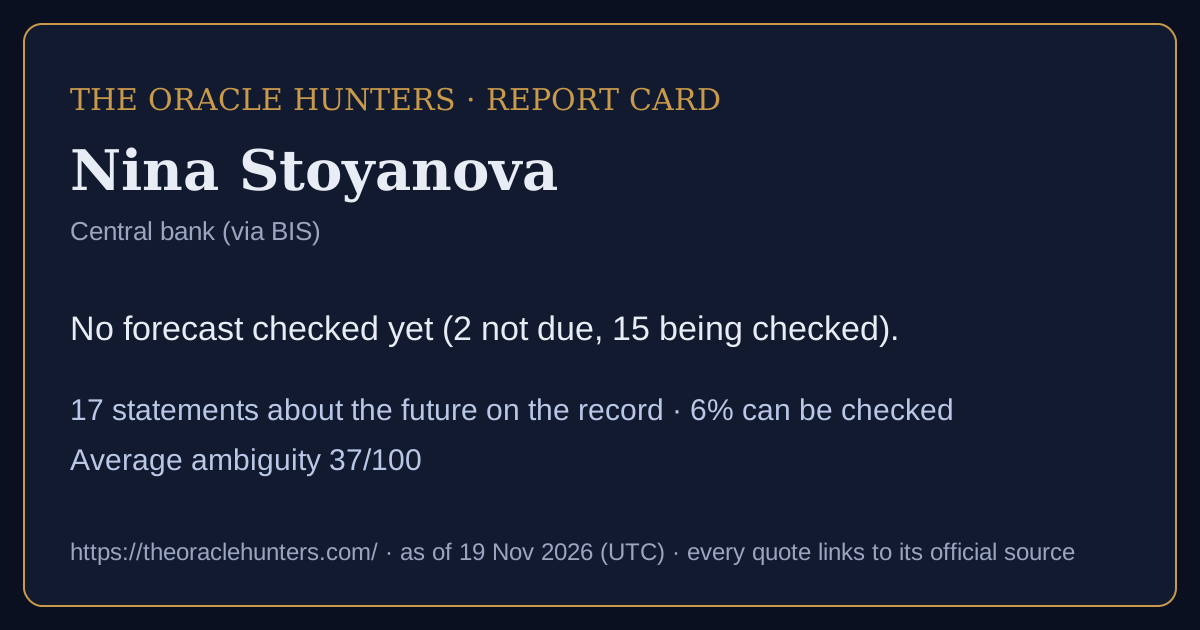
Nina Stoyanova
Central bank (via BIS)
Track record: No forecast checked yet (2 not due, 15 being checked).
17forecasts & commitments on the record
6%can be checked as stated
37average ambiguity (0-100)
0goalpost moves recorded
0confirmed U-turns
Timeline
came true partly did not not due / being checked / too vague
Calibration score: shown after 10 checked forecasts with a stated likelihood (now 0).
How they speak about the future: based on data 15, stated on authority 2.
Kinds of claim: forecast 15, mixed claim 1, commitment 1. · Download this report card as a picture
In the nine words
πρόγνωσιςInference from evidence15 · 88%προαναγγελίαPublic pre-announcement1 · 6%μαντείαInspired knowledge1 · 6%
How to read this
Each box is one sentence a public figure or institution said about the future, word for word, with a link to the official text. Can be checked means it names what will happen, by when, and how likely - so it can be compared with official figures later. Too vague to check means it does not. Ambiguity (0-100) is how many different ways the sentence can be read. When the date passes, the forecast is compared with official data and marked came true, partly or did not come true. Labels judge the sentence, never the person. Full guide and glossary.On the record (17)
In the area of payment and settlement systems, all projects related to the euro area accession will be completed by the end of 2023.
In the area of statistics, by the end of 2023 the BNB is going to bring to completion its work on joining the AnaCredit register and the Register of Institutions and Affiliates Data (RIAD) of the European System of Central Banks (ESCB).
The Bulgarian depositories are expected to join T2S, together with a few other securities depositories from the European Union (EU), within this year's migration window planned in line with the system's schedule for the middle of September 2023.
The successful cooperation between the BNB, BORICA AD and the banks in our country is expected to yield results by the end of 2023 with the implementation of another important project - to connect the BISERA7-EUR payment system operated by BORICA AD to TIPS.
The project for full SEPA reachability of credit transfers executed in euro is expected to be completed by the end of 2023.
The implementation of batch credit transfers in the public sector is planned to begin in the second half of 2023, which will lead to much faster processing and availability of transferred funds that will be received within a few minutes to an hour.
Instant payments, which are in a process of introduction also in Bulgaria, open banking, and the increasing use of mobile technologies are topical issues both in the country and in the European Union, issues that we will continue to talk about.
- Assess the need for mandatory adherence to the SEPA Instant Credit Transfer scheme in euro (SCT Inst.) by the end of 2021 and determining the criteria according to which payment service providers will be subject by this obligation;
Regulation of the concept of the so-called 'open finances'- access to financial and non-financial institutions to a broad range of financial information regarding the customers with the latter's consent with a view the provision of innovative services is expected to be proposed by mid-2022 building on the experience gained in the implementation of 'open banking';
The contraction of economic activity due to the pandemic crisis is expected to affect traffic through the RINGS and TARGET2-BNB systems, which reported a decline in the total number of processed payments for the second quarter of 2020 compared to the same period in 2019, respectively by 17 % for RINGS and 28% for TARGET2-BNB.
The service provides the possibility of settlement in other currencies and is expected to make immediate payments in Swedish kroons in 2022 in TIPS.
Both processes are expected to be completed by the end of 2020 within the deadlines for the European Union.
Although the pandemic has led to some delays in the implementation of migration plans, according to available data, we expect Bulgaria to successfully complete migration by the end of the year within the projected pan-European deadline.
Due to the expected significant number of applications for exemption from the contingency mechanism, a simplified procedure for consulting EBA is envisaged until the end of 2019.
Payment service providers will have to apply these requirements as of 19 April 2020.
We expect that these changes would be passed by the end of July this year.
This will allow by the end of next year financial institutions to freely select the place where they trade in government securities issued in Bulgaria, in compliance with the requirements under Regulation 2015/61 concerning the assessment of liquid assets in the form of government securities.
Also said - not checkable as stated (12 newest)
Remarks about the future with no date, figure or likelihood that could be checked. They are kept on the record and shown here, but not scored.
All payment service providers that have joined the SEPA Instant Credit Transfer scheme (SCT Inst.) and are reachable in TARGET 2, should be reachable either as a participant or as an reachable party (i.e., through another payment service provider that is a participant) and in the TARGET 2 instant payment service TIPS by the end of 2021;
- -In addition to the review of PSD2, a review will also be carried out of the Settlement Finality Directive 4 , and assessment will be made if payment institutions and electronic money institutions should be eligible for direct participation in designated payments systems, subject to certain conditions and risk mitigating measures.
Instant credit transfers are the basis on which pan-European payment solutions are expected to be built.
The ambition is to complete the full introduction of instant payments in the European Union by the end of 2021.
One of the important aspects in it should be the forthcoming revision of the Payment Services Directive (PSD 2) in 2021.
In 2020, we witnessed the unprecedented pandemic caused by COVID-19, the imposition of measures to prevent its spread, which led to an economic downturn, as well as to many difficulties facing business and the people we have to deal with on a daily basis.
However, the delayed application of security requirements for online card transactions should not adversely affect customers.
In addition, in cases pursuant to Article 17 of Regulation (EU) 2018/389 regarding corporate payment processes and protocols, a payment service provider will have to submit to the BNB an audit report performed by auditors with expertise in IT security and payments.
Where an account servicing payment service provider chooses to use a dedicated interface allowing access (API), it should provide a fallback mechanism that will allow the providers of the new types of services to use the customer interface of the relevant account servicing payment service provider in case of problems with the dedicated interface.
Where a payment service provider wishes to benefit from any of the exemptions, it will have to notify BNB in advance, indicating the particular payment service to be exempted.
In the interest of clarity regarding interpretation of the conditions for exemption, the European Banking Authority (EBA) has adopted Guidelines on the conditions to benefit from an exemption from the contingency mechanism under Article 33 (6) of Commission Delegated Regulation (EU) 2018/389, which the BNB will follow.
- Secondly, Regulation 260/2012 establishing technical and business requirements for credit transfers and direct debits in euro is going to become applicable to us.