Nils Bernstein
National Bank of Denmark
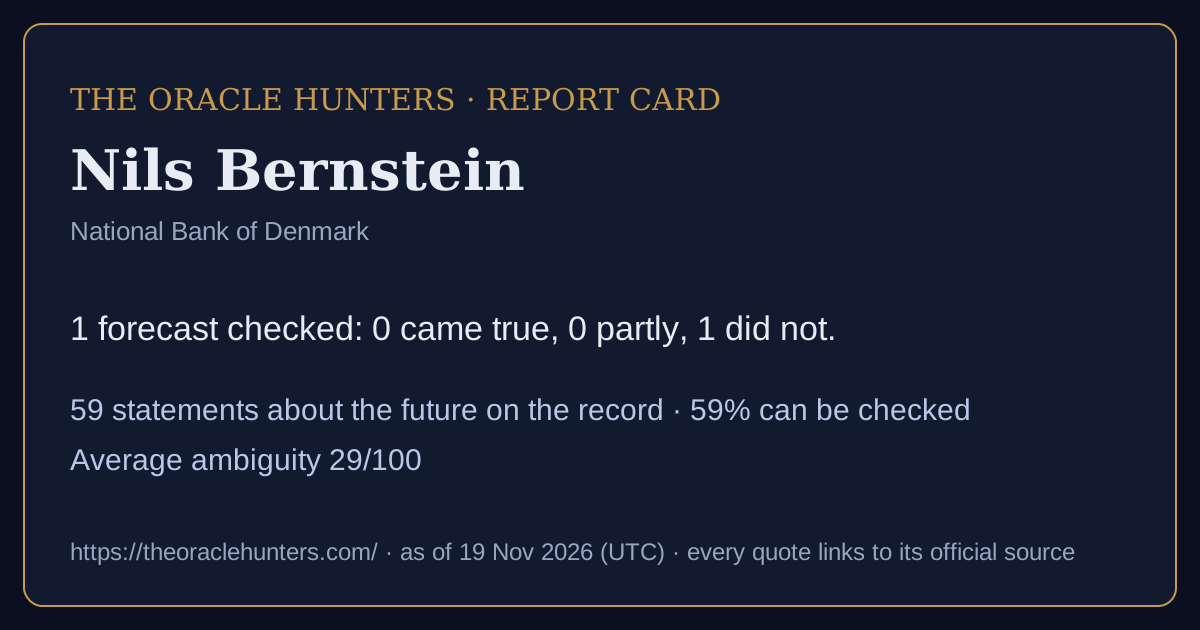
Track record: 1 forecast checked: 0 came true, 0 partly, 1 did not.
59forecasts & commitments on the record
59%can be checked as stated
29average ambiguity (0-100)
0goalpost moves recorded
0confirmed U-turns
Timeline
came true partly did not not due / being checked / too vague
Calibration score: shown after 10 checked forecasts with a stated likelihood (now 1).
How they speak about the future: based on data 46, stated on authority 7, educated guess 6.
Kinds of claim: forecast 46, mixed claim 9, scenario (if… then) 4. · Download this report card as a picture
In the nine words
πρόγνωσιςInference from evidence46 · 78%μαντείαInspired knowledge7 · 12%πρόνοιαPreparing for the future4 · 7%εἰκασίαConjecture2 · 3%
How to read this
Each box is one sentence a public figure or institution said about the future, word for word, with a link to the official text. Can be checked means it names what will happen, by when, and how likely - so it can be compared with official figures later. Too vague to check means it does not. Ambiguity (0-100) is how many different ways the sentence can be read. When the date passes, the forecast is compared with official data and marked came true, partly or did not come true. Labels judge the sentence, never the person. Full guide and glossary.Checked
Our most recent forecast operates with output growth of just over 1 per cent this year.
Did not come true. Said: economic growth above 1% in 2012. Official figure for Denmark: -0.0% (World Bank open data). Missed. Off by 1.0 points. official data · checked 14 Nov 2026 · automatic check against official data (rules v3)
On the record (59)
We estimate that the economy will grow by 1-1½ per cent next year compared with this year.
When the new Budget Act with a tougher sanction regime comes into force, starting with the budgets for 2014 to 2017, there is a greater chance that this will also be the case in future.
The international organisations all predict that the world economy will pick up only gradually in 2013, and growth estimates have generally been adjusted downwards, particularly for the euro area.
This year the government deficit is expected to be just over 4 per cent of GDP.
But this year consumption growth will be considerably lower, presumably below 1/4 per cent.
The committee on systemically important financial institutions will be presenting its final report at the end of the year.
It now looks as if global growth this year and next year will be lower than expected in the spring.
Our most recent forecast operates with output growth of just over 1 per cent this year.
Did not come true. Said: economic growth above 1% in 2012. Official figure for Denmark: -0.0% (World Bank open data). Missed. Off by 1.0 points. official data · checked 14 Nov 2026 · automatic check against official data (rules v3)
Until now, the main focus area - besides observing the 3-per-cent requirement for the actual budget balance - has been to ensure continuous annual improvement of the structural balance by at least 0.5 per cent of GDP for member states not observing the medium-term objective of balance or surplus.
With respect to financial resources for the short term crisis fighting, the ceiling of the EFSF/ESM will be reassessed in March 2012 and the financial resources to the IMF will be increased substantially through bilateral loans.
This situation is likely to continue well into 2012, and we do not expect growth in Denmark to pick up in earnest before 2013.
To the extent that higher market interest rates in the euro area lead to pressure on the krone, Danmarks Nationalbank will follow its usual practice, including raising interest rates if necessary.
In the euro area, inflation stood at 2.7 per cent in March, which is considerably above the medium-term target of just below 2 per cent.
Danmarks Nationalbank expects growth in 2011 to be just below 2 per cent, which is actually above the EU average.
Potential growth is the determining factor for how difficult it will be to achieve the 2020 plan's target of reducing public consumption as a ratio of cyclically adjusted GDP from 29 to 27 per cent.
Even if all the proposals in the 2020 plan were to be adopted, we will be facing a lengthy period of sustained government deficits after 2020.
If interest rates suddenly begin to rise unexpectedly, pressing house prices down, our proposal means that the property value tax automatically decreases, and this will dampen the price fall.
This debt-financing mechanism is to be established for euro area member states from mid-2013 and will replace the temporary financing mechanism for euro area member states in sovereign debt difficulties.
Danmarks Nationalbank eagerly awaits the forthcoming plan that will chart Denmark's economic policy course until 2020.
If we in Denmark are to avoid government debt growing to unmanageable proportions in the long term, we will need to increase taxes, adding to the already heavy tax burden, and put a much tighter rein on public spending than ever before.
The economic recovery plan deals with the period until 2015, but after that adverse demographics will increase the government deficit for many years - unless action is taken.
As a result, the Commission has ordered or will order these member states to reduce their deficits to below 3 per cent of GDP within a short span of years.
If we want quicker action, we have to accept that the basis for the action will not be 100 per cent certain.
We will probably have to wait until 2013 to see Danish output return to the level observed immediately before the crisis.
The IMF expects the government debt of the old OECD countries taken as one to reach 110 per cent of GDP by 2014.
If the low growth continues in the euro area in the coming period, the normalisation of interest rates will be postponed.
And most EU member states are expected to run budget deficits exceeding 3 per cent of GDP this year.
It will be replaced by an increased deposit guarantee of kr. 750,000, and until the end of next year its will be possible to subscribe to guarantees for individual loans applying until the end of 2013.
Most forecasts show that the recovery will be slow, and in our assessment we will not be back at the 2007 output level until some time in 2013 at the earliest.
In addition, the banks' contribution to the financing of the government guarantee under Bank Rescue Package I will amount to kr. 35 billion.
According to the latest estimate, unemployment will not peak until early 2011 at around 190,000 persons.
This year, we expect output to decline even more strongly than last year, but slightly less than in the rest of the EU.
Later this year, the legislation on covered bonds - or SDOs, as we call them in Danish - will be reviewed on the basis of the experience gained.
For those who do not lose their jobs, real disposable incomes will grow considerably in the current and coming year thanks to sizeable wage increases and tax cuts in 2009 and, particularly, in 2010.
Next year, a deficit of the same magnitude is expected.
We do not believe that unemployment will peak until early 2011.
Global output is now expected to decline by more than ½ per cent this year.
This development will accelerate in 2009, and by year-end housing costs as a ratio of disposable income is estimated to be some 3-6 per cent lower than in 2008.
If nothing else is done, the banks will go on the defensive and cut their activities, thereby reducing the balance-sheet total to meet the capital requirements.
Most forecasters believe that the global economy will turn sometime during 2009.
We expect zero growth and rising unemployment next year, but nevertheless, it is important to remember that Denmark goes into recession from a situation with low unemployment, extensive labour shortages and relatively high wage increases.
Actually, next year most households will see a sizeable increase in their real disposable incomes due to sustained high wage increases and lower taxes.
For the first time since World War II, there are widespread concerns that the industrialised world will see a fall in output next year.
In Denmark's case we may have to wait until 2010.
However, unemployment will not reach a level that is compatible with sustainable long-term development in wages until 2010.
It looks as if Europe will avoid actual recession, but must be prepared for modest growth rates of between 1 and 2 per cent in the coming years.
Until now, the international organisations have reduced their growth forecasts only moderately - except in respect of the USA, where growth in 2008 is now predicted to be less than 2 per cent - but no recession is foreseen.
At the same time, the government surplus was around 4 per cent of GDP in 2006 and will presumably also be among the highest in the industrialised world this year.
At the beginning of 2008 the ECB is expected to take the final decision on whether to develop the system.
The new legislation on SDOs also comprises a tightening of mortgage-credit legislation, required by EU-legislation, namely that throughout the duration of the loan no mortgage loan may have a value that exceeds 80 per cent of the value of the home that is mortgaged.
Showing the newest 50 - the ledger has all 59.
Also said - not checkable as stated (12 newest)
Remarks about the future with no date, figure or likelihood that could be checked. They are kept on the record and shown here, but not scored.
Under Bank Rescue Package 3, not only shareholders, but also unsecured and subordinated creditors could lose their money if a bank failed.
I will not go into detail, but merely note that we now have a mechanism for handling distressed banks which works and which ensures, that taxpayers will not ultimately pay for a distressed bank.
Denmark was among the first countries to introduce a bank resolution scheme under which those who had lent money to the distressed bank could also lose their investment.
But it is still uncertain to which extent they may be included in the liquidity reserves of the banks in future.
In general, lack of collateral is not a problem in Denmark, but naturally it may be so for a few banks, especially those under pressure.
It has been a general principle in Denmark throughout the financial crisis that the banking sector itself should fund the process of 'tidying up' the sector.
The estimate of next year's deficit is subject to much uncertainty due to the new rules on taxation of capital pensions.
On the other hand, it should also be emphasised that consolidation is underway, especially in many European economies, and medium-term strategies to ensure fiscal sustainability are in place.
So in many cases young families who already have limited liquidity at their disposal will have to start repaying their loans when the current period of deferred amortisation expires.
Growth in the world economy was weaker than expected in the 1st half of 2012 and declined further over the summer.
Presumably the situation in the housing market will have to improve first.
For example, they must have extra capital, the option to convert loan capital into subordinate capital as well as recovery plans, and they may be subject to additional supervision.