Niklaus Blattner
Swiss National Bank
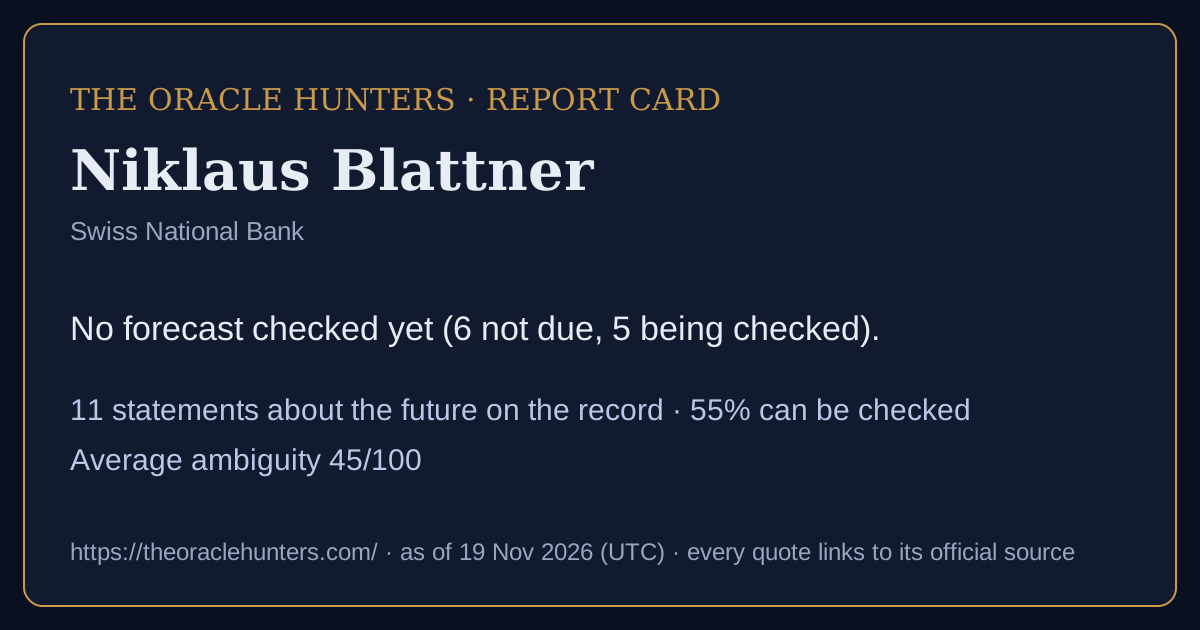
Track record: No forecast checked yet (6 not due, 5 being checked).
11forecasts & commitments on the record
55%can be checked as stated
45average ambiguity (0-100)
0goalpost moves recorded
0confirmed U-turns
Timeline
came true partly did not not due / being checked / too vague
Calibration score: shown after 10 checked forecasts with a stated likelihood (now 0).
How they speak about the future: based on data 7, educated guess 2, stated on authority 2.
Kinds of claim: forecast 9, scenario (if… then) 2. · Download this report card as a picture
In the nine words
πρόγνωσιςInference from evidence7 · 64%πρόνοιαPreparing for the future2 · 18%μαντείαInspired knowledge2 · 18%
How to read this
Each box is one sentence a public figure or institution said about the future, word for word, with a link to the official text. Can be checked means it names what will happen, by when, and how likely - so it can be compared with official figures later. Too vague to check means it does not. Ambiguity (0-100) is how many different ways the sentence can be read. When the date passes, the forecast is compared with official data and marked came true, partly or did not come true. Labels judge the sentence, never the person. Full guide and glossary.On the record (11)
The consequences for the macroeconomic outlook are clear: if labour productivity and/or labour input fail to improve, the impending demographic development will lead to slower medium and long-term growth.
The Swiss National Bank expects Switzerland's GDP to expand by just over 2% this year.
The final report of the working group will be completed in the second half of 2005.
The Federal Department of Finance will prepare a statement by the end of next year and submit it to the Federal Council.
The classification will be finalised at the beginning of next year.
The revised law will presumably enter into force in May 2004.
Price stability is considered to have been achieved if inflation, measured by the national consumer price index, is below 2% in the medium term.
If implemented in a determined manner, structural reforms will contribute to expanding the euro area's potential for non-inflationary growth and to reducing its high level of unemployment.
Turning to price developments, Eurostat's flash estimate indicates that annual HICP inflation fell from 2.0% in May to 1.7% in June.
As regards the analysis under the first pillar of our monetary policy strategy, the three-month average of the annual growth rates of M3 increased to 7.5% in the period from March to May 2002, from 7.4% in the period from February to April.
Moreover, it is to be expected that overall HICP inflation rates will fluctuate around 2% in the coming months.
Also said - not checkable as stated (12 newest)
Remarks about the future with no date, figure or likelihood that could be checked. They are kept on the record and shown here, but not scored.
In future, Switzerland will have to produce more with fewer resources.
Without a careful analysis of the long-term developments in the real economy, any monetary policy assessment, and consequently any inflation forecast, will be inadequate.
Third, the economically active population could be strengthened by increasing the number of qualified immigrants.
At the same time, Switzerland's employment quota could be lifted if more women now living in Switzerland entered the workforce.
National infrastructures may, for example, set up mutual links to facilitate trade, i.e. the settlement of cross-border transactions.
On the one hand, it is obvious that the adjustment of the financial market infrastructures to the special features of global financial markets may contribute to reducing risks related to the settlement of cross-border transactions.
Otherwise, financial stability will be jeopardised.
Those infrastructure operators that are organised as profit-oriented public companies, in particular, are likely to further intensify competition with the banks in the future.
In addition, there are various potential conflicts, for example between the objective of exploiting economies of scale as much as possible - which might only be possible through cross-border cooperation - and the objective of maintaining independence.
They have pursued this strategy so far, and will need to continue doing so in the future.
Yet a competitive environment will develop only if market participants can choose freely among the different providers and if the infrastructures are interoperable, i.e. if the providers grant each other and their participants mutual non-discriminatory access.
The EU's new Markets in Financial Instruments Directive (MiFID), for example, is expected to bring about important changes and intensify competition in the European financial market.