Nick Harvey
Ministry of Defence · GBR
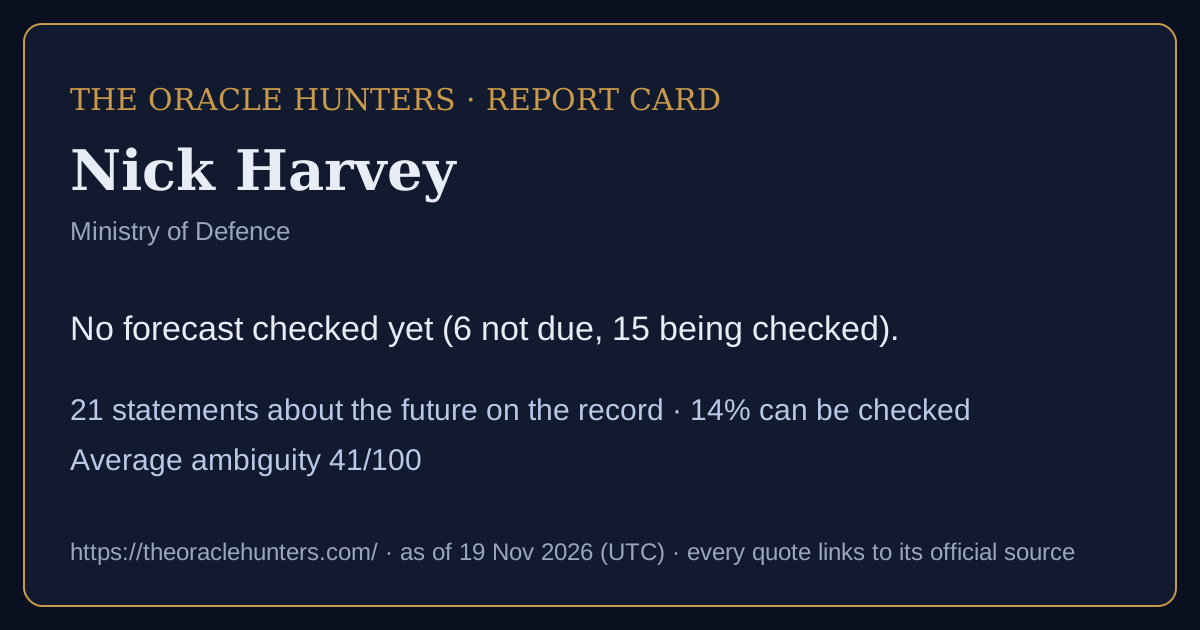
Track record: No forecast checked yet (6 not due, 15 being checked).
21forecasts & commitments on the record
14%can be checked as stated
41average ambiguity (0-100)
0goalpost moves recorded
0confirmed U-turns
Timeline
came true partly did not not due / being checked / too vague
Calibration score: shown after 10 checked forecasts with a stated likelihood (now 0).
How they speak about the future: based on data 17, stated on authority 3, educated guess 1.
Kinds of claim: forecast 15, mixed claim 5, scenario (if… then) 1. · Download this report card as a picture
In the nine words
πρόγνωσιςInference from evidence17 · 81%μαντείαInspired knowledge3 · 14%πρόνοιαPreparing for the future1 · 5%
How to read this
Each box is one sentence a public figure or institution said about the future, word for word, with a link to the official text. Can be checked means it names what will happen, by when, and how likely - so it can be compared with official figures later. Too vague to check means it does not. Ambiguity (0-100) is how many different ways the sentence can be read. When the date passes, the forecast is compared with official data and marked came true, partly or did not come true. Labels judge the sentence, never the person. Full guide and glossary.On the record (21)
In terms of our will to ensure that this does not happen, I will paraphrase the Defence Secretary’s statement of 5 January this year :
Second, during the past decade, in very close cooperation with the US and Canada, the UK led a £90 million international programme of assistance to Russia with its chemical weapon destruction programme, managing projects at the Shchuch’ye destruction facility on behalf of 12 other donors.
Let’s not forget that we are still spending considerable sums on defence, over £150 billion over the next decade on defence equipment and support alone.
As we approach the next general election, and in preparation for the next defence review in 2015, the approach the political parties take to the defence budget will be a measure of how committed they are to realising Future Force 2020.
The UK will be hosting a confidential expert-level meeting of the P5 early next year, this will be the first time that the P5 have met to focus on verification.
On current plans, the subsequent reduction in our total stockpile of nuclear warheads to no more than 180 will be completed by the mid 2020’s.
This programme has commenced and we expect completion across the fleet by 2015.
A survey completed earlier this year by the UK company Detica was probably the most thorough ever conducted in the UK: it put the figure at £27 billion which seems plausible.
The international cyber conference which the Foreign Secretary announced the UK will host later this year will be an important first step in beginning the process of establishing principles that all nations should adhere to in cyberspace.
So I am delighted to announce that the City of Plymouth will host the fourth Armed Forces Day national event on Saturday 30 June 2012!
If the UK-France partnership can provide a roadmap for others to strengthen their capability by working with each other in similar ways it will be to the benefit of both NATO and the EU.
And we have moved quickly on this work - the facilities will be operational by 2015, with the first UK experiment time-tabled for 2017.
But we will need to embed cultural and behavioural change in the defence and security apparatus of both countries, because reticence, and dare I say suspicion, still sometimes remains.
We have made it clear that there will not be British troops in a combat role or in the numbers they are now in Afghanistan by 2015 and depending on progress we may be able to start reducing our footprint earlier as we transition to more of a support role.
Ladies and Gentlemen, this year will be special for the Royal United Services Institute as it celebrates the 180th anniversary of its establishment by the Duke of Wellington.
As we approach the next General Election, and as we prepare for the next Defence Review in 2015, the key debate will be around how we meet the financial challenges of Future Force 2020 and the vision of a Britain active on the world stage and protected at home.
As David Cameron and Nick Clegg have both made clear recently - this year will be a difficult year - as the tough decisions we have taken in the Budget and the Comprehensive Spending Review become a reality.
The summit set out that transition of lead responsibility for security from international to Afghan forces will begin in early 2011, with the objective of Afghans leading on security operations in all provinces by the end of 2014.
Britain is clear that we will no longer have troops in a combat role by 2015, but we foresee an enduring role in the country as part of a wide relationship.
But the outcome means that we will maintain our position as a leading military power, with the 4th largest defence budget in the world and our Defence spending will remain above NATO’s minimum of 2% of GDP.
Let me make absolutely clear to him that throughout the spending period that we have outlined today, we will remain above NATO’s 2% figure without resorting to the sort of things that NATO includes in its figure, such as military pensions.
Also said - not checkable as stated (12 newest)
Remarks about the future with no date, figure or likelihood that could be checked. They are kept on the record and shown here, but not scored.
So, to conclude, I believe the answer to the question posed by this conference, do politicians have the will and legitimacy to act in defence of the shipping industry, has to be yes.
We will seek to provide this key leadership position and for as long as the coalition mission is needed.
This dependency will increase in the years to come as the UK becomes more reliant on imported energy.
So the UK is committed to the security of this region and will maintain a naval presence in the long term.
It is agile and flexible, able to fight, deter, contain, project power, stabilise, reassure, and deliver training to our friends and allies without any need to reconfigure.
And even when chemical weapon destruction is complete, the OPCW and the convention will have to continue to adapt to new threats, challenges and priorities, to prevent the re-emergence of chemical weapons any time in the future.
We will have to respond to developments in science and technology, and maintain the effectiveness of industry verification.
I can assure you that the UK will continue to engage actively and constructively on all these issues.
We must continue to share information, experience and expertise, so that we can complete the job.
I am convinced, that in this era of great volatility, in this era of interconnectedness, in this era of economic exposure, Britain will continue to need all the benefits, all the influence and all the security that accrue from being a maritime power of significance.
Only with healthy public coffers can we hope to sustain, in the long term, the investment required for the high tech, well equipped military forces we know we will need in the future.
From an operational point of view, maritime power is essential in a world where we have to project power to protect our national security.