Nick Clegg
Cabinet Office · GBR
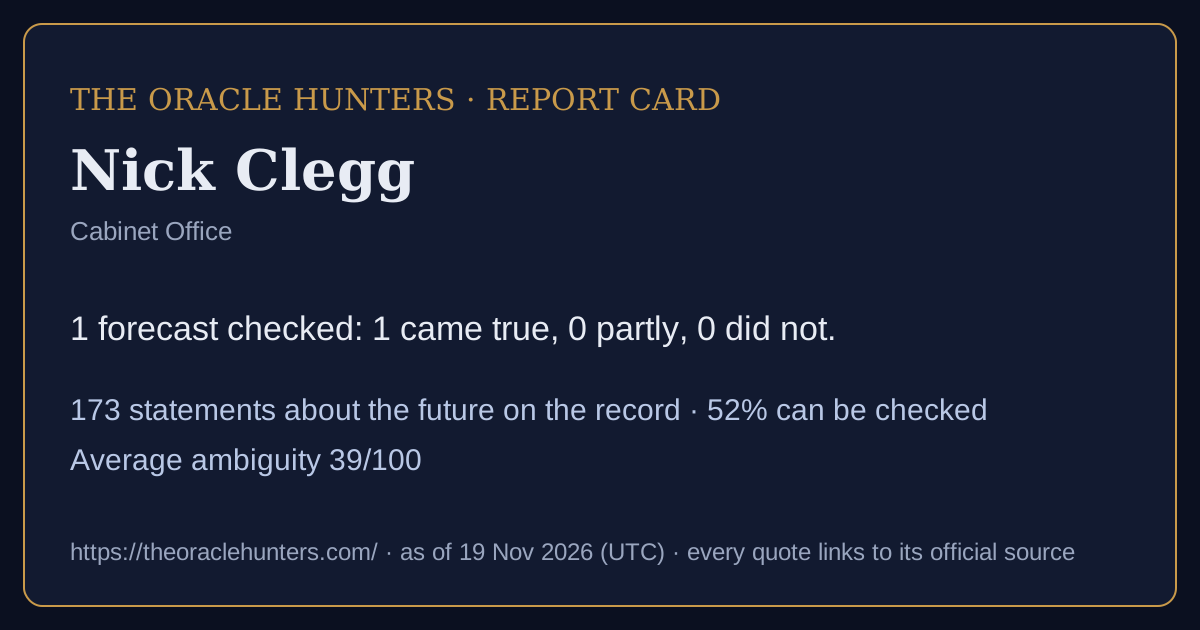
Track record: 1 forecast checked: 1 came true, 0 partly, 0 did not.
173forecasts & commitments on the record
52%can be checked as stated
39average ambiguity (0-100)
0goalpost moves recorded
0confirmed U-turns
Timeline
came true partly did not not due / being checked / too vague
Calibration score: shown after 10 checked forecasts with a stated likelihood (now 1).
How they speak about the future: based on data 132, stated on authority 37, educated guess 4.
Kinds of claim: forecast 115, mixed claim 34, commitment 19, scenario (if… then) 5. · Download this report card as a picture
In the nine words
πρόγνωσιςInference from evidence123 · 71%μαντείαInspired knowledge24 · 14%προαναγγελίαPublic pre-announcement19 · 11%πρόνοιαPreparing for the future5 · 3%εἰκασίαConjecture2 · 1%
How to read this
Each box is one sentence a public figure or institution said about the future, word for word, with a link to the official text. Can be checked means it names what will happen, by when, and how likely - so it can be compared with official figures later. Too vague to check means it does not. Ambiguity (0-100) is how many different ways the sentence can be read. When the date passes, the forecast is compared with official data and marked came true, partly or did not come true. Labels judge the sentence, never the person. Full guide and glossary.Checked
We’re relieved when we hear that the economy is expected to grow this year by 1.4%.
Came true. Said: economic growth around 1.4% in 2013. Official figure for United Kingdom: 1.7% (World Bank open data). On target. Off by 0.3 points. official data · checked 14 Nov 2026 · automatic check against official data (rules v3)
On the record (173)
So, from April this year, many patients experiencing psychosis for the first time, will start treatment within 2 weeks of referral – the same waiting time for consultations for cancer diagnosis.
And the evidence shows that treating psychosis rapidly not only dramatically improves someone’s chances of recovery, it could also save the NHS £44 million a year in reduced hospital admissions.
The support is here, the expertise is here and we are committed to backing you all the way: creating new jobs, boosting trade and driving growth in the UK and across South Asia for decades to come.
We’ve also extended a new £1 billion line of credit for businesses looking to invest in Indian infrastructure projects.
So, I’m pleased to confirm that, from April 2015, the civil service will be offering equal parental pay and support to all its employees – male and female.
In the New Year, a panel led by teachers and educators will scrutinise the best ideas, then work with Ofsted, the teaching unions and other leading education stakeholders to put them into action starting early next year.
This includes supporting over £790 million worth of infrastructure projects such as improvements to the City Centre, boosting transport links and building new housing, as well as creating a new £130 million Skills Bank.
As the risk of floods and other extreme weather events increases, the coalition government is investing record levels of resources – £3.2 billion over the course of this Parliament – to strengthen our flood defences and protect against the erosion of our coastline.
It hasn’t been easy, but I’m pleased to announce today that the government will be putting the funding in place to ensure the path is completed by 2020.
So, I’m pleased to announce today that British shoe company Pavers will be investing £10million in India: increasing the number of its Indian stores from 35 to 100 and creating new jobs both here and in the UK.
Challenging the myth that FGM is a religious or cultural necessity is key to us ending this practice and, earlier this year, Norman and Lynne met with faith leaders from across the UK to discuss what more we could do together to secure change.
In total, we’ve committed up to £2.9 billion to over 400 projects, with £280 million to support businesses in the Yorkshire and Humber area – creating and safeguarding around 63,000 jobs.
The Local Growth Fund will be worth £2 billion every year for the next 6 years, boosting growth across every regional economy in the UK.
These will extend the powers that we’ve already given to local leaders, with access to a £12 billion pot of funding to help them create jobs, meet the growing demand for new homes in their area and get projects essential to the competitiveness of their local economy moving.
Economically, it’s estimated that the race could generate an extra £100 million for the UK’s economy in the years to come and our more immediate target is to create at least £20 million in new trade and investment opportunities across the country.
On Monday, building on the success of our City Deals, we will be announcing the first in a series of new Growth Deals.
Think of the opportunities for local jobs and growth, if – together – we could increase that figure.
Our economy is growing again – with Britain forecast to grow faster than any other G7 economy this year.
This investment will bring production of the new Discovery vehicle to Halewood in 2015, creating 250 jobs.
By 2017, UK industry predicts that Britain will be producing 2 million cars a year, beating our all-time peak of 1.92 million in 1972.
By 2020, it’s estimated that there will be around £40 billion worth of renewable electricity projects in the UK.
This includes the partial conversion of the Drax Coal Power Station to biomass fuels – which when completed will provide around 10% of the UK’s 2020 renewable electricity target.
For example, in 2011, working with the Gates Foundation, we were able to leverage extra funds that will enable GAVI to vaccinate nearly 250 million children, saving around 4 million lives by 2015.
That impacts on all of us, with estimates showing that the UK could boost its GDP by up to £23 billion if we use the skills of our female workforce more effectively.
Well between 2011 and 2012, the low carbon and renewable sector grew by around 3% and it’s expected to keep on growing.
A robust EU target will be absolutely crucial for getting a good global deal at the Paris Summit in 2015.
Its first few projects alone will support a reduction in greenhouse gas emissions equivalent to taking over 1 million cars off our roads.
The benefits in terms of our greenhouse gas emissions could, potentially, be very significant – around a fifth come from our roads, which is why the Coalition has said that we want all new cars and vans purchased here to be effectively zero emission by 2040.
We’re relieved when we hear that the economy is expected to grow this year by 1.4%.
Came true. Said: economic growth around 1.4% in 2013. Official figure for United Kingdom: 1.7% (World Bank open data). On target. Off by 0.3 points. official data · checked 14 Nov 2026 · automatic check against official data (rules v3)
The Coalition will need to spend the next 18 months locking in the recovery, and whoever is in government after 2015 will need to continue with that task.
And next May the Euro-elections are bound to become a proxy for the bigger question of ‘in versus out’ – a debate that will play out in the 2015 general election too.
On Monday we announced that we will provide 1.6 billion dollars to the Global Fund to fight AIDS, TB and Malaria.
Tunisia is also focused on building a new democracy and economic growth, with progress towards a new constitution, and further elections expected in 2014.
The UK will continue to cut emissions, as well as giving over 6 billion dollars to assist developing countries to do the same and adapt to environmental changes.
In energy, our £3.8 billion UK Green Investment Bank, headquartered here in Scotland, is helping to boost private sector investment in green energy projects.
And ahead of the official launch of our new £1 billion UK Business Bank, we are already accepting proposals for the project’s first investment round.
But our latest research shows that the long-term effect of a new border between our two countries - with all of the new rules, regulations and systems it will require - will reduce Scotland’s GDP by 4%, equivalent to £5 billion in 2012, over the next 30 years.
The Core Cities Group estimates this investment will create around 400,000 new jobs, 70% of which will be based outside of London.
This time next year, the people of Scotland will be gearing up for one of the most important collective decisions you will ever take together.
Now I’m not saying that all of this trade will be lost, if Scotland votes Yes in 2014.
This means that from 2015, if your family doesn’t receive support through tax credits or Universal Credit, but both parents are working, or you’re a lone working parent, the government will provide 20% of your childcare costs up to a cost of £6,000, per child, per year.
But most importantly, we’ve been able to back up those commitments: recycling the savings we’re making day to day so we can guarantee £300 billion of capital spending by the end of the decade. £100 billion of this has already been allocated for infrastructure to support.
With access to £1 billion of government capital, the Business Bank will help boost the flow of credit moving around our economy further and ensure your businesses can access a greater, more diverse range of lending providers and products.
And from April next year, we will offer every business a £2,000 cut in their National Insurance bill.
The publication of Strike Prices for renewable technologies and other energy reforms announced by my Liberal Democrat colleagues Ed Davey and Danny Alexander will unlock up to £110 billion energy infrastructure investment and support 250,000 jobs by 2020.
It’s kick-starting important projects like the conversion of the Drax Coal Power Station to use bio-mass fuels, the energy impact of which, when completed, will equate to us taking 3 million cars off the road and contribute around 10% of the UK’s 2020 renewable electricity target.
For example, it’s going to take an estimated investment of £200 billion by 2020 for us to realise Britain’s low-carbon ambitions.
I’m proud that we will honour our commitment to spend 0.7% of this nation’s wealth helping the world’s poorest countries.
In 2020, a further third will come in under the new system, and then again in 2025.
In 2015 a third of members will be elected, or a combination of elected and appointed.
Showing the newest 50 - the ledger has all 173.
Also said - not checkable as stated (12 newest)
Remarks about the future with no date, figure or likelihood that could be checked. They are kept on the record and shown here, but not scored.
Every area of every CCG and mental health trust in the country will have to report on this.
Or developing diabetes but being too scared to tell your family, friends and your boss about what’s happening, because you’re worried about how they might react and possibly losing your job.
This brings together senior ministers from across government to tackle the complex issues that will never be solved by one department alone, like improving mental health services for young people, addressing welfare and employment issues and preventing more people with severe mental health problems from ending up in police cells and prisons.
This, alongside the introduction of waiting time standards, will end the longstanding financial discrimination which has existed in mental health – because the block grants used to pay Mental Health Trusts in the past, and the lack of maximum waiting times, made them particularly vulnerable to local cuts.
We will continue to fight day in, day out to ensure Britain remains the modern, diverse outward facing trading nation it’s always been - doing business with our European neighbours and the rest of the world.
Prime Minister Modi has made boosting investment, jobs and growth a priority for his government and, when I met with him in the summer, we discussed the critical role Britain could play in helping India realise its ambitions.
UK Trade and Investment stands ready to offer whatever support companies may need, with on-the-ground operations in India, Pakistan, Bangladesh and Sri Lanka.
I hope to see more of your names amongst the nominees and winners next year.
A lot of the themes will be echoed in the sessions we’re having later, whether it’s how we increase skills – the skills base in the north of England to make sure that our youngsters have got the right skills to occupy the right jobs, enhance investment into the north of England, create the sum of our parts, our great …
We have to ensure that all parts of the country can stand on their own two feet, and no longer rely simply on the tax revenues being generated in the City of London being transported northwards to provide what turns out to be an illusion of economic stability through subsidies to the north.
But there is light at the end of the tunnel: once the deficit is gone and public spending is growing, my party will be able to deliver a better financial deal for all those who work in our public services.
In the coming months, I want to see the scale and reach of these schemes – along with those you’re part of – grow right across our public services.