Nicholas Macpherson
HM Treasury · GBR
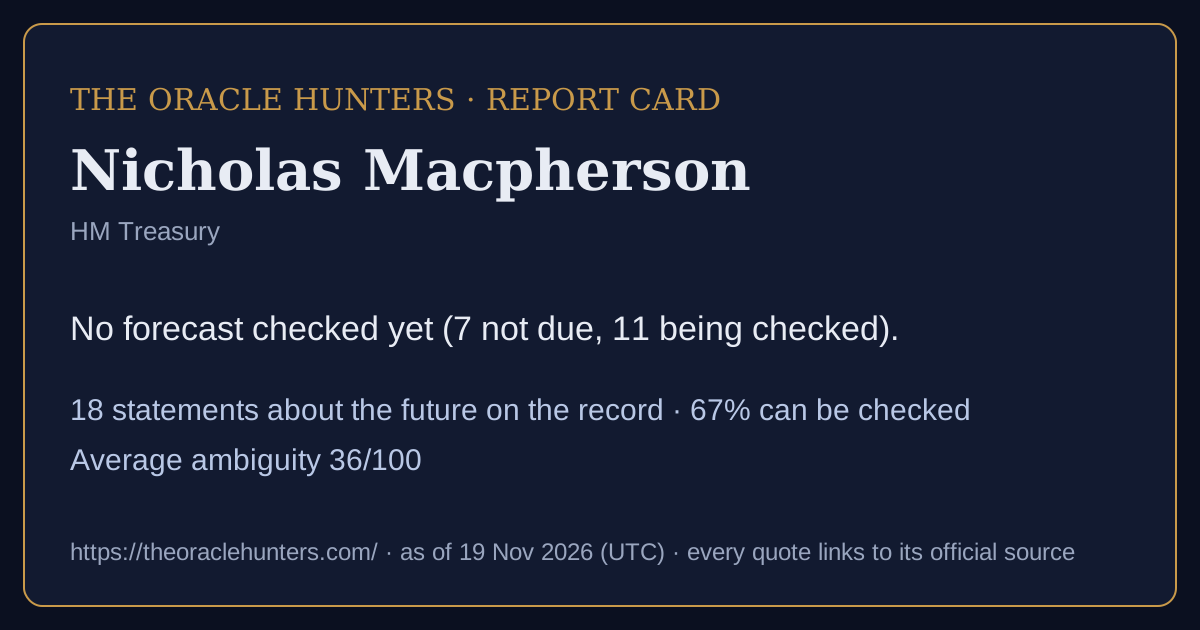
Track record: No forecast checked yet (7 not due, 11 being checked).
18forecasts & commitments on the record
67%can be checked as stated
36average ambiguity (0-100)
0goalpost moves recorded
0confirmed U-turns
Timeline
came true partly did not not due / being checked / too vague
Calibration score: shown after 10 checked forecasts with a stated likelihood (now 0).
How they speak about the future: based on data 14, stated on authority 2, educated guess 2.
Kinds of claim: forecast 14, mixed claim 3, scenario (if… then) 1. · Download this report card as a picture
In the nine words
πρόγνωσιςInference from evidence14 · 78%μαντείαInspired knowledge2 · 11%πρόνοιαPreparing for the future1 · 6%εἰκασίαConjecture1 · 6%
How to read this
Each box is one sentence a public figure or institution said about the future, word for word, with a link to the official text. Can be checked means it names what will happen, by when, and how likely - so it can be compared with official figures later. Too vague to check means it does not. Ambiguity (0-100) is how many different ways the sentence can be read. When the date passes, the forecast is compared with official data and marked came true, partly or did not come true. Labels judge the sentence, never the person. Full guide and glossary.On the record (18)
If the UK government chooses to increase income tax to fund an increase in health spending, the Barnett Formula means that the Scottish Government will automatically receive a population share of the increased funding.
As a result more than 50% of the Scottish Government’s budget will be directly financed by Scottish taxpayers.
The further tax devolution agreed by the Smith Commission means that it will retain around 40% of Scottish tax.
In the same year the UK is projected to have a deficit of a little over 2 per cent of GDP.
And so how an independent Scotland’s public finances would look relative to the rest of the UK in, say, 2016-17, the putative year of independence, was likely to be very different from 2012-13 – the last year for which detailed data were available.
The independent OBR forecasts them to fall below 1 per cent of GDP from 2035-36.
With growth now accelerating, we are likely to see more occasions where receipts surprise on the upside but, unless we discover the holy grail of locking in tax receipts for good, my guess is that we will be running hard to stand still for many years to come.
The OBR are forecasting borrowing of £122 billion this year.
And it will only be 2014-15 that net debt begins to fall as a share of national income.
Next month, it will publish its first detailed fiscal sustainability report.
Six days later the Chancellor delivered his first Budget, tightening policy by a further £40 billion: informed by an OBR Budget forecast that confirmed the Government had more than a fifty per cent chance of achieving its fiscal mandate of a cyclically adjusted current balance by 2015-16.
I expect staffing levels to be around 1000 in 2014, the smallest in my time at the Treasury (once machinery of government changes are taken into account).
And it will apply for other departments from next year.
On pensions: as with social security benefits, the uprating of public service pensions will, in future, be based on the Consumer Price Index, rather than, at present, the Retail Price Index - this will take effect from the uprating in April 2011.
In May, it announced £6 billion of spending reductions and efficiencies for this year;
The spending envelope announced in the Budget means 25 per cent reductions on average for unprotected departments, and some departments will need to go further than this.
The fact is national income - or GDP - is some 11 per cent lower this year than we expected at the time of the 2007 Spending Review.
In the five years to 1999 total spending as a share of GDP fell by 6.2 per cent, compared to the 7.5 per cent that it will need to fall between now and 2015/16.
Also said - not checkable as stated (12 newest)
Remarks about the future with no date, figure or likelihood that could be checked. They are kept on the record and shown here, but not scored.
Whether Keynes himself would have supported such an approach, had he lived, we will never know: the General Theory was focused on addressing persistent depression.
A “permanent” stimulus will lead consumers to conclude that it will have to be financed, neutralising its impact.
It also provided much though not all of the basis for what came to be known as “Keynesianism”: a view that government could not just manage demand but seek to smooth the operation of the trade cycle through fiscal policy.
Keynes’ case for public works in the 1930s rested on his view that nominal (and hence real) wages could not adjust not least because of the strength of the trades union movement.
In a democracy, it is difficult to see how fiscal policy could be contracted to an independent body.
Similarly, it’s in the nature of a banking crisis that government deficits are likely to rise, often sharply.
And just as the Treasury has played a leading role in setting out the implications of Scotland leaving the free trade area that is the United Kingdom, so would I expect it to play a critical role in setting out the economic implications of the options of staying in or leaving the EU, should there be a referendum on our …
With the benefit of hindsight a greater focus on credit might have prevented the build up of risk in the system before 2007: the creation of the Financial Policy Committee at the Bank of England with new macro-prudential tools should certainly make the macroeconomic framework more robust in future.
And the fewer the impediments there are to trade, the more the economy will grow and the greater the prosperity of the nation.
Of course, one of the lessons of the financial crisis is that price stability on its own will not deliver stability in output.
Capital markets may be more open than they used to be and so at the margin an increased public sector deficit may be less likely to crowd out private sector borrowing and investment.
it would not be fair to speak of the great increase in the expenditure of the country without considering the great extension of the means by which that increase is supported … We ought to have a clear knowledge of the proportion which our wealth bears to our expenditure, in order that we may be able to take a comprehensive …