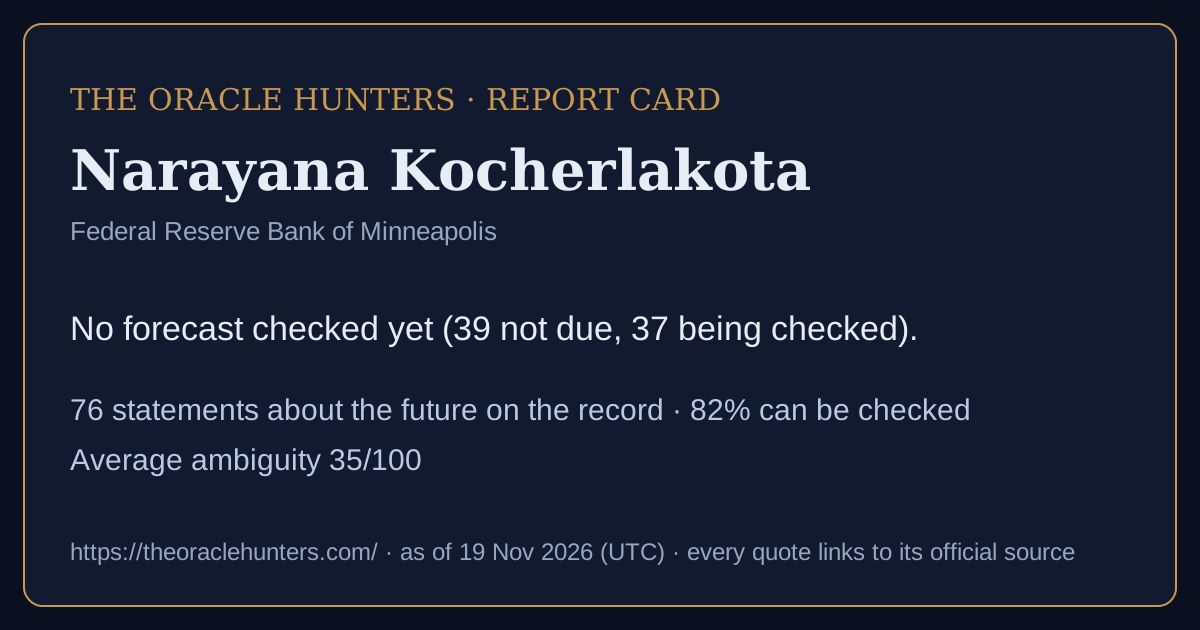
Narayana Kocherlakota
Federal Reserve Bank of Minneapolis
Track record: No forecast checked yet (39 not due, 37 being checked).
76forecasts & commitments on the record
82%can be checked as stated
35average ambiguity (0-100)
0goalpost moves recorded
0confirmed U-turns
Timeline
came true partly did not not due / being checked / too vague
Calibration score: shown after 10 checked forecasts with a stated likelihood (now 0).
How they speak about the future: based on data 72, educated guess 4.
Kinds of claim: forecast 58, mixed claim 12, scenario (if… then) 6. · Download this report card as a picture
In the nine words
πρόγνωσιςInference from evidence69 · 91%πρόνοιαPreparing for the future6 · 8%φρόνησιςPractical wisdom1 · 1%
How to read this
Each box is one sentence a public figure or institution said about the future, word for word, with a link to the official text. Can be checked means it names what will happen, by when, and how likely - so it can be compared with official figures later. Too vague to check means it does not. Ambiguity (0-100) is how many different ways the sentence can be read. When the date passes, the forecast is compared with official data and marked came true, partly or did not come true. Labels judge the sentence, never the person. Full guide and glossary.On the record (76)
For example, the Bank of Canada typically makes its monetary policy choices so that the inflation rate is projected to return to 2 percent within two years. 2 I say 'typically' - there are certainly situations in which the Bank of Canada chooses policy so that inflation is projected to return to target more slowly (sometimes taking as long as …
This lack of specificity suggests that appropriate monetary policy might engender inflation that is far from the 2 percent target for years at a time and thereby creates undue inflation (and related employment) uncertainty.
Inflation persistently below the 2 percent target could create doubts in households and businesses about whether the FOMC is truly aiming for 2 percent inflation, or some lower number.
Without symmetry, inflation might spend considerably more time below 2 percent than above 2 percent.
Indeed, my benchmark outlook is that PCE inflation will not rise back to 2 percent until 2018.
This sluggish inflation outlook implies that, at any FOMC meeting held during 2015, inflation would be expected to be below 2 percent over the following two years.
For example, the Bank of Canada typically makes its monetary policy choices so that the inflation rate is projected to return to 2 percent within two years.
And I expect it to remain below 2 percent until 2018.
If consolidation exceeds projected rates, that might suggest that new supervision and regulation has changed the dynamics of banking.
Our estimates suggest, for example, that the median reduction in return on assets for banks with less than $50 million in assets would be 14 basis points if they need to increase staff by half a person, and 45 basis points if by two employees. 1
In fact, the inflation rate has averaged 1.6 percent since the start of the recession six and a half years ago, and inflation is expected to remain low for some time.
And I expect this number to fall further through the course of this year, to around 5.7 percent.
In a similar vein, earlier this year, the Congressional Budget Office (CBO) predicted that inflation will not reach 2 percent until 2018 - more than 10 years after the beginning of the Great Recession.
There will be just 263 banks in Minnesota in 2024, a 23 percent decline from 341 currently, assuming that consolidation over the next 10 years continues the trend seen over the past 30.
But if the FOMC uses inflation targeting, the borrower's repayments are likely to remain surprisingly expensive in real terms even in 2042, 30 years after taking out the mortgage.
But there is an alternative: The FOMC could target a slightly higher inflation rate for a few years after 2018 in order to make up for the shortfall in the price level.
If the FOMC simply targets a 2 percent inflation rate after 2018, then the price level will be permanently 2.2 percent lower than was expected in 2012.
If my inflation forecast is right, the price level in 2018 will be about 2.2 percent below what it would have been had the FOMC hit its inflation target over the preceding six years.
I've described how I expect that the PCE inflation rate will run below the FOMC's 2 percent target for several years - possibly until 2018.
I have argued that, for some time to come, the FOMC will only be able to achieve its dual mandate outcomes if the time path of real interest rates is considerably lower than in 2007 as much as two full percentage points lower.
In remarks that I gave earlier this year, I described an analytical mean-variance framework that the Committee could use to answer this question. 5 Today, I'll simply sketch the elements of that framework.
In 2007, that household could have received a mortgage with a down payment of 10 percent of the purchase price, or even lower.
I expect it to remain below the FOMC's inflation target of 2 percent for several years.
If the FOMC simply targets a 2 percent inflation rate after 2018, then the price level will be permanently 2.5 percent lower than was expected in 2012.
Like the CBO, I anticipate that inflation will rise only slowly, returning to the FOMC's target in about 2018.
If my inflation forecast is right, the price level in 2018 will be about 2.5 percent below what it would have been had the FOMC hit its inflation target over the preceding six years.
Earlier this year, the Congressional Budget Office (CBO) predicted that inflation will not reach 2 percent until 2018.
Right now, personal consumption expenditure (PCE) inflation is running well below 2 percent and is expected to continue to do so for several years.
For example, the supply-constrained models typically imply that employment will rise if there is a temporary cut in the payroll tax rate paid by employers.
Real gross domestic product (GDP) almost doubled from 1939 to 1944. 4 The unemployment rate fell by 13 percentage points in three years, falling from nearly 15 percent in 1940 to under 2 percent by 1943. 5 Employment rose by 50 percent from 1939 to 1943. 6 Importantly, these reversals proved to be enduring: As of 1950, all three variables …
And I'm not the only one forecasting a slow return to 2 percent inflation.
Personally, I expect that, over the long run, the unemployment rate will converge to just over 5 percent.
It rose slowly throughout 2007 to reach 5 percent by the end of the year.
I've told you that inflation has been, is and will be too low relative to the FOMC's target of 2 percent.
The good news is that the FOMC does expect inflation to turn back toward 2 percent.
Earlier this year, the Congressional Budget Office predicted that inflation will not reach 2 percent until 2019.
It has said too that it expects inflation to move back toward 2 percent over the medium term.
However, most FOMC participants project that, over the longer run, unemployment will be between 5 percent and 6 percent if monetary policy keeps inflation close to 2 percent.
The Committee could increase the level of accommodation in 2012 by changing the estimate of at least six to seven quarters to some longer period of time.
Suppose, for example, that the following scenario occurs in 2012, in which economic conditions are worse than expected.
Like the rest of my colleagues on the FOMC, I expect unemployment to normalize at 5 percent or 6 percent in the longer run under optimal monetary policy.
Notice that the second cell of the November 2012 row is the forecast for inflation over the course of 2013, and the second cell of the November 2011 row is the forecast for inflation over the course of 2012.
With that in mind, the Committee should provide public guidance on how it will respond to other scenarios in 2012.
These changes in the dashboard readings suggest that, in the scenario that the economy evolves in 2012 as the Committee expects, the Committee should reduce the level of monetary accommodation over the course of 2012.
You might well ask: will the Fed raise interest rates in a sufficiently timely and effective manner to keep inflation at 2 percent or a little less?
Thus, if the interest rate on the loan is 5 percent per year and lenders expect inflation to be around 2 percent, the real interest rate
Suppose hypothetically that core inflation, and the outlook for core inflation, has risen to 3 percent by the end of 2013, while unemployment has fallen to between 8 percent and 8.5 percent.
For example, the Committee recently projected that in 2011, core inflation will be 1.9 percent and that it will fall back in 2012 and 2013 to around 1.7 percent.
But the unemployment rate, currently 9 percent, remains disturbingly high - and FOMC meeting participants are projecting that it will fall to only about 8 percent over the next two years.
You might well ask: Will the Fed raise interest rates in a sufficiently timely and effective manner to keep inflation at 2 percent or a little less?
Showing the newest 50 - the ledger has all 76.
Also said - not checkable as stated (12 newest)
Remarks about the future with no date, figure or likelihood that could be checked. They are kept on the record and shown here, but not scored.
Its language about symmetry is pretty clear, at least as central banking communications go: 'the Bank is equally concerned about inflation rising above or falling below the target and will act ... in order to bring inflation down, or to push it back up, to 2 percent.' 1 In my view, the FOMC should use similar language to characterize its …
Hence, monetary stimulus designed to raise employment will also help the FOMC pursue its inflation objective.
The second consequence of low real interest rates is that asset returns should be expected to be highly volatile.
This new source of relevant information should be expected to induce more variability into asset prices and returns. 3
I probably didn't appreciate the event as much as I should have.
We will have access to more and better ideas if our employees have a large number of distinct life journeys.
Speech by Mr Narayana Kocherlakota, President of the Federal Reserve Bank of Minneapolis, at the Council on Asian Pacific Minnesotans 2014 Asian Heritage Dinner, St. Paul, Minnesota, 9 May 2014.
Many of you will remember that, in early 2009, we were in the depths of the Great Recession.
I was highly motivated to serve my country as best I could in this hour of need, and so I applied for the job.
Some observers could be led to think that diversity is an ultimate objective of the organization, and so there is an implicit trade-off between achieving a diversity objective and achieving the other goals of the organization.
During that time, the Federal Reserve specified an explicit target for inflation, began holding regular press conferences and greatly expanded its use of forward guidance that is, its communications about the likely future evolution of policy.
By many measures, employment remains low and is expected to remain so for several years.