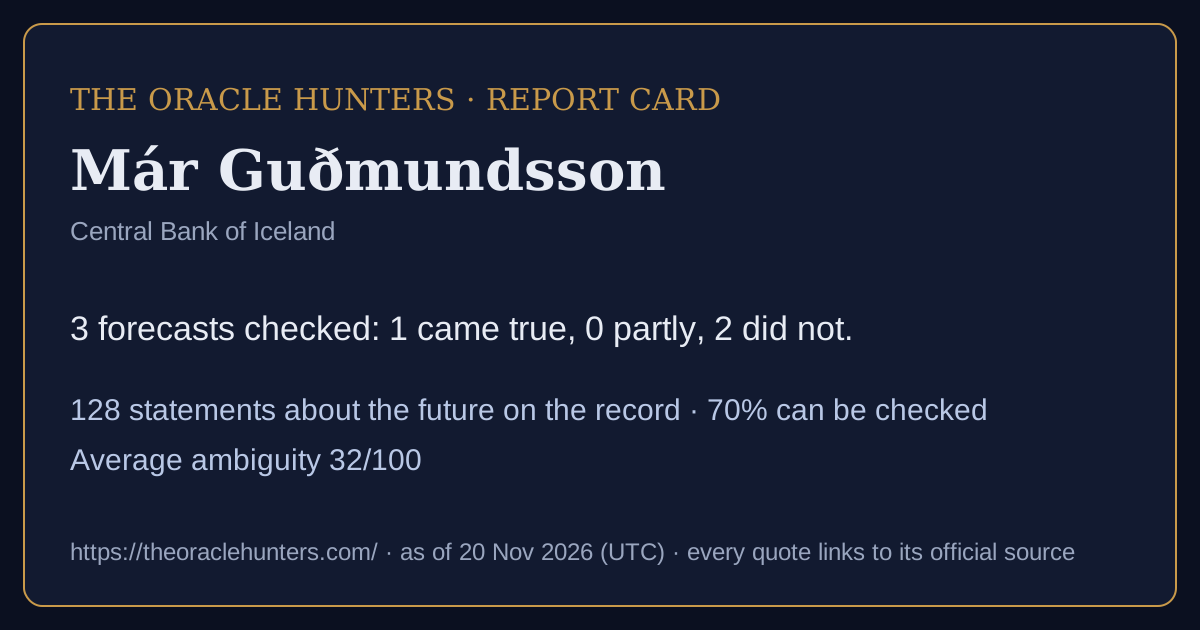
Már Guðmundsson
Central Bank of Iceland
Track record: 3 forecasts checked: 1 came true, 0 partly, 2 did not.
128forecasts & commitments on the record
70%can be checked as stated
32average ambiguity (0-100)
0goalpost moves recorded
0confirmed U-turns
Timeline
came true partly did not not due / being checked / too vague
Calibration score: shown after 10 checked forecasts with a stated likelihood (now 3).
How they speak about the future: based on data 86, stated on authority 25, educated guess 17.
Kinds of claim: forecast 93, mixed claim 21, scenario (if… then) 13, commitment 1. · Download this report card as a picture
In the nine words
πρόγνωσιςInference from evidence83 · 65%μαντείαInspired knowledge24 · 19%πρόνοιαPreparing for the future13 · 10%εἰκασίαConjecture5 · 4%πρόβλεψιςSeeing the signs2 · 2%προαναγγελίαPublic pre-announcement1 · 1%
How to read this
Each box is one sentence a public figure or institution said about the future, word for word, with a link to the official text. Can be checked means it names what will happen, by when, and how likely - so it can be compared with official figures later. Too vague to check means it does not. Ambiguity (0-100) is how many different ways the sentence can be read. When the date passes, the forecast is compared with official data and marked came true, partly or did not come true. Labels judge the sentence, never the person. Full guide and glossary.Checked
GDP growth is projected to measure just under 3% this year and then rise to about 3½% in 2015 before tapering off again to 3% in 2016.
Came true. Said: economic growth around 3.5% in 2015. Official figure for Iceland: 3.8% (World Bank open data). On target. Off by 0.3 points. official data · checked 14 Nov 2026 · automatic check against official data (rules v3)
GDP growth this year will be slightly over 3%, which is above the forecasts from a year ago, largely due to changes in inventories and a smaller-than-forecasted contraction in public consumption.
Did not come true. Said: economic growth above 3% in 2011. Official figure for Iceland: 1.4% (World Bank open data). Missed. Off by 1.6 points. official data · checked 14 Nov 2026 · automatic check against official data (rules v3)
- GDP will contract by about 8½% in 2009 and by almost 2½% in 2010.
Did not come true. Said: economic growth around 2.5% in 2010. Official figure for Iceland: -2.2% (World Bank open data). Missed. Off by 4.7 points. official data · checked 14 Nov 2026 · automatic check against official data (rules v3)
On the record (128)
It is unlikely that this alone will push Iceland into a contraction this year, though.
But it is questionable whether a real rate of less than 1% will suffice for an economy at or above full employment, with inflation already above the target, with a positive output gap, and with GDP growth that is approaching equilibrium from above.
According to the Bank's survey of market agents' expectations, published on Monday, most respondents expected a 0.25 rate increase before the end of the year.
Inflation will rise above the target in 2019 but then remain close to the target for the rest of the forecast horizon, partly because the forecast assumes that interest rates will rise when inflation does.
The positive output gap will narrow gradually and close by the end of the forecast horizon, which is in 2021.
Therefore, as compared with the last three years, growth in export revenues will ease considerably this year and in the years to come.
GDP growth will measure 2.6% over the next three years, close to the average level that will allow the economy to grow without importing labour.
On the other hand, the banks are being cautious in maintaining a so-called 'management premium' over and above the Financial Supervisory Authority's minimum requirement, as it could erode confidence in the banks if their capital ratios fall below the minimum were they to face only mild headwinds.
If forecasts materialise, the conditions for lowering the SRR will improve in the coming term, as Iceland's positive output gap is projected to keep narrowing and global interest rates are expected to rise.
However, if other decisions that affect domestic cost levels and demand pull in another direction, such a tug-of-war could result in a further rise in the real exchange rate and could adversely affect employment levels.
In the near future, the Bank will take the initiative on this, with the aim of establishing the forum before the end of this year.
Moreover, the banks must bear in mind that the countercyclical capital buffer is currently 1.25%, but the Financial Stability Council has signalled that it could increase it in stages to 2.5% as the financial cycle gets more wind in its sails.
The current account surplus is projected at 2% of GDP by the end of the forecast horizon and could easily be eroded by a surge in demand and/or lower export revenues.
If the special reserve requirement were not in effect, the Central Bank would probably have to hold larger foreign exchange reserves so as to mitigate the risk associated with carry trade-related inflows and the potential for sudden outflows.
Inflation will converge with the target in mid-2018 and remain close to target for the rest of the forecast horizon.
GDP growth will slow over the next three years, but this is both desirable and inevitable.
Domestic inflation could therefore rise above target more quickly unless domestic pressures ease commensurably.
How could the domestic economy grow by more than 7% in 2016 without overheating and unleashing inflation?
Extrapolations to 2025 indicate that, other things being equal, the Central Bank will record losses of 18 b.kr. per year from 2018 onwards, and the Bank's equity will be negative thereafter.
In this context, it gives cause for concern that the fiscal stance in terms of the cyclically adjusted primary balance has eased over the past two years and appears likely to do so again this year.
If there is the will to impede the rise in the real exchange rate and mitigate the crowding-out effect that tourism has on other sectors, which is certainly needed, but without sacrificing price stability, it must be done with policy instruments that can have a lasting impact on the real exchange rate, such as tighter fiscal policy.
For this year, it is forecast that GDP growth will remain well above long-term growth in potential output and demand pressures will still increase, but that inflation is projected to remain below target for most of the year.
If inflation expectations remain at target, both nominal and real rates will decline accordingly.
In the wake of the Central Bank's large foreign currency purchases this year, the question has arisen whether large foreign exchange reserves are a problem in and of themselves; i.e., whether they jeopardise the Bank's finances to such a degree that they could undermine its ability to pursue appropriate monetary policy at any given time.
It should be noted, though, that balance of payments figures for Q3/2016 could change the picture somewhat, but they will not be available until the beginning of next month.
It will start at 210 krónur per euro for any amount and could rise as high as 190 krónur per euro if the volume exceeds 175 billion krónur.
These instruments will initially bear an interest rate of 0.5%, which will be reviewed annually.
Then we will have a policy panel moderated by Jörg Decressin, Deputy Director of the European Department of the IMF, with two Governors, Karnit Flug from Israel and myself, Turalay Kenc, Deputy Governor of the Central Bank of Turkey, Luiz A.
The Central Bank plans to strengthen these processes still further by launching a new publication next year.
Unlike in many previous forecasts, the strong current account surplus will persist for the entire forecast period, which extends until 2018, in part because national saving will remain above the historical average.
If this turns out to have been the case, there will have been an underlying current account surplus averaging over 5% of GDP each year since 2009.
It sufficed to cover the deficit in interest, dividend, and wage movements to and from the country (excluding the calculated interest on the old banks' estates), and the current account surplus thus measured was probably close to 5% of GDP.
The Bank's Financial Market Infrastructure report, to be published later this year, will discuss this in greater detail.
This certainly entails an increase in the positive output gap this year, but that tension will subside as the forecast horizon progresses, owing in part to a tighter monetary stance.
According to the forecast, inflation will peak at just over 4% in 2017 and then taper off over the remainder of the forecast horizon.
Had that not been forthcoming, we would have had to impose a one-off stability tax of around 31% to deal with the externality, as we could no longer hold the Icelandic nation hostage to the situation.
Therefore, potential capital outflows amounting to almost 40% of GDP might have sought a speedy exit if capital controls had been lifted overnight.
4, Productivity measured as the ratio of GDP to total hours worked, Central Bank baseline forecast 2015-2018.
Terms of trade are projected to improve significantly this year, contributing to a larger current account surplus than would otherwise occur, but the improvement will reverse to an extent in 2017 and 2018.
Domestic demand will grow well in excess of GDP during the forecast horizon, which extends into 2018.
According to the forecast published yesterday, the positive output gap is expected to peak next year at 1½% of GDP.
According to the forecast, inflation will therefore rise in coming months, overtaking the target next year and peaking at just over 4% in the first half of 2017.
According to the Bank's forecast, published yesterday, GDP growth in 2015 and 2016, measuring 4.6% and 3.2%, respectively, will exceed growth in potential output.
Therefore, potential outflows amounting to 40% of GDP might seek a speedy exit if we were to lift the capital controls tomorrow.
Taking into account the part of these assets that are already financed in foreign currency, we get the result that unfinanced domestic assets that could revert to foreign residents with the unwinding of these estates will amount to 25% of GDP (see Figure 12).
It will have probably more than gained that back by the first quarter of this year.
If attempts to ease the tension in the labour market are unsuccessful and wages rise far more than is consistent with the inflation target, it will be unavoidable to respond by tightening the monetary stance; i.e., by raising interest rates.
If the theory applies to the current situation in Iceland - and a number of factors indicate that it does - increased cohesion in this sense could create the conditions for lower unemployment and lower interest rates, but without losing control of inflation.
Furthermore, it can be assumed that real wages will rise if the decline in oil prices proves long-lived, but the impact on inflation will taper off.
This drop could prove temporary, but even if not, it is beyond the scope of domestic monetary policy.
Showing the newest 50 - the ledger has all 128.
Also said - not checkable as stated (12 newest)
Remarks about the future with no date, figure or likelihood that could be checked. They are kept on the record and shown here, but not scored.
element in national security - that the authorities must guarantee, directly or indirectly, that there will always be a domestic payment channel independent of foreign entities.
This is the last speech I will give at the Annual Meeting of the Central Bank of Iceland, as I will step down as Governor this August, as is provided for by law, after ten years in the position.
In this context, I will give my assessment of how successfully the Central Bank has achieved its objectives.
This could manifest itself in economic instability, an unsustainable external position, and above-target inflation.
Certainly, a positive output gap could have ended in overheating and instability.
The problem with both is that other policies, such as fiscal policy, will then have to take care of domestic economic stabilisation.
## Már Guðmundsson, Governor of the Central Bank of Iceland, panel comments in the 50 th Anniversary Conference of the Central Bank of Malta, Valletta, 4 May 2018.
economic sense of these terms rather than the legal one), and assume that relative risk premia are constant, then long-term interest rates in the small countries will be pegged to long-term rates in the large one.
In this type of world, the small countries could still have independent monetary policy of a sort, provided that they have a flexible exchange rate regime.
They could pick their own inflation targets and set their own short-term rates that would affect economic activity in the short run and inflation in the long run.
Before the crisis, some argued that these patterns could be due to common shocks, convergence of monetary policy frameworks, and increased credibility of those frameworks.
We must therefore consider realistically whether we can expect further reduction of interest rates without an outright slack in the economy.