Murray Sherwin
Reserve Bank of New Zealand
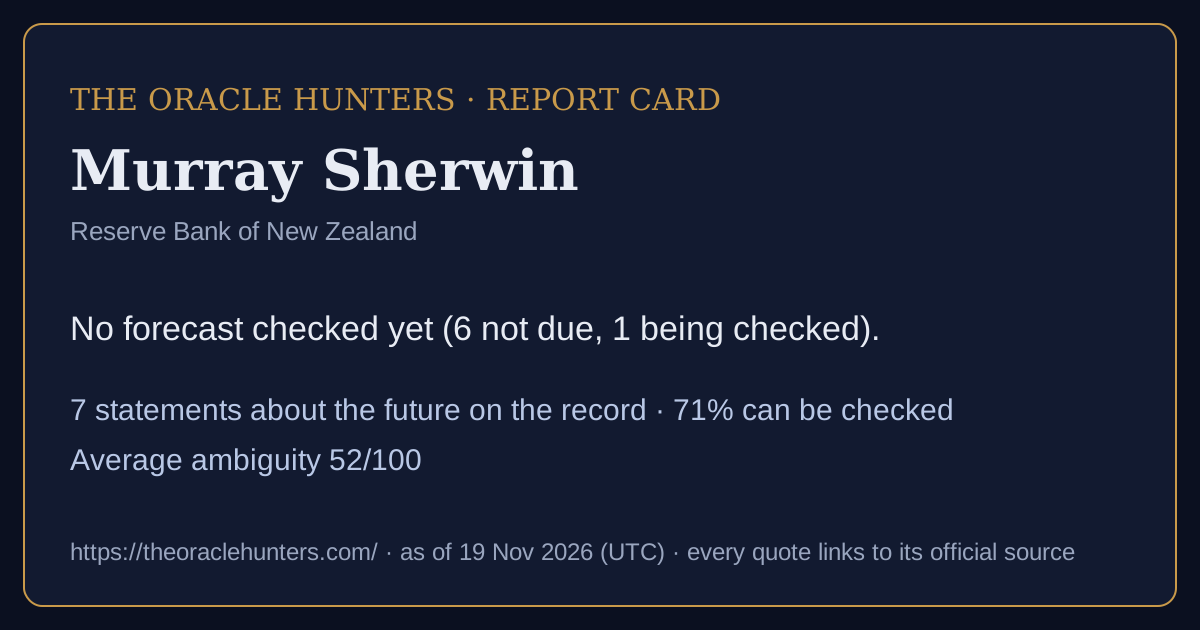
Track record: No forecast checked yet (6 not due, 1 being checked).
7forecasts & commitments on the record
71%can be checked as stated
52average ambiguity (0-100)
0goalpost moves recorded
0confirmed U-turns
Timeline
came true partly did not not due / being checked / too vague
Calibration score: shown after 10 checked forecasts with a stated likelihood (now 0).
How they speak about the future: based on data 7.
Kinds of claim: forecast 6, mixed claim 1. · Download this report card as a picture
In the nine words
How to read this
Each box is one sentence a public figure or institution said about the future, word for word, with a link to the official text. Can be checked means it names what will happen, by when, and how likely - so it can be compared with official figures later. Too vague to check means it does not. Ambiguity (0-100) is how many different ways the sentence can be read. When the date passes, the forecast is compared with official data and marked came true, partly or did not come true. Labels judge the sentence, never the person. Full guide and glossary.On the record (7)
- Asia would eventually recover, but growth would probably settle at something closer to 4 to 6 percent rather than the 7 to 10 percent growth rates of old.
After successfully driving down inflation from a 1985 peak in the high teens, Roger Douglas became concerned that the public - including financial markets, employers and unions - were expecting the Government to be content with progress to that point and that inflation and, more importantly, inflationary expectations, were settling at around 5 to 7 percent.
The public purse is the mostly likely source of substantial, and early, new Most countries in the region went into this crash with relatively light public debt loads probably absorb an additional debt burden of, say, 10 to 20 percent of GDP equivalent in recapitalise banks and deal, at least in part, with the bad debts.
Even for Japan, non-performing assets of the banking system (not all of which will 'losses') are estimated by one of the credit rating agencies at 30 percent of GDP.
As we look forward to 1999 and 2000, we can do no better guess at when these downward influences will run their course, and when robust, susta recovery will commence within the Asian region.
If our longer-term growth potential is around 3 percent, it is probably the case that growth outturns in the 1 percent to 5 percent range will be the norm.
As Dr. Brash went on to say, the Reserve Bank believes that New Zealand's longer-term growth potential is probably of the order of 3 percent annually at present -- a result of a trend growth in the working age population of around 1.5 percent and trend growth in output per person, or productivity, also of around 1.5 percent.
Also said - not checkable as stated (12 newest)
Remarks about the future with no date, figure or likelihood that could be checked. They are kept on the record and shown here, but not scored.
Any spending over that cap must be drawn from the Bank's reserves, and under-spending of the agreed limit may be added to reserves.
First, a couple of definitional points to help locate the discussion we will be engaging in over the rest of the day.
Ultimately, the board could recommend the Governor's dismissal should they feel that he is not diligently or competently pursuing the objective established for him - although, of course, there are intermediate courses of action available to the board before reaching such a drastic conclusion.
Inflation targeting arose in New Zealand in an environment that will seem rather familiar to many of our Asian friends - at least in some important respects.
And while I will attempt to generalise the lessons we have learned, and to draw from the experience and structures of other inflation targeting central banks, it is important to highlight up front that there are few fixed points for the architects of a new inflation targeting regime to fasten on.
These are awkward times for small, open economies as they struggle to find monetary and financial structures that will facilitate growth, prosperity and stability in a world characterised by increasing openness to trade and capital flows and, it seems, increasing volatility.
They acknowledge that crises will still occur and that there is a need to create institutional mechanisms to overcome the information asymmetries and collective-action problems that prevent them from being rapidly resolved.
It is, of course, possible that the restaurateur will assist you in exercising that self-restraint, but none of us should rely on him to do so.
Indeed, the risk now is that an early return to positive growth is, in some cases, weakening the political will to undertake those still necessary domestic policy reforms.
The banking system will often be the point at which stresses associated with this behaviour come to the surface.
Creditors face incentives to run for the exits at the first sign of trouble and, in doing so, are likely to exacerbate any emerging problem.
Rather, we are focussed on policy settings which should ensure that inflation a year or two ahead will be at about the centre of the target range.