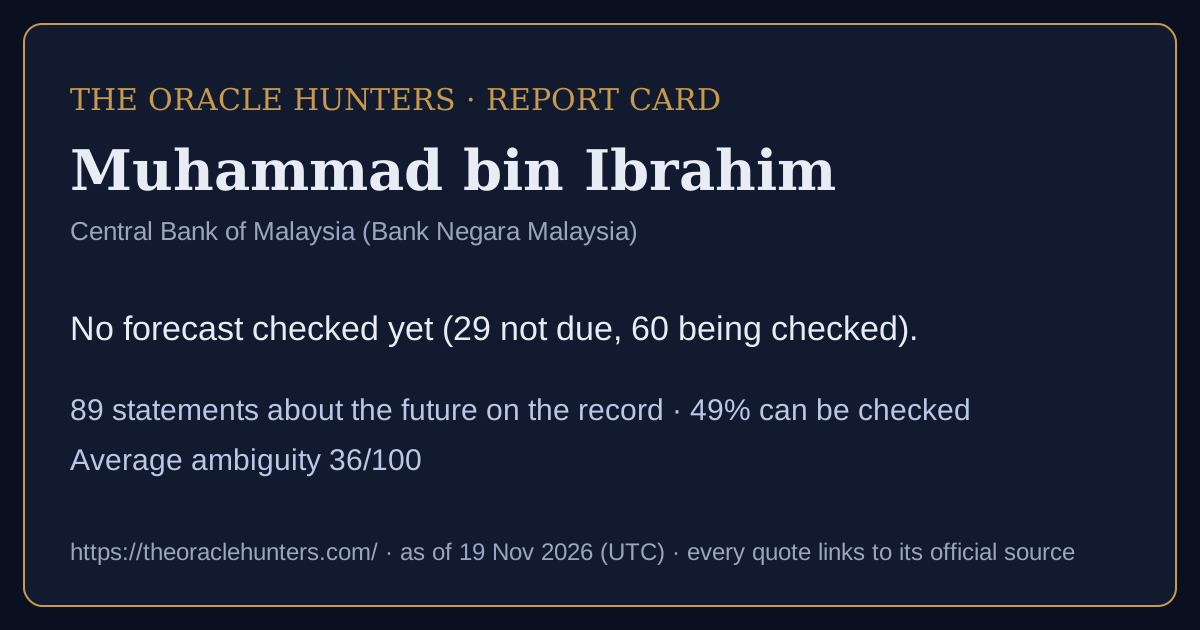
Muhammad bin Ibrahim
Central Bank of Malaysia (Bank Negara Malaysia)
Track record: No forecast checked yet (29 not due, 60 being checked).
89forecasts & commitments on the record
49%can be checked as stated
36average ambiguity (0-100)
0goalpost moves recorded
0confirmed U-turns
Timeline
came true partly did not not due / being checked / too vague
Calibration score: shown after 10 checked forecasts with a stated likelihood (now 0).
How they speak about the future: based on data 68, stated on authority 16, educated guess 5.
Kinds of claim: forecast 77, mixed claim 8, scenario (if… then) 4. · Download this report card as a picture
In the nine words
πρόγνωσιςInference from evidence67 · 75%μαντείαInspired knowledge16 · 18%πρόνοιαPreparing for the future4 · 4%φρόνησιςPractical wisdom1 · 1%εἰκασίαConjecture1 · 1%
How to read this
Each box is one sentence a public figure or institution said about the future, word for word, with a link to the official text. Can be checked means it names what will happen, by when, and how likely - so it can be compared with official figures later. Too vague to check means it does not. Ambiguity (0-100) is how many different ways the sentence can be read. When the date passes, the forecast is compared with official data and marked came true, partly or did not come true. Labels judge the sentence, never the person. Full guide and glossary.On the record (89)
This will be launched by the end of the year.
T o this end, consultations with the industry will be conducted this year on proposals to sharpen accountability of individuals holding senior roles.
I will aim higher this year and outline the case for bankers as guardians of the financial system.
In the coming months, the Bank will introduce minimum standards for the nascent but growing area of mobile payments.
We are also pleased to announce that a specialised executive Islamic finance education programme tailored for directors of Islamic banks and takaful operators will be launched in the first half of this year.
The Bank, the insurance and takaful industry, and the National Registration Department will roll out a new, automated mechanism this year to expedite the process for claiming death benefits.
However, at the rate it is growing, we will only reach 16% in 2020, from the 14.8% today.
A strong GDP growth figure will be less meaningful if they do not create good quality jobs, better distribution of incomes and higher standard of living for the people.
What this means is that if members of the public do not believe in the central bank's ability to control inflation, a rise in prices could trigger public expectations that prices will rise even more in the future.
If the inflation trend deviates beyond a central bank's expected target, typically around 2%, the central bank should use its policy tools, namely the interest rate, to bring inflation back to target.
In setting an example to inspire such exchanges, beginning January 2018, Bank Negara Malaysia's website will feature an enhanced version of the SAC microsite, starting with the Bahasa version to provide more detailed disclosure of the SAC's works.
We estimate that there are about 10 million bank accountholders who are not using online services, while the remaining 2 million adults are likely to be unbanked.
In the case of Malaysia, we estimate that at the current rate of decline, it will take us about 27 years before cheques can be reduced to a negligible level of 0.1 per capita, with an estimated cost to the banking and business community of about RM12.9 billion.
To reflect the higher cheque processing cost, hasten the migration away from cheques, and incentivise individuals and businesses to migrate to a lower cost of doing business, beginning 2 January 2021, the cheque fee will be increased from 50 sen to RM1.00 and gradually thereafter, to reflect the actual cost of cheque processing.
By the end of 2020, it is envisaged that individuals and businesses will be able to make and receive payments seamlessly via online banking, payment cards and mobile payments.
At the current rate of decline, we are likely to achieve the Financial Sector Blueprint target of reducing cheque usage to 100 million in the year 2019, one year ahead of schedule.
This is in line with global developments where the size of the global payments industry has increased to account for 34 percent of overall banking revenues in 2016 and is projected to become a USD$2 trillion dollar industry by 2020.
Beginning 2018, Bank Negara Malaysia will designate persons converting crypto currencies into fiat money currencies as reporting institutions under the Anti-Money Laundering, Anti-T errorism Financing and Proceeds of Unlawful Activities Act 2001.
On this front, I am delighted that the Continuing Professional Development program will start from next year, and will become mandatory for all FMAM's members.
The theme of my speech will be a bit different this year.
Moving forward, effective January 2018, the Bank will publish enforcement actions taken against financial institutions and intermediaries for non-compliance with rules and regulations.
To put this in perspective, Google has projected that Southeast Asia's web-generated business will multiply over 6 times to $200 billion by 2025, from $31 billion in 2015.
World growth is projected to grow an average of 3.5% in the next two years.
Come 2020, more than 24 billion internet-connected devices will be installed.
A significant step forward came last month when our respective Trade Ministers announced a target for bilateral trade of USD30 billion in the coming years.
This will form part of the D-SIB policy framework which will be released later this year for industry consultation.
Survey results collected from banking institutions and financial holding companies earlier this year are currently being analysed and will facilitate further refinements to the assessment methodology to identify D-SIBs.
This is projected to reach 1 million units by 2020.
This year, we have embarked on an initiative, working with the Credit Guarantee Corporation in Malaysia, to develop behavioral insights that will enable microfinance providers to integrate business and technological strategies that best serve the poor.
Collectively, we shall achieve our targets to migrate users to PIN verification by 1 July 2017.
Beginning next year, we will be raising the stakes further by publishing enforcement actions taken by Bank Negara Malaysia.
T o add seriousness in upholding ethical standards and integrity, beginning 1 January 2018, a strengthened transparency framework for our enforcement actions will also be introduced to serve as an added deterrence against misconduct.
Bank Negara Malaysia and the FMC will continue monitoring the activities in the financial market and, if deemed necessary, will introduce appropriate measures to strengthen the policies that are already in place.
This was notably mentioned by the Federal Reserve Bank of New York paper in May 2005, that an estimated 60 to 80 percent of NDF volume is generated by speculative interest.
I hope 2017 will bring less of these, but then for financial market players, surprises, volatilities and uncertainties are not totally undesirable as they also bring along lucrative trading opportunities.
Today, I am pleased to announce three key policy initiatives that will be embarked upon in 2017:
Unfortunately, talent shortage has been a persistent issue which, if not resolved, will not only hold back the industry from gaining new ground; it could lead to a further retrenchment of business growth.
As a catalyst, beginning next year, insurers will be required to offer pure protection products through a direct channel without commissions.
In fact, the World Trade Organisation has projected for world trade to grow by only around 3% in 2016 and 2017.
Banks remain the largest financiers to SMEs, and this relationship is expected to remain, thanks to the high approval rates of close to 80%.
The Bank and PIDM will be initiating a series of engagement sessions with the industry from early next year to share more details on this work and how it will affect your institutions.
More than 300,000 oil and gas workers have been laid off globally since mid-2014; some USD 380 billion of global oil and gas projects have been deferred or cancelled; and more than USD 150 billion worth of assets have been planned for disposal or divestment.
The Institute of Internal Auditors (IIA) for example, has proposed several changes to the Internal Audit Standards, which are expected to take effect in January 2017.
Amid a confluence of shocks, ranging from weaker-than-expected growth prospects to geopolitical uncertainty and moderation in China's economic growth, oil prices declined by more than 50% in a span of 6 months in 2014.
We should expect Malaysian economic growth to range between 4.0 to 4.5 % for 2016.
Moving forward, expanding public access to financial services will remain important for the remaining 8% of the
This will be guided by the ASEAN Economic Community Blueprint 2025, which focuses on the three key pillars of financial integration, financial inclusion and financial stability in the region.
An estimated 10% to 40% of overall banking revenues could be at risk by 2025 due to fintech innovations outside banking institutions that are able to achieve a significant pricing advantage.
We expect Malaysia-Thailand trade links to reach RM100 billion in 2015.
Debit card transactions on the other hand, are likely to maintain its double digit growth rate of about 40% in 2015 (39% in 2014).
Showing the newest 50 - the ledger has all 89.
Also said - not checkable as stated (12 newest)
Remarks about the future with no date, figure or likelihood that could be checked. They are kept on the record and shown here, but not scored.
There are other initiatives in store, we will step up efforts to ensure that the roles, responsibilities and accountabilities of leaders of financial institutions are clear and transparent.
These guardians will '...unite themselves in philosophy and spirit and swiftness and strength...and they ought to be wise and efficient."
Remarks by Mr Muhammad bin Ibrahim, Governor of the Central Bank of Malaysia (Bank Negara Malaysia), at the AICB Graduation Ceremony 2018 "Bankers as Guardians of the Financial System", Kuala Lumpur, 12 May 2018.
Banks especially, will have to reinvent themselves or risk being disrupted.
We should expect PayNet to ensure that the payment infrastructure of this country will always be at the cutting edge of technology.
This should also account for demographic, behavioural and psychological factors that may be at play.
Based on a study by the Royal Bank of Scotland and Natwest in 2014, a customer who uses mobile and online banking instead of going to a physical bank branch stands to enjoy about 24 hours of time saved and about 10 kilometers of travelling distance saved per year.
Seamless and secure payments between bank and non-bank e-money accounts will also become a reality.
Given the importance of financial inclusion for the nation and takaful being a product with pseudo-social leanings, we should expect much more from takaful operators.
Therefore, we should always remain on our guard, as the global economic and financial conditions may change rapidly following many developments such as normalisation of interest rates, geopolitical risks and the tendency to adopt policies that might curtail open trade.
We will also strengthen the governance of takaful operators, including how takaful funds are managed, to further safeguard the interests of takaful participants.
Malaysia's financial institutions especially must not lay idle as innovations will be relentless in accessing and penetrating the traditional market long enjoyed by the banks.