Moses D Pelaelo
Bank of Botswana
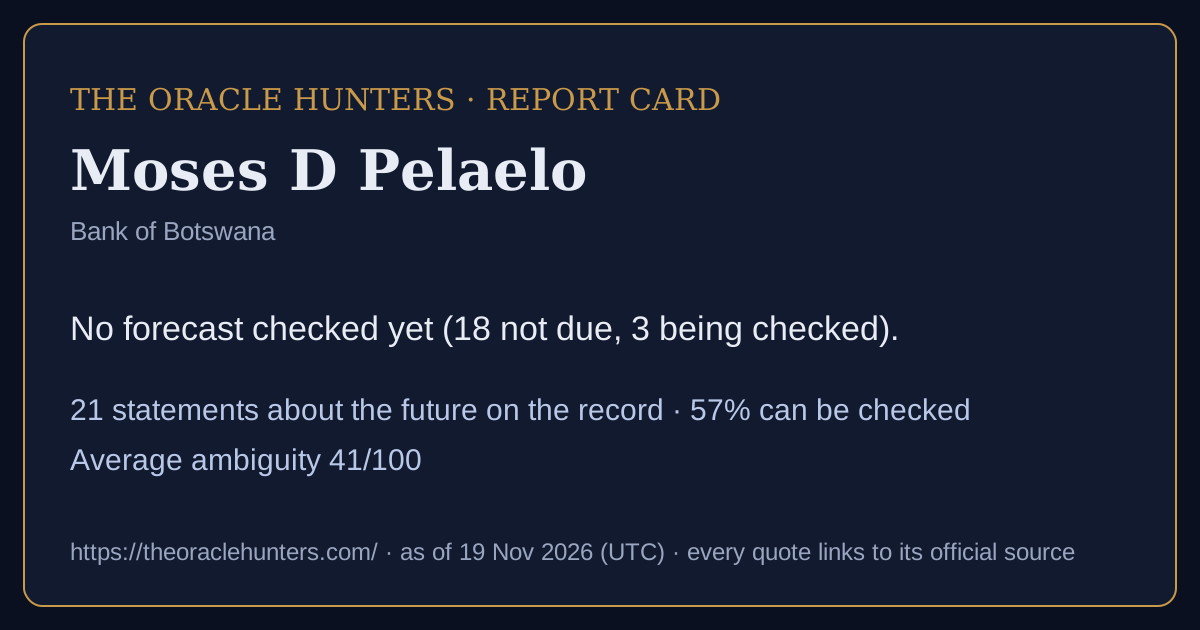
Track record: No forecast checked yet (18 not due, 3 being checked).
21forecasts & commitments on the record
57%can be checked as stated
41average ambiguity (0-100)
0goalpost moves recorded
0confirmed U-turns
Timeline
came true partly did not not due / being checked / too vague
Calibration score: shown after 10 checked forecasts with a stated likelihood (now 0).
How they speak about the future: based on data 20, stated on authority 1.
Kinds of claim: forecast 18, mixed claim 2, commitment 1. · Download this report card as a picture
In the nine words
How to read this
Each box is one sentence a public figure or institution said about the future, word for word, with a link to the official text. Can be checked means it names what will happen, by when, and how likely - so it can be compared with official figures later. Too vague to check means it does not. Ambiguity (0-100) is how many different ways the sentence can be read. When the date passes, the forecast is compared with official data and marked came true, partly or did not come true. Labels judge the sentence, never the person. Full guide and glossary.On the record (21)
Mr Loeto will indicate that the Bank recorded net income of P8.8 billion in 2020, of which P2.9 billion was net distributable income paid to Government.
Distinguished Ladies and Gentlemen, the objective of the Bank's monetary policy is to achieve price stability, defined as a low, stable and predictable level of inflation within 3 - 6 percent, in the medium term.
Distinguished Guests, based on available data, the current projections suggest that domestic inflation will, in the short term, revert to and remain within the Bank's medium-term objective range of 3 - 6 percent.
Overall, both external and domestic pressures on inflation are expected to be benign, and it is projected that inflation will revert to within the Bank's 3 - 6 percent medium-term objective range from the second quarter of 2020.
Distinguished Guests, as the Honourable Minister of Finance and Economic Development indicated in the 2019/20 Budget Speech, the domestic economy is forecast to grow by 4.2 percent in 2019, slightly lower than the estimate of 4.5 percent for 2018.
Growth in emerging market and developing economies is projected at 4.5 percent in 2019, slightly lower than the 4.6 percent in 2018.
The US GDP growth is forecast to decline from 2.9 percent in 2018 to 2.5 percent in 2019, as the impact of the fiscal stimulus dissipates.
Honourable Minister and Distinguished Guests, as I conclude, it is important to note that the continuing success in containing inflation within the desired 3 - 6 percent medium-term inflation objective, to which the Bank remains fully committed, must in the end, involve the cooperation of all key players in the economy, including Government, parastatals and the private sector.
The budgeted 3.6 percent expansion in government spending in 2019/20 and the implementation of initiatives such as the doing business reforms, are expected to further support growth in economic activity and employment creation.
In this respect, during this year, the Bank will adopt what is known as 'Reserves Averaging' in the determination of Primary Reserves Requirement for banks and also shorten the maturity of the 14-day BoBCs to seven days.
It is for these reasons that the Bank's primary mandate of price stability, is clearly defined as a sustainable level of annual inflation that is within the medium-term objective range of 3 - 6 percent.
However, the good news is that, according to the 2015 Bill Gates Annual Letter, it is estimated that by 2030, about 2 billion people who do not have bank accounts today, will be storing money and making payments with their mobile phones.
In this respect, it is welcome that more than 70 percent of members of the Financial Stability Board intend to introduce new initiatives to boost cyber security in the coming year.
In Botswana, inflation was low and stable, and fluctuated around the lower end of the desired objective range of 3 percent, hence broadly consistent with projections for the year.
Looking back, it is estimated that global output growth was 3.1 percent in 2016, compared to 3.2 percent in 2015, and weaker than the projection of 3.4 percent early in the year.
This forecast takes into account possible increase in some administered prices, the impact of which, however, is not expected to result in short-term inflation over-shooting the upper boundary of the objective range of 3 - 6 percent.
As the Honourable Minister indicated in the 2017/18 Budget Speech, the domestic economy is forecast to grow by 4.2 percent, an improvement from the estimated 2.9 percent for 2016.
Global inflation is forecast to be 3.3 percent in 2017 as advanced economies reflate to achieve the desired targets and as the effect of the earlier decrease in energy prices dissipates.
Due to these factors, global inflation increased slightly from 2.8 percent in 2015 to 2.9 percent in 2016, but much lower than the forecast of 3.4 percent at the beginning of the year.
As this new leadership team settles down to the business of running the affairs of the Bank, taking the baton and moving forward, | want to assure you that we shall continue to do our best and strive to steer this Bank to higher levels of institutional performance, with the same vigour and profound excellence.
In addition to former Governor Mohohlo, whom we will have an opportunity to appropriately bid farewell in early 2017, let me extend a special recognition to two of our colleagues, Ms Rachel Tshephe of the Currency &
Also said - not checkable as stated (12 newest)
Remarks about the future with no date, figure or likelihood that could be checked. They are kept on the record and shown here, but not scored.
For the reasons that should be obvious to many, this is an invitation that the Head of Banking Supervision Department, Mr Godfrey Ngidi and I could not decline.
For example, monetary policy action, involving upward or downward adjustment of interest rates, will affect saving and borrowing decisions of those that use banks and other financial institutions; and
Ladies and Gentlemen, I need to highlight also that Absa Bank is not new in Shakawe; the bank first opened a branch in Shakawe in 2007, temporarily closed it for business in August 2018 to upgrade it and find a place where it could conveniently and satisfactorily serve customers.
There could be no better indication by Absa Bank of its determination to share with the Botswana Government the responsibility to provide financial services, economic infrastructure and facilities widely in the country.
It should also address the hitherto apparent diminution of services as public servants and other service providers occasionally depart from their stations here in Shakawe to travel long distances for banking services in Gumare and/or even as far as Maun.
I must be quick to indicate, Managing Director and Chairman of ABSA that this movement towards digital platforms should not result in abrupt closure of brick-andmortar branches without providing more cost-effective alternative channels for maintenance of high-quality banking services.
Therefore, where opportune and prudent, the Bank will continue to implore banks, including Access Bank, into active participation and contribution to the national development and transformation agenda.
I will, therefore, complement the Honourable Minister's insightful observations by projecting a central bank and regulatory perspective on some key aspects.
Distinguished Guests, while the Bank of Botswana has clear mandates as enshrined in Section 4 of the Bank of Botswana Act, I will, for the purposes of today's event, distill and project three aspects deriving from those mandates.
In this context, the ' supervisory risk-perimeter ' takes a consolidated view of the banking group, not only to identify sources of strength, but also likely sources of adverse impact on financial condition, reputation and overall safety and soundness of the financial system.
The overriding issue for Botswana is financial inclusion generally, where it is expected that Access Bank PLC will add to vibrancy of market competition and broader coverage in attracting customers, diversity of products and services, quality of service provision and related cost rationalisation, for the benefit of both its investors and customers.
commercial bank loans in Botswana (very low compared to peer upper middle-income economies) need to improve markedly, which will go a long way towards helping the economy to realise its potential.