Mojmír Hampl
Czech National Bank
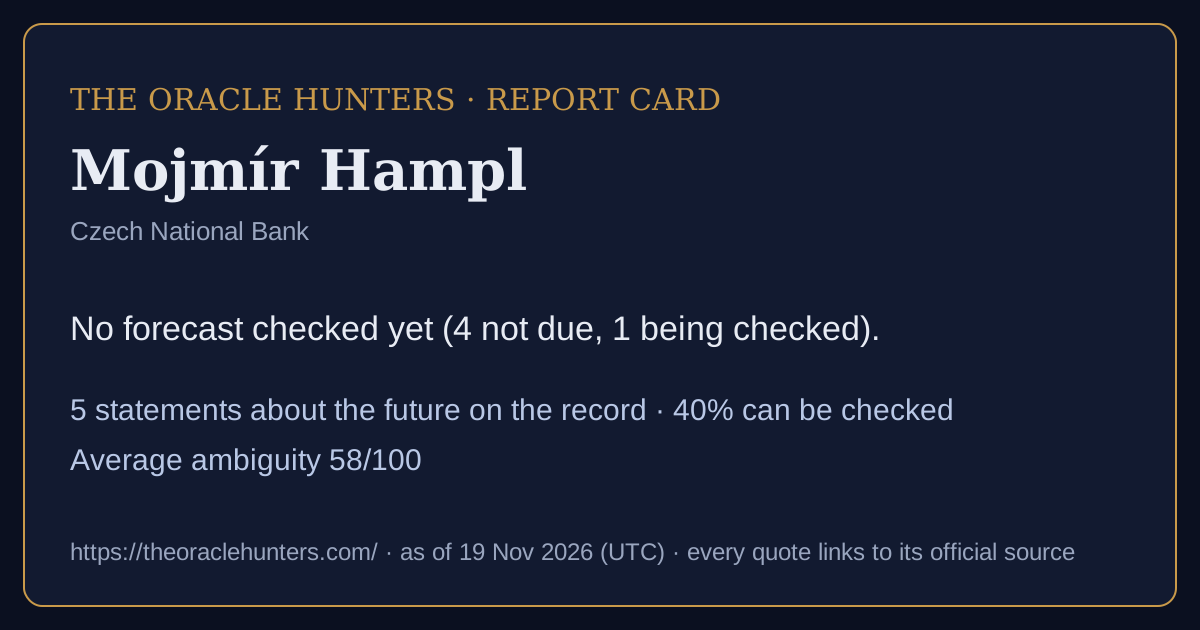
Track record: No forecast checked yet (4 not due, 1 being checked).
5forecasts & commitments on the record
40%can be checked as stated
58average ambiguity (0-100)
0goalpost moves recorded
0confirmed U-turns
Timeline
came true partly did not not due / being checked / too vague
Calibration score: shown after 10 checked forecasts with a stated likelihood (now 0).
How they speak about the future: based on data 4, educated guess 1.
Kinds of claim: forecast 3, scenario (if… then) 1, mixed claim 1. · Download this report card as a picture
In the nine words
πρόγνωσιςInference from evidence3 · 60%εἰκασίαConjecture1 · 20%πρόνοιαPreparing for the future1 · 20%
How to read this
Each box is one sentence a public figure or institution said about the future, word for word, with a link to the official text. Can be checked means it names what will happen, by when, and how likely - so it can be compared with official figures later. Too vague to check means it does not. Ambiguity (0-100) is how many different ways the sentence can be read. When the date passes, the forecast is compared with official data and marked came true, partly or did not come true. Labels judge the sentence, never the person. Full guide and glossary.On the record (5)
I could talk about how much energy it consumes at some points last year, the bitcoin ecosystem consumed twice as much energy as Nigeria, an oil giant with 190 million people.
If the central bank allowed transfers from bank accounts to the digital currency, it would have to cap the amount a single individual could hold in the digital currency, perhaps at the level of the median monthly salary.
These prospects also hold more specifically for the Czech economy, for which we at the Czech National Bank currently forecast the equilibrium real 3-month interest rate to stand at around 1%.
But if this model is right, higher rates would not help either, as rates substantially above equilibrium would mean that demand for loans from banks would decline sharply and the riskiness of future projects would increase, and even currently viable projects might turn into unviable, nonperforming ones.
This year we achieved an incredible outcome: Austria, the Czech Republic and Hungary will have the right to appoint an executive director - one of the 24 executive directors in the IMF - each country for a fixed term.
Also said - not checkable as stated (12 newest)
Remarks about the future with no date, figure or likelihood that could be checked. They are kept on the record and shown here, but not scored.
In other words, it has to pay all the costs of Eurozone membership many years before it becomes a member - and without any assurance that it will be accepted to the club at all.
T alks about joining the Eurozone are simply not part of the political agenda, and we now have a fourth or so government in a row declaring that this issue will be left 'for the next government after the next elections' - so it is being postponed to political infinity.
Listeners themselves can answer the question of whether the labour market and labour law are likely be made more or less flexible (and dismissals made easier) in the future.
This year, however, they tried their luck: perhaps they felt that the conditions would never get any better than under Bulgarian presidency of the EU and Jean-Claude Juncker's vocal emphasis on how the euro should become the currency of the entire Union.
In one breath they say that we should not adopt the euro so that we can keep our own currency and hence retain the ability 'to weaken the koruna in bad times' - and then criticise the Czech National Bank for doing exactly that in the bad times of 2013.
For example, if the population is not averse to modest inflation, the central bank will have a hard time imposing an ultra-low-inflation environment, with all the associated costs and benefits, over the long run.
In general, Czechs despise inflation, and the central bank needs to explain repeatedly why it uses the worldwide standard of a 2% inflation target instead of targeting literal stability of the CPI level, or 0% inflation.
When I attend conferences and seminars at other central banks, my foreign colleagues often assume that such a policy must have been tremendously popular.
Canonically, the same goes for us: either we can continue to stabilise ourselves, in which case we don't need the euro, or we will destabilise ourselves, but in that case we will potentially harm others in the euro club and Eurozone membership will be a hindrance in bad times.
Speaking points by Mr Mojmír Hampl, Vice Governor of the Czech National Bank, at St. Antony's College, University of Oxford, Oxford, 21 May 2018.
It is not part of the real political agenda, and we now have a fourth or so government in a row declaring that this issue will be left 'for the next government after the next elections' - so it is being postponed to political infinity.
Listeners themselves can answer the question of whether the labour market and labour law are likely