Mohammed Laksaci
Bank of Algeria
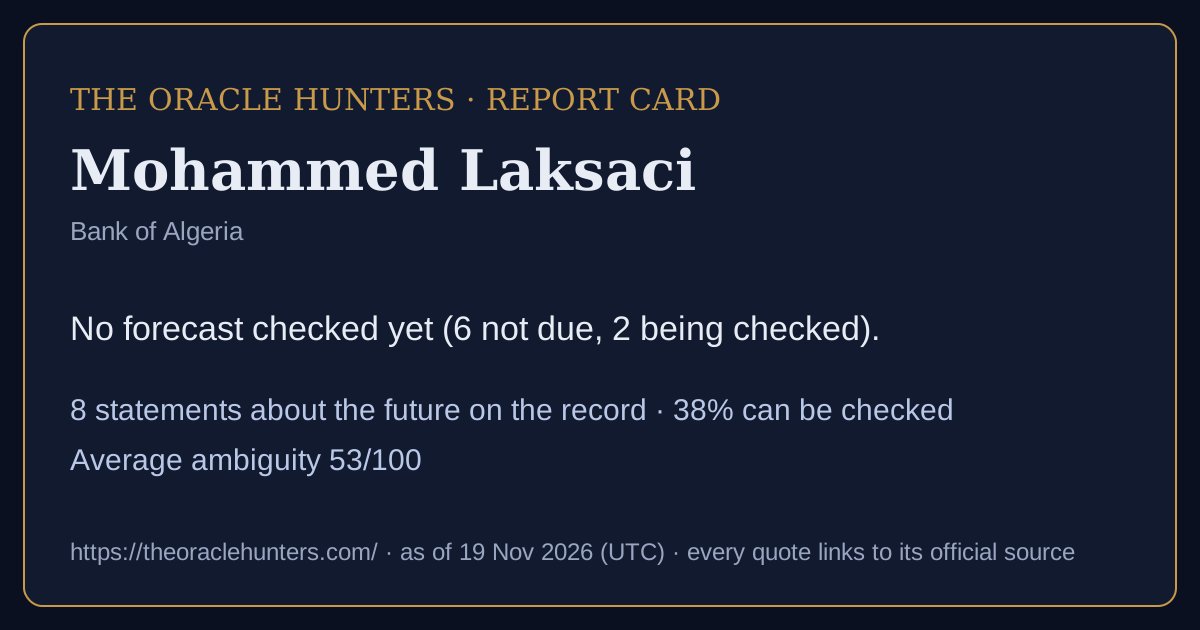
Track record: No forecast checked yet (6 not due, 2 being checked).
8forecasts & commitments on the record
38%can be checked as stated
53average ambiguity (0-100)
0goalpost moves recorded
0confirmed U-turns
Timeline
came true partly did not not due / being checked / too vague
Calibration score: shown after 10 checked forecasts with a stated likelihood (now 0).
How they speak about the future: based on data 8.
Kinds of claim: forecast 8. · Download this report card as a picture
In the nine words
How to read this
Each box is one sentence a public figure or institution said about the future, word for word, with a link to the official text. Can be checked means it names what will happen, by when, and how likely - so it can be compared with official figures later. Too vague to check means it does not. Ambiguity (0-100) is how many different ways the sentence can be read. When the date passes, the forecast is compared with official data and marked came true, partly or did not come true. Labels judge the sentence, never the person. Full guide and glossary.On the record (8)
Overall, excluding credits repurchased by the Treasury, bank credits to the private sector (enterprises and households) stood at dinar billion 3120 by end 2014, with the share of medium and long term credits increasing from 62.3 percent by end 2013 (61.3 percent by end 2012) to 64.3 percent.
The credits to deposits ratio rose from 69.5 percent by end 2013 to 74.7 percent by end 2014 and 86.7 percent by end 2015, indicating a decline in the surplus of banks' collected resources compared to extended credits.
To mitigate the liquidity stress some banks are starting to face, the Bank of Algeria may reduce the reserve requirement rate, which now stands at 12 percent.
Consequently, the banking sector's liquidity, in excess since 2002, declined gradually during 2015 to reach dinar billion 1833 by the end of the year (a decline of 33 percent), after relative stability in 2014 (dinar billion 2731 by end 2014).
The completion in 2014 of the modernization of the existing credit bureau and the establishment of a new infrastructure for the development of a broader credit bureau will provide an important tool to monitor credit risk as of the second half of 2015.
- -continued high growth in the non-oil sector, expected to exceed 9% in 2009 against 6.1% in 2008;
The strengthened macroeconomic stability, as evidenced by subdued inflation (4.4 % in 2008 despite the surge in world commodity prices) and a real exchange rate of the Dinar near its equilibrium level, as well as important foreign exchange reserves ($143 billion, by end 2008) and low external debt, have constituted sound safeguards against the inherent shocks of the current international …
By end 2008, total medium and long term debt stood at only $4 billion (less than 3% of GDP).
Also said - not checkable as stated (12 newest)
Remarks about the future with no date, figure or likelihood that could be checked. They are kept on the record and shown here, but not scored.
Banks should also further develop their advisory activity for SMEs, particularly with regard to investment projects analysis.
In the context of strengthening bank supervision, the new approach, more prospective and risk-based, will be more focused on the process of banks' credit allocation with a view to containing both the re-emergence of risk concentration and increase in nonperforming loans.
In addition, existing micro-prudential regulation tools - such as loan to value ratios, minimum reserve requirement (also a monetary policy instrument), and the ratio of debt service to revenue - have been revisited and could be adjusted as needed to face potential systemic risks.
In the same vein, the Council on Money and Credit has also enacted in May 2011 a second regulation establishing an internal surveillance system and a ceiling by counterpart regarding interbank outstanding lending and borrowing, especially those occurring in the money market.
Moreover, as regards the strengthening of the capacity in assessing the banking sector risk, Bank of Algeria will rely, as of the beginning of 2015, on the effective use of the new stress test model, and on the generalization of the bank rating system.
The new risk-based, forward-looking supervision approach will be focusing on the banks' credit allocation process in order to avoid the reemergence of credit risk concentration.
Anchored within a framework of strengthened stability, the deepening of the financial sector reform as of 2014 will form the basis for a better allocation of national savings to foster productive investments and financing of nonhydrocarbon inclusive and job-creating growth, that is less dependent on the budget and is driven by SMEs development.
Finally, banks' financial soundness, as reflected in their global capital adequacy ratio (16.54% in 2008), which is key to ensuring adequate financing of productive investment, should contribute to achieving growth potential in the non-oil sectors over the period 2010-14.
- -sizeable savings in the stabilization fund despite the expected first budget deficit for several years;
Increased capital of the banks in 2009, in the context of abundant liquidity and sustained efforts to improve credit evaluation and risk management, should stimulate further improvement in banks' credit allocation to productive investment in support of sustained growth.
In particular, domestic financing available for companies established in partnership, as encouraged through measures introduced in the Supplementary Budget Law, should provide further opportunities to banks operating in Algeria.
It should be noted that the measures introduced in the Supplementary Budget Law of July 2009 do not affect the current convertibility regime nor do they affect capital transfers related to foreign direct investments (FDIs).