Miyako Suda
Bank of Japan
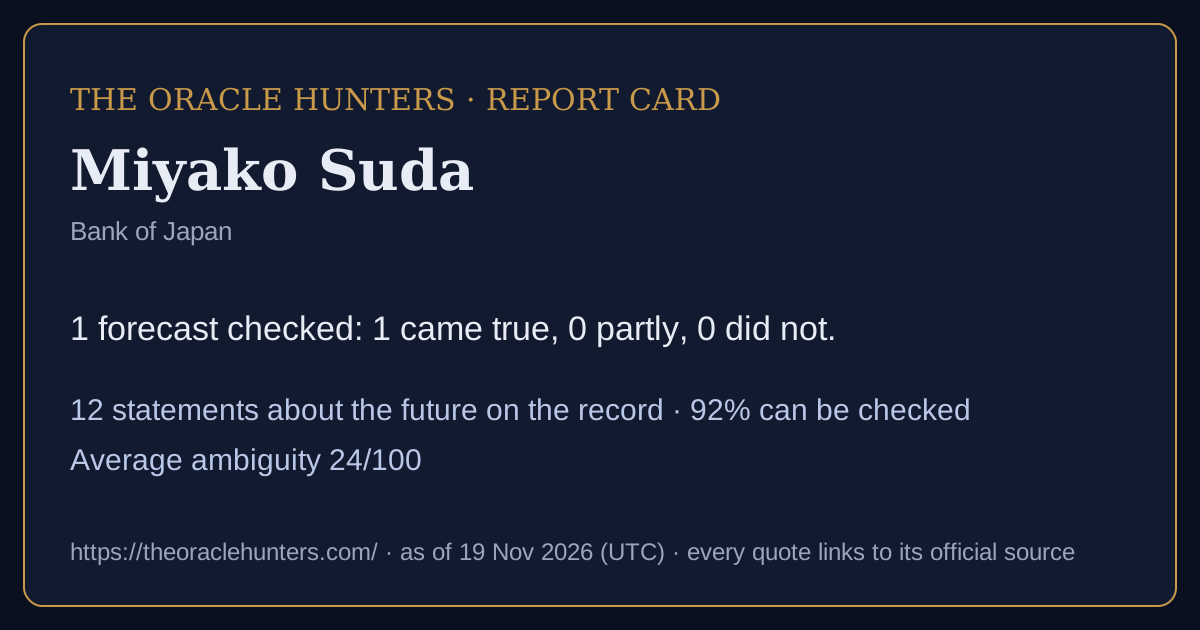
Track record: 1 forecast checked: 1 came true, 0 partly, 0 did not.
12forecasts & commitments on the record
92%can be checked as stated
24average ambiguity (0-100)
0goalpost moves recorded
0confirmed U-turns
Timeline
came true partly did not not due / being checked / too vague
Calibration score: shown after 10 checked forecasts with a stated likelihood (now 1).
How they speak about the future: based on data 9, educated guess 3.
Kinds of claim: forecast 8, scenario (if… then) 4. · Download this report card as a picture
In the nine words
How to read this
Each box is one sentence a public figure or institution said about the future, word for word, with a link to the official text. Can be checked means it names what will happen, by when, and how likely - so it can be compared with official figures later. Too vague to check means it does not. Ambiguity (0-100) is how many different ways the sentence can be read. When the date passes, the forecast is compared with official data and marked came true, partly or did not come true. Labels judge the sentence, never the person. Full guide and glossary.Checked
As for the outlook, though the pace of growth in overseas economies will probably continue to slow for the time being, the recovery trend itself is likely to remain intact, and from 2011 the growth rate will start to increase again.
Came true. Said: economic growth would fall in 2011. Official figures for Japan: 4.1% in 2010, -0.2% in 2011 (World Bank open data). official data · checked 14 Nov 2026 · automatic check against official data (rules v3)
On the record (12)
In the Outlook Report, the Bank projected that the timing of the year-on-year rate of change in the CPI entering positive territory would likely be sometime in fiscal 2011, and that thereafter the rate of increase would start rising through fiscal 2012.
In fiscal 2012, Japan's economy is expected to continue growing at a pace above its potential amid the continued relatively high growth in overseas economies, especially emerging and commodity-exporting economies.
However, although the effects of the appreciation of the yen may continue to linger, the economy is expected to return to a moderate recovery path once we enter fiscal 2011, given that - with growth in overseas economies expected to pick up again - exports are projected to continue increasing and firms' sense of excessive capital stock and labor is …
Starting with the outlook for the economy, the pace of recovery is likely to slow temporarily in the second half of fiscal 2010 due to factors such as the slowdown in overseas economies and the ending of the boost from policy measures targeted at durable consumer goods, as well as the recent appreciation of the yen.
Meanwhile, the effects of balance-sheet adjustments will continue in the U.S. economy, but growth there is expected to accelerate again from 2011 on the back of a rise in exports, mainly to emerging and commodity-exporting economies, and a moderate recovery in business fixed investment and private consumption.
As for the outlook, though the pace of growth in overseas economies will probably continue to slow for the time being, the recovery trend itself is likely to remain intact, and from 2011 the growth rate will start to increase again.
Came true. Said: economic growth would fall in 2011. Official figures for Japan: 4.1% in 2010, -0.2% in 2011 (World Bank open data). official data · checked 14 Nov 2026 · automatic check against official data (rules v3)
If a central bank provides funds or is perceived to be doing so for fiscal spending when the room for increases in fiscal spending is limited, its credibility as an independent policymaker will be tarnished.
If these developments lower the expected growth rate even more, prices will come under further downward pressure.
This statement is based on the belief that firms' expectations for economic growth, and hence the outlook for growth, will change if each and every one of us moves forward and takes action to tackle these structural changes. 3
Also, if expansionary macroeconomic policies are maintained for longer than is necessary, this could lower the expected medium- to long-term growth rate of domestic demand by slowing down the response to structural changes, keeping resources in inefficient areas, and delaying improvements in productivity in the economy as a whole.
For the present, the economy and prices are moving largely in line with the main scenario presented in the April 2010 Outlook Report, and the year-on-year rate of change in the CPI is likely to return to positive territory in fiscal 2011.
As for prices, under the assumption that medium- to long-term inflation expectations remain stable, there are prospects that the year-on-year rate of change in the CPI (excluding fresh food) could turn positive in fiscal 2011 as the aggregate demand and supply balance moderately improves.