Miguel Arias Cañete
European Commission · EU
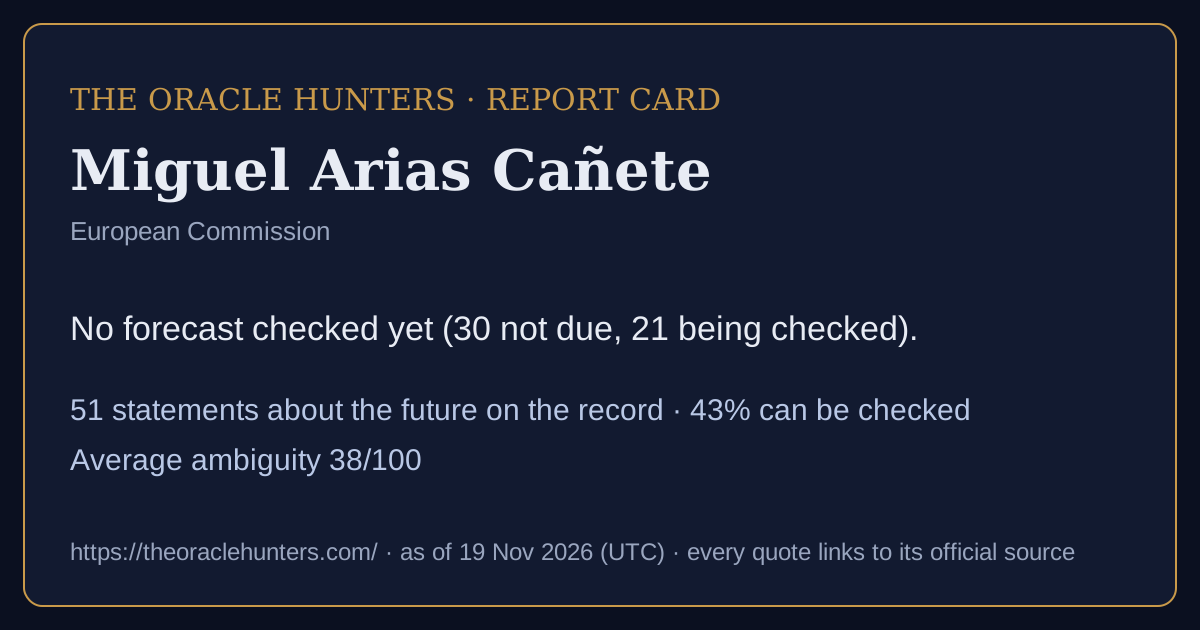
Track record: No forecast checked yet (30 not due, 21 being checked).
51forecasts & commitments on the record
43%can be checked as stated
38average ambiguity (0-100)
0goalpost moves recorded
0confirmed U-turns
Timeline
came true partly did not not due / being checked / too vague
Calibration score: shown after 10 checked forecasts with a stated likelihood (now 0).
How they speak about the future: based on data 40, stated on authority 10, educated guess 1.
Kinds of claim: forecast 33, mixed claim 14, scenario (if… then) 2, commitment 2. · Download this report card as a picture
In the nine words
πρόγνωσιςInference from evidence39 · 76%μαντείαInspired knowledge8 · 16%προαναγγελίαPublic pre-announcement2 · 4%πρόνοιαPreparing for the future2 · 4%
How to read this
Each box is one sentence a public figure or institution said about the future, word for word, with a link to the official text. Can be checked means it names what will happen, by when, and how likely - so it can be compared with official figures later. Too vague to check means it does not. Ambiguity (0-100) is how many different ways the sentence can be read. When the date passes, the forecast is compared with official data and marked came true, partly or did not come true. Labels judge the sentence, never the person. Full guide and glossary.On the record (51)
The publication of the Commission proposal in November will stimulate further debate within the EU – with active input from the Council and the European Parliament expected in the course of 2019.
Coming forward in November with the Commission proposal will also allow us to have a broad and thorough discussion next year so that we can submit a long-term strategy to the UNFCCC, at the latest in early 2020, as required under the Paris Agreement.
Our initial calculations suggest that the European Union could consider raising the level of ambition and increase its target from the current 40% to slightly over 45% by 2030.
With the cost of renewables having dropped enormously in recent years – solar panels are more than 80% cheaper to produce than they were 10 years ago - we need to consider the likely developments in terms of technological innovation and economies of scale.
While our current approach to reduce emissions by at least 80% is compatible with a 2°C objective, our long-term strategy will have to consider more ambitious options in order to achieve 1.5°C.
One thing is clear: if we want to meet the Paris goals, we will need to look at higher reductions in emissions than is presently the case for the longer term, building on our recently agreed 2030 targets for renewables and energy efficiency.
Indeed on 23-24 May of this year, the Commission will be co-hosting in Copenhagen, together with Denmark, Finland, Norway, Sweden and the Nordic Council, the Ninth meeting of the Clean Energy Ministerial (CEM).
Overall, good progress is being made in the discussions with the Council and the Parliament on the Clean Energy package proposals and I expect them to be adopted before the end of this year.
It is a measure of the success of all involved that the first gas from Azerbaijan will be delivered to Turkey this summer already, and that it should arrive in Europe as of 2020.
In this context we will notably have to find an agreement on the level of the targets for renewables and energy efficiency for 2030, where the Parliament is pushing for a higher level of ambition compared to our proposals of 27% for renewables and 30% for efficiency.
As I just mentioned, the EU will prepare, by 2020, a mid-century low emissions development strategy, that will enable the EU to lead the global transformation towards climate neutrality.
Reducing our emissions by at least 40% by 2030 is in line, in the medium term, with the Paris Agreement's goals.
With global supply of LNG set to increase by up to 50% in the next few years, we have a major opportunity to strengthen our resilience, diversify our supply sources and boost our competitiveness.
Our proposals later this year for a new electricity market design will provide the flexibility and demand response to make that happen.
The point is that gas will still be an important part of our energy system come 2030.
We are talking of major projects like the Galloper Wind Farm in the UK, where €300m of EU investment is helping to build an offshore wind farm capable of providing enough clean energy to supply over 300,000 homes from 56 of the world’s largest wind turbines.
That is why our new €315 Billion European Fund for Strategic Investments, launched last year, has made renewable energy projects a priority.
These projects are so important when you consider that $13.5 trillion of investment in clean energy technologies and energy efficiency will be needed to implement the INDCs.
Our proposals later this year will focus on increased regional co-operation and ensuring that renewables become the driving force of our energy system.
You just have to look at the RE100 project that has seen the world's biggest multi-nationals committing to using 100% renewable electricity.
In all of this, we will increase our support to the vulnerable to adapt to climate change and to cope with loss and damages.
With the Gemini project for example the European Investment Bank invested 587 million euros of EU public money.
That will then feed into the Commission's Strategic Communication on Research and Innovation due before the end of 2016.
Its 600MW will supply renewable electricity for more than 1.5 million people and 785,000 households!
Together with the Strategic Transport Research and Innovation agenda and with the Global Technology and Innovation Leadership Initiative, they will represent the three strands that will contribute to the research and innovation competitiveness strategy to be presented as of part of the State of the Energy Union in 2016.
Fourthly, we will have to intensify our collaboration before 2020 and reduce even more emissions.
That's particularly important because better demand-response could help us save up to €100 billion a year.
And that could not be better reflected than in the theme of this year's conference.
This will need a strengthened ETS and the proposals we are going to make next week will be an important milestone for that.
If we are to achieve our target, up to 50% of generation will have to come from renewable sources by 2030.
Therefore, as part of the Energy Union, the Commission will publish a Nuclear Illustrative Programme (PINC) by the end of the year.
That will have to be implemented by the Member States by February 2018 and will bring the highest level of protection of workers, patients and the general public across Europe.
The EU has amended the Nuclear Safety Directive, which will need to be implemented by August 2017.
I want to be clear on this: there will be new standards post-2020.
When it comes to transport, the report shows that with a share of 5.7% in 2014, achieving our 10% target of renewable energy in transport will certainly be challenging, yet feasible.
So, in the first half of next year, together with the Effort Sharing Decision, the Commission will also present a Communication on Decarbonisation of Transport which will set out our strategy to reduce greenhouse gas emissions in transport.
To get there, NON-ETS sectors, that is to say transport, agriculture and the building sector, will have to reduce emissions by 30% compared to 2005.
So far, 38 renewable projects and Europe's first large-scale carbon capture and storage project have been awarded NER300 funding amounting to €2.1 billion.
And if we raise our ambition further on renewable and energy efficiency, this could reach 1.2 million.
The programme will be renewed under the 2030 climate and energy framework and extended to low-carbon innovation in the industrial sector.
Our 2030 climate and energy targets could create a further 700,000 jobs.
And we will need intelligent transport solutions to meet our 2020 target of having 10% of the transport fuel of every EU country come from renewable sources such as biofuels.
Later this year I will be going to Paris to agree on a global climate deal which will put renewables front and centre of our energy system in 2030 and beyond.
If we reach our 2030 target, around half of electricity production will come from renewables in 15 years.
It is clear that a lot of investment will be needed in the years to come – we had previously estimated the needs at around 1 trillion euro by 2020.
And it is these same objectives that will drive the next stage of development of the Internal Energy Market, where much remains to be done if we are to achieve my vision of a truly integrated market.
Furthermore, the EU will become more dependent on imports; for example the 10 BCM delivered via the Southern Corridor at the end of the decade will be offset by declining domestic production, unless the EU succeeds in developing shale gas.
A Communication on market design this year will launch this process.
The long term job is to review the ETS, for which I will make a proposal later this year.
To me this means becoming a global hub for developing and manufacturing the next generation of renewable energy technologies, and putting into place the policies that will be the example of how to catalyse an extraordinary expansion of investment in new, highly competitive clean energy; for this is what the 27% target by 2030 demands.
Showing the newest 50 - the ledger has all 51.
Also said - not checkable as stated (12 newest)
Remarks about the future with no date, figure or likelihood that could be checked. They are kept on the record and shown here, but not scored.
Ukraine has embarked on an impressive energy reform agenda, and we will continue to provide all the help needed to bring it to a successful end.
In the coming weeks I will pay a visit to Egypt and discuss our energy cooperation.
In that regard, we (the EU and the Member States) should deliver on our commitment to scale up the mobilisation of climate finance in order to contribute our share of the 100 billion US dollars per year by 2020.
It will not be easy, but we are determined to deliver.
We should continue to support developing countries in the implementation of their national climate action plans, with such support programmes to be rolled out as of this year.
The special report by the Intergovernmental Panel on Climate Change on the specific policy implications of a 1.5°C goal will be critical in informing those discussions.
And that is why we will reinforce our dialogue with international partners to promote free, liquid and transparent global LNG markets.
All countries will have to ensure the supply of households and essential social service in case of a crisis.
In practice this means Member States will have to give priority to protected consumers in neighbouring countries over non-protected customers at home.
The investment figures I just mentioned are a stunning riposte to all those who expected clean energy investment to stall on falling oil and gas prices.
We will capitalise on that momentum tomorrow when all 28 EU Energy Ministers will join Vice-Presidents Šefčovič, Katainen and I to discuss how best to unlock the potential of research and innovation in the energy transition.
In just a few months we will head to Paris to secure a legally binding, ambitious global climate agreement.