Michelle W Bowman
Federal Reserve
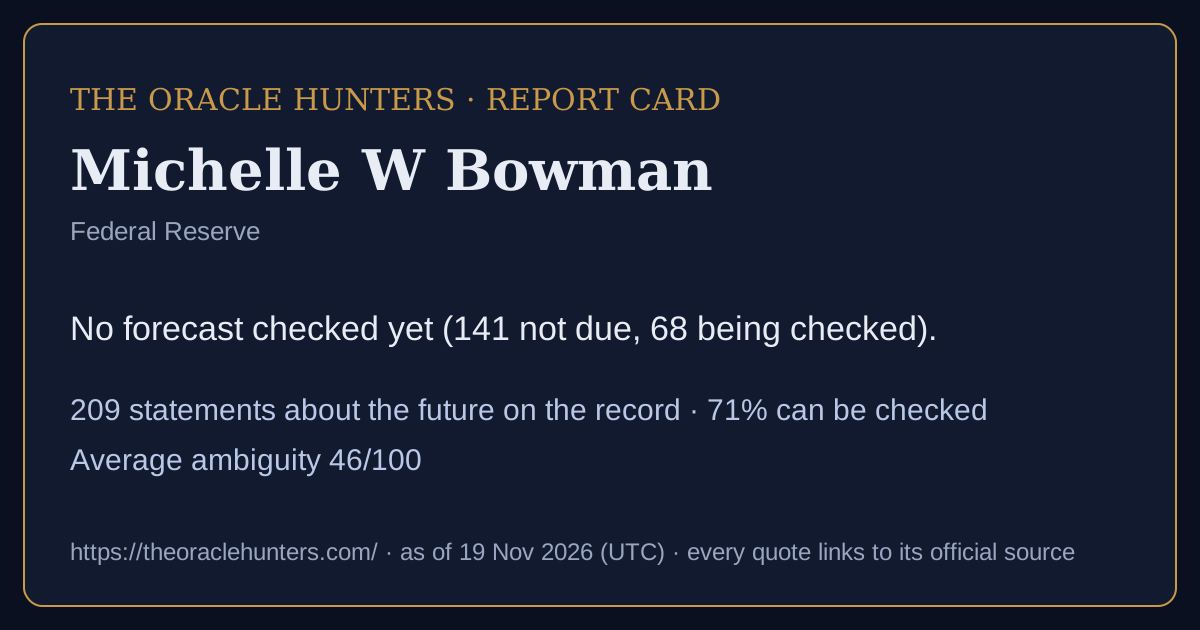
Track record: No forecast checked yet (141 not due, 68 being checked).
209forecasts & commitments on the record
71%can be checked as stated
46average ambiguity (0-100)
0goalpost moves recorded
0confirmed U-turns
Timeline
came true partly did not not due / being checked / too vague
Calibration score: shown after 10 checked forecasts with a stated likelihood (now 0).
How they speak about the future: based on data 140, stated on authority 53, educated guess 16.
Kinds of claim: forecast 162, mixed claim 27, scenario (if… then) 12, commitment 8. · Download this report card as a picture
In the nine words
πρόγνωσιςInference from evidence134 · 64%μαντείαInspired knowledge48 · 23%πρόνοιαPreparing for the future12 · 6%προαναγγελίαPublic pre-announcement8 · 4%εἰκασίαConjecture5 · 2%πρόβλεψιςSeeing the signs2 · 1%
How to read this
Each box is one sentence a public figure or institution said about the future, word for word, with a link to the official text. Can be checked means it names what will happen, by when, and how likely - so it can be compared with official figures later. Too vague to check means it does not. Ambiguity (0-100) is how many different ways the sentence can be read. When the date passes, the forecast is compared with official data and marked came true, partly or did not come true. Labels judge the sentence, never the person. Full guide and glossary.On the record (209)
Futures markets expect oil prices to decline only gradually, as global oil consumption is projected to exceed supply at least through the end of this year.
I expect the labor market to remain stable and inflation to slow, as special factors currently holding inflation elevated gradually wane or unwind next year.
While I continue to expect that several of the factors currently boosting inflation will abate next year, currently inflation has proven to be more persistent than I had anticipated.
While the labor market has improved more than I expected this year, our progress on lowering inflation has disappointed.
Note that currently reported GDP growth in the first half of this year may be overestimated by about 0.3 percentage point, reflecting downward revisions in the retail sales annual update that were not folded into the Bureau of Economic Analysis (BEA) 2026 annual revision of the national accounts.
As these shocks wane or unwind and with no inflationary pressures emerging in the labor market, my forecast is for core PCE inflation to move closer to 2 percent next year.
For the past 15 years, a community bank has been defined as a bank with assets of less than $10 billion.4 Fixed asset thresholds can push a smaller noncomplex bank into a higher supervisory tier with standards designed for more complex institutions and stronger supervisory scrutiny—like those based on the risk of their activities.
Later this year, the Board will consider broader structural reforms to bank portfolios defined by asset size and updates to the large bank tailoring framework.
Later this year, the Board will consider updates to fixed-dollar asset thresholds in the Board's regulations to account for inflation and economic growth.
This year's workshop demonstrates the Federal Reserve System's ongoing commitment to identify and equip community banks with resources that may be necessary to combat cyber risks.
In addition to finalizing these two rules, I will recommend consideration of a third proposal that will revise the 2027 test models.
They will also include alternative model considerations and specific model changes the Board plans to implement for the 2027 stress test.
In addition, and before the end of this year, I expect the Board to finalize reforms to risk-based capital requirements for large and small banks as well as improvements to the global systemically important bank (GISB) surcharge.
We stand ready to share our experiences, learn from others, and work together toward common goals of financial stability, innovation, and economic growth.
The feedback we hear from you today and throughout the public comment period will help inform our final report delivered to the U.S. G-20 presidency later this year.
Changes to the underlying structure of the economy that are expected to persist in the longer run may result in employment rising above existing assessments of maximum employment without necessarily generating upward pressure on inflation above 2 percent.8 The combination of low inflation and low unemployment may reflect positive supply shocks that are working their way through the economy.
Most often, this occurs when inflation is already near or expected to run below 2 percent and the labor market is fragile or expected to deteriorate, with rising unemployment and relatively weak job gains.
Therefore, looking through temporary inflation shocks may be appropriate to achieve optimal policy, as long as doing so does not affect our credibility to bring inflation back to 2 percent.
According to the U.S. Chamber of Commerce's Small Business Index, 44 percent of small businesses expect to increase investment over the next year, and 42 percent expect to increase staffing.
Banks that maintain HQLAs at or above 100 percent of presumed outflows are often reluctant to use them out of concern they will fall below the minimum LCR.
Strong risk management, whether in credit, liquidity, cybersecurity, or operations, remains essential, and we will continue to examine for these risks
Since banks securitize roughly 75 percent of their mortgage originations to low- to-moderate income, or LMI, borrowers, the capital treatment may particularly affect mortgage availability and affordability for these borrowers.7
On the outlook for monetary policy, with inflation close to 2 percent, after excluding one-off tariff effects, and with unemployment near estimates of its natural rate but at risk of deteriorating, I continue to see policy as moderately restrictive.
With a less dynamic low-hiring, low-firing labor market, which some have said is giving rise to a "jobless expansion," we could see layoffs rise quickly if firms begin to reassess their staffing needs in response to weaker activity.
Based on the latest consumer and producer price reports, 12‑month core PCE inflation likely stood at or a little below 3 percent in December, up somewhat since September.
On inflation, we have seen considerable progress in lowering the underlying trend, considering that still-elevated inflation mostly reflects tariff effects on goods prices that I expect will fade this year.
Ultimately, also considering that inflation remains somewhat elevated, at this meeting I decided to lean in favor of waiting for the upcoming sequence of data releases in order to gain more certainty about how the economy is likely to evolve in the coming months.
I am also confident that inflation will come down toward 2 percent as tariff effects on goods inflation continue to wane in coming months.
These decisions were intended to proactively limit the risk of greater and more persistent damage to the labor market, while inflation continued to show signs that it is on a sustained downward trajectory toward our 2 percent objective.
Based on the latest consumer and producer price reports, 12‑month core PCE inflation likely stood at 2.9 percent in December.
We will continue to focus on improving the mergers and acquisitions review process, assessing the appropriateness of capital requirements across the banking system, addressing payments and check fraud, and strengthening examiner training and development.
Core services inflation is already roughly consistent with our target, and only core goods inflation remains elevated, but I expect it to start moving down in coming months as the effects of earlier price increases and one-time tariff-related adjustments fade.
On inflation, we have seen considerable progress in lowering the underlying trend, considering that still-elevated inflation mostly reflects tariff effects that I expect will fade this year.
I am also increasingly confident that inflation will come down toward 2 percent as tariff effects on goods inflation continue to wane in coming months.
The proposal will invite public comment on the specific modeling changes that the Board plans to implement for the 2026 stress test, including proposed changes that address the sensitivity of pre-provision net revenue projections to recent bank performance, and to improve the design and related assumptions for certain models including credit losses, operational risk and securities.
If fiscal sustainability concerns are not addressed in the years ahead, by stabilizing or reversing the upward trajectory of the federal debt-to-GDP ratio, I am afraid that r* and interest rates could rise and crowd out private investment.
With tariff-related price increases likely being a one-time effect, my view is that inflation will return to 2 percent after these effects dissipate.
Recognizing the substantial risk that unacceptably high inflation could persist, and once the conditions in the labor market were moving toward the FOMC's goal of maximum employment, by the end of 2021 I shifted my focus to the inflation side of our mandate and to bringing inflation down toward our 2 percent goal.
We are continuing to enhance examiner training and development, and we will continue to prioritize economic growth and safety and soundness in the bank regulatory framework.
This shift is appropriate now because forecasters widely expect inflation to significantly decline next year, and as further deterioration in labor market conditions would likely lead to more persistent damage to the employment side of the mandate, that would be difficult to address with our tools.
Based on the latest consumer and producer price reports, 12‑month core PCE inflation likely stood at 2.9 percent in August.
The surge in immigration likely boosted the rise in unemployment through mid-2024, and lower immigration may now be masking a steeper rise in unemployment this year.
Although less immigration likely explains some of the slower payroll gains and economic growth this year, immigration does not fully explain the slowing.
This should be especially the case since forecasters widely expect inflation to significantly decline next year, and as further deterioration in labor market conditions would likely lead to more persistent damage to the employment side of the mandate that would be difficult to address with our tools.
For example, reducing the CBLR requirement from 9 percent to 8 percent could not only allow more community banks to adopt the framework but also increase balance sheet capacity for all CBLR firms, facilitating additional support for local economies through lending.
With tariff-related price increases likely representing a one-time effect, my view is that inflation will return to 2 percent after these effects dissipate.
With housing services inflation on a sustained downward trajectory and other core services inflation already consistent with 2 percent inflation, only core goods inflation remains elevated—likely reflecting limited passthrough from tariffs.
My Summary of Economic Projections includes three cuts for this year, which has been consistent with my forecast since last December, and the latest labor market data reinforce my view.
The theme of this year's conference is "Unleashing a Financially Inclusive Future." Today, we will hear from a number of experts that will help to explore what the future might hold for financial inclusion.
With housing services inflation on a sustained downward trajectory, and other core services inflation already consistent with 2 percent inflation, only core goods inflation remains somewhat elevated likely reflecting limited passthrough from tariffs.
Showing the newest 50 - the ledger has all 209.
Also said - not checkable as stated (12 newest)
Remarks about the future with no date, figure or likelihood that could be checked. They are kept on the record and shown here, but not scored.
A supervisory organization that treats every issue as equally important will tend to devote substantial attention to matters that are easiest to document, measure, and track, leaving other risks that require synthesis, experience, and enhanced judgment to receive less attention than they deserve.
They should prioritize work on areas that matter most—issues related to safety and soundness as well as financial stability.
By expanding the range of institutions treated as community banks that operate using a traditional community bank business model and relationship banking and appropriately modifying the supervisory expectations and regulatory requirements for these firms, we will preserve safety and soundness while effectively applying appropriately tailored and risk-calibrated supervision and regulation.
This regulatory housekeeping should not require comprehensively and routinely revisiting our regulations to update thresholds so that they remain appropriate for future economic conditions, so we have included mechanisms that will allow this adjustment on a regular cadence.
If an issue arises that may present a material financial risk to a regulated firm's safe and sound operation, but this issue is not sufficiently addressed by existing supervisory tools, those issues should be escalated up the management chain for review.").
This increase in dealer holdings has likely absorbed some positions previously held predominantly by hedge funds as part of the cash-futures basis trade.
Throughout the next two days, you will gain valuable perspective through a cybersecurity tabletop exercise, explore how AI can enhance cyber defenses and its potential risks, hear from the Secret Service and the Federal Reserve's Cybersecurity Analytics Support Team, and engage more deeply with examiners, community bankers, and industry professionals, including those from the Cyber Risk Institute.
These changes have clear impacts on banks—they must continuously evolve cyber defense strategies and tactics.
In finalizing these reforms, we will finally close the book on an opaque and unnecessarily unpredictable framework.
In the coming weeks, the Federal Reserve Board will consider final revisions to the Board's stress testing framework.
If firms take additional risks, they should expect those risks to be reflected in greater losses in the stress test, which in turn would lead to higher capital requirements.
Redirects examiners' attention to prioritize threats that could result in significant harm to the financial condition of a banking organization or U.S. financial stability, instead of focusing excessively on procedural or documentation footfaults.