Michelle Donelan
Department for Education · GBR
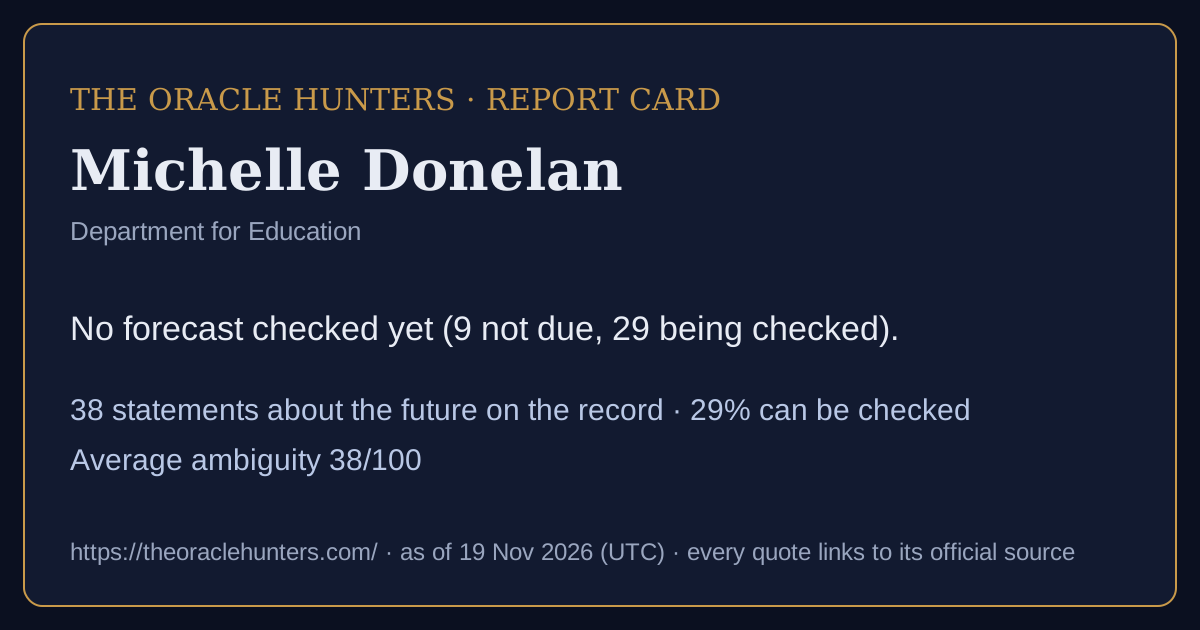
Track record: No forecast checked yet (9 not due, 29 being checked).
38forecasts & commitments on the record
29%can be checked as stated
38average ambiguity (0-100)
0goalpost moves recorded
0confirmed U-turns
Timeline
came true partly did not not due / being checked / too vague
Calibration score: shown after 10 checked forecasts with a stated likelihood (now 0).
How they speak about the future: based on data 24, stated on authority 14.
Kinds of claim: forecast 25, mixed claim 11, commitment 2. · Download this report card as a picture
In the nine words
πρόγνωσιςInference from evidence24 · 63%μαντείαInspired knowledge12 · 32%προαναγγελίαPublic pre-announcement2 · 5%
How to read this
Each box is one sentence a public figure or institution said about the future, word for word, with a link to the official text. Can be checked means it names what will happen, by when, and how likely - so it can be compared with official figures later. Too vague to check means it does not. Ambiguity (0-100) is how many different ways the sentence can be read. When the date passes, the forecast is compared with official data and marked came true, partly or did not come true. Labels judge the sentence, never the person. Full guide and glossary.On the record (38)
Next month I will travel to Korea to co-host the second summit, and we have the France safety summit planned for early next year.
Our £1 billion semiconductor strategy is unlocking new investment in semiconductor manufacturing which will be fundamental for the net zero transition.
The Budget last week was the latest affirmation of our commitment here, from a new £7.4 million upskilling fund pilot that will help SMEs develop AI skills of the future… to the announcement that we will invest in AI Document Processing and a new pilot for using AI in speeding up planning processes.
But as I said earlier this year, data-driven public services are not just a nice to have, they are an absolute necessity if we are going to be able to deliver more for the public at better value for money.
And that is also why this year, I will develop a regulatory support service specifically designed to help science and tech companies to navigate rules and regulations.
UKRI will simplify and expand its support for innovative, growing firms across the country with InnovateUK aiming to reach a million innovators by the end of the year, and to halve the average time it takes companies to go from application to receiving grant funding.
And it will be designed to turn missed opportunities into seized opportunities - embodying what I want this year for my department to be all about – aspiration, opportunity, and delivery.
So today, I am committing to the data-driven scale-up agenda and will be making data access a government priority this year – looking at ways of improving data access and data use in order to fuel even faster growth in scale-ups, whilst of course continuing to prioritise data privacy and data consent.
That is why we have set ourselves a clear target to spend £20 billion pounds per annum in research and development by next year, which is record levels of funding.
Colleges and universities are set to benefit from up to £32 million of additional funding this year so they can invest in equipment and facilities that will support technical studies, and boost training opportunities with businesses in key areas such as digital, construction and health care.
We are also announcing a new £25,000 repayment threshold – which will be introduced for new borrowers from 2023 - meaning graduates will make at least a modest contribution to paying back their student loan once they start benefitting from it.
£750 million will go towards delivering high quality teaching, facilities and equipment and expand the UK’s provision of high-cost, high-return subjects that will in turn drive our economy in the future, including the growth of strategically important STEM subjects, and turbocharge something I am particularly passionate about - degree apprenticeships.
In response to the recommendations made by the Augar panel, we are going to be seeking views on exploring the use of targeted student number controls as a possible option to stem the growth of low quality courses.
So from 2025, we will have lifelong learning accounts.
In fact, as a result of 7 years of fee freezes, a student finishing their course in 2024/25 will need to borrow over £5,000 less than they otherwise would have to.
Our relentless focus on quality is what has led us to where we are now, and it is why today I can announce that we will be investing almost £900m of new money in higher education over the next three years.
The fact that more students from disadvantaged backgrounds went to university this year than ever before in history, and that a disadvantaged 18-year-old is 82% more likely to go to university today than they were in 2010 are triumphs, but I am afraid not the finish line.
So from 2025, we will have LLE accounts.
approved 30 digital higher technical qualifications for first teaching in September 2022, and by 2025 these qualifications will be rolled out across all technical routes;
Well, after 2025, that technician could log onto their online LLE account and see their loan entitlement, and receive clear signposting of the courses and modules they can get onto to reach their career goals.
That is why this year we will be piloting short courses and I will be announcing the successful bids soon.
The Turing scheme will be backed by a budget of £110m, and will provide funding for around 35,000 students in universities, colleges and schools to go on placements and exchanges across the world for the upcoming academic year.
The Graduate Immigration Route, for example, will launch this year.
What we learn from this trial will inform our approach to lifelong learning, and is a key step towards our delivery of the Lifelong Loan Entitlement, as well as supporting some students to participate on shorter modular courses in England as early as 2022.
Introduced from 2025, the Lifelong Loan Entitlement will provide individuals with a loan entitlement to the equivalent of four years of post-18 education to use over their lifetime.
From 2022, we will be trialling loan-funded access to tuition fees for certain modules at a number of institutions across England.
We will consult on the detail and scope of the Lifelong Loan Entitlement this year to make sure that it works as effectively as possible.
Recent polling from Universities UK shows 82 per cent of prospective students in England who are either unemployed, at risk of unemployment, or looking to learn new skills would be keen to study individual modules at a university degree level.
By doing so, we will be helping all those who have the ability, attainment and desire to pursue higher education by giving them high quality options that will lead to the good graduate jobs – that will in turn transform their lives.
We will consult on the detail and scope of the Lifelong Loan Entitlement this year and will set out proposals for how we introduce this reform and consensus on how it can really benefit students and enable providers to put on the type of courses which will fill these skills gaps.
So, imagine how this year’s cohort will feel?
And I am pleased to tell you, that we have worked with the OfS, UKRI and the Department of Health and Social Care to identify a number of sources of unnecessary bureaucracy that will be removed immediately, and we are going to look to cut this further with a system-wide review over the coming months.
We have also confirmed that undergraduate and master’s graduates, will benefit from two years of leave in the UK to work, or look for work, under the new, globally competitive, Graduate route, when it is introduced in Summer 2021.
That’s why, I really welcome the launch of UCAS’ Clearing+ this year, so that those applicants in clearing will be sent a personalised set of options and courses they could take with the grades they have achieved.
This has been based on forecasts from the sector themselves, which allows additional growth of up to 5% in the next academic year.
In addition to this, the £1m of funding that I announced in March for the OfS Challenge Competition to develop innovative approaches to addressing mental health challenges for at risk groups will also move this agenda forward.
Universities didn’t close and students will graduate as planned and new students will start university this year.
I want to use this opportunity to highlight and remind everyone that last year we announced a new Graduate Route to enable international students who had been awarded their degree to stay and work here for up to two years, this will be introduced in Summer 2021.
Also said - not checkable as stated (12 newest)
Remarks about the future with no date, figure or likelihood that could be checked. They are kept on the record and shown here, but not scored.
In phase 2 from Seoul to France, we will push the boundaries of nascent science of frontier AI testing and evaluation.
I look forward to engaging in detailed discussions and agreeing on concrete, tangible actions that will propel us into the next phase of global AI safety policy.
International collaboration between AI safety institutes and their equivalents will be absolutely mission critical to our shared success, and today’s showcase provides an opportunity to learn from one another and lay the very foundations for sustained and productive collaboration.
As the pace of AI development accelerates, we must match that speed with our own effort and action if we are to grip the risks and seize the opportunities.
But, no matter what path you take, this government will do all it can to support you.
That is why I set out a pro-safety, pro-innovation approach to regulating AI that will drive growth and create jobs across the country.
Some of those firms will benefit from BridgeAI, too, which is supporting British businesses in high-growth sectors like construction and logistics to boost their productivity - and compete on the global stage.
Because it is talented people like you who hold the key to the kind of sustainable economic growth that will see Britain succeed in the century to come.
Curing cruel diseases like cancer and dementia are genuinely now on the cards with advancements in AI around the corner, which is great news but should not mean we just sit and wait and expect it to happen.
Let’s think about that for a moment – every 13 seconds, this government, working with industry, is improving another person’s economic output by £217 – and probably more in the same household.
The pilots will help generate new AI services to support teaching and promote better data access and services in the adult social care sector.
The NHS has already used innovative data analysis to target the HPV vaccine at younger patients, where its benefits will be felt most strongly.