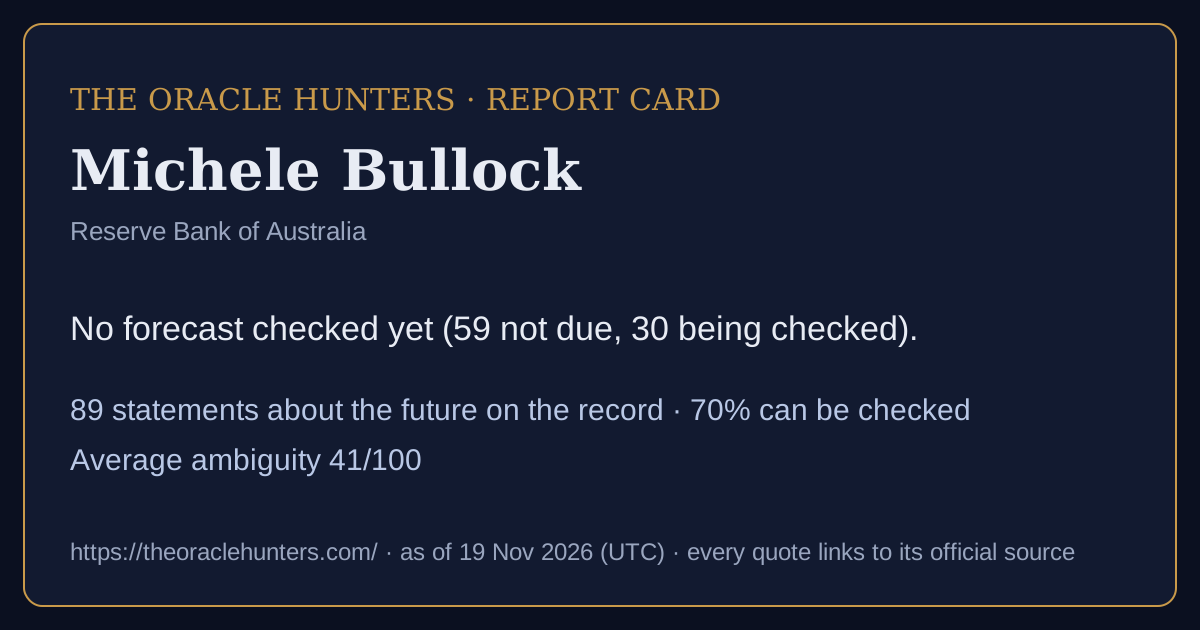
Michele Bullock
Reserve Bank of Australia
Track record: No forecast checked yet (59 not due, 30 being checked).
89forecasts & commitments on the record
70%can be checked as stated
41average ambiguity (0-100)
0goalpost moves recorded
0confirmed U-turns
Timeline
came true partly did not not due / being checked / too vague
Calibration score: shown after 10 checked forecasts with a stated likelihood (now 0).
How they speak about the future: based on data 47, educated guess 23, stated on authority 19.
Kinds of claim: forecast 58, scenario (if… then) 21, mixed claim 7, commitment 3. · Download this report card as a picture
In the nine words
πρόγνωσιςInference from evidence43 · 48%πρόνοιαPreparing for the future21 · 24%μαντείαInspired knowledge17 · 19%προαναγγελίαPublic pre-announcement3 · 3%εἰκασίαConjecture3 · 3%φρόνησιςPractical wisdom1 · 1%πρόβλεψιςSeeing the signs1 · 1%
How to read this
Each box is one sentence a public figure or institution said about the future, word for word, with a link to the official text. Can be checked means it names what will happen, by when, and how likely - so it can be compared with official figures later. Too vague to check means it does not. Ambiguity (0-100) is how many different ways the sentence can be read. When the date passes, the forecast is compared with official data and marked came true, partly or did not come true. Labels judge the sentence, never the person. Full guide and glossary.On the record (89)
We are not alone in being concerned about inflation – central banks in many other advanced economies are responding by increasing their policy rates or signalling they will do so if needed.
As you know, the Monetary Policy Board sets monetary policy such that inflation is expected to return to the midpoint of the 2–3 per cent target range.
We are not alone in being concerned about this - central banks in many other advanced economies are responding to this global inflation shock by increasing their policy rates or signalling they will do so if needed.
As you know, the Monetary Policy Board sets monetary policy such that inflation is expected to return to the midpoint of the 2-3 per cent target range.
Our latest forecasts - which were published in the August Statement on Monetary Policy - suggested that inflation will not return to around the midpoint of the target range until late 2027.
While it had declined to around 2½ per cent by the end of 1984, this came at the cost of a sharp rise in the unemployment rate from around 6 per cent at the turn of the decade to a peak of 10½ per cent in 1983 (Graph 7).
While the effect on fuel prices and headline inflation has so far been smaller than initially feared, headline inflation remained well above target at 4 per cent in May (Graph 1).
- We will learn more about how higher fuel prices are filtering through to other prices from the June Consumer Price Index (CPI) data released the day after this speech is delivered (29 July).
We had expected conditions to ease in response to the changed outlook for monetary policy and the rise in the cash rate earlier this year.
We will be carefully monitoring conditions to assess how the combined effects of higher interest rates and the energy price shock are playing out.
GDP growth is expected to slow this year, reflecting the effects of higher interest rates and the conflict in the Middle East.
In our baseline forecasts published in May, headline inflation is expected to peak at over 4½ per cent in the June quarter, while underlying inflation remains above the target range until mid-2027.
Headline inflation was 3.8 per cent in the year to January and it will continue to be boosted for a time by the unwinding of electricity rebates.
We will also be publishing more insights from this survey later this year.
With underlying inflation now expected to enter the 2-3 per cent range in mid-2027 and the labour market still somewhat tight, the Board was unanimous in its decision to raise the cash rate in February.
Nonetheless, I would encourage all industry participants and the public sector to take this opportunity to work collaboratively to develop a system that delivers the attributes the public expect, and that supports innovation and resilience in our economy, well beyond 2030.
The Governance Board will report on our progress on achieving the objectives of the Review by the end of this year.
The recent interest rate cuts are expected to support spending by households and businesses, and growth in the Australian economy is expected to pick up a little further over the next year.
That's why it feels especially timely to be speaking with you today about a major structural shift reshaping Australia's economy — one that, if harnessed effectively, could unlock new waves of innovation, creativity and future productivity growth.
Beyond AI, the Productivity Commission estimates that data sharing and access in a mature digital environment could add an additional $10 billion to Australia's annual economic output. ?
Recent analysis from the Australian Government suggests that generative AI alone could contribute between $45 billion and $115 billion annually to the Australian economy by 2030. 2
Raising interest rates makes little sense if inflation is expected to ease once temporary supply disruptions are resolved - it would only weaken the job market.
We expect headline inflation in the June quarter to be in the lower half of our 2-3 per cent target range although that partly reflects the ongoing effect of temporary cost-of-living relief.
If you cast your mind back to 2022, you will recall that inflation was higher than it had been in decades, peaking at 7.8 per cent at the end of that year.
Our overall assessment at the time of our most recent forecast in May was that there was still some tightness in the labour market, and we expected it to ease a little over the remainder of this year.
We expect trimmed mean inflation to fall a little further in the June quarter in year-ended terms.
As that effect unwinds, we expect headline inflation to pick up to around the top of the band at the end of this year and into the first part of 2026.
If so, it would continue to weigh on output growth and could result in a sharper deterioration in the labour market than currently projected.
But in the forecasts published this week, the central projection suggests that if monetary policy is eased too quickly or by too much, disinflation could stall and inflation would settle above the midpoint of the target range.
The Governance Board will report on our progress on implementing the reforms by the end of this year.
We discussed some of our initial concerns publicly in December following a period of extensive consultation with stakeholders, and next month will publish a report outlining
Our forecasts for the economy, which are conditioned on the market implied cash rate path, have growth strengthening over the course of this year, the unemployment rate rising a little before stabilising at 4… per cent, and underlying inflation coming down further to a little above the midpoint of our 2-3 per cent target range from late 2025 onwards.
We expect the Payments System Board to consider and respond to this consultation in the first half of next year.
I have held media conferences after each of the Board's decisions this year, and these will continue next year.
If we fail to bring inflation down in a sustainable way, cost-of-living pressures will only compound and monetary policy would need to remain restrictive for longer.
Our forecasts published in the November Statement on Monetary Policy suggest that a sustainable return to target will occur in 2026.
Looking ahead for Australia, RBA staff expect inflation to return sustainably to the 2.5 per cent midpoint of the target range by late 2026 as restrictive financial conditions gradually bring the economy and labour market into better balance.
Monetary policy settings will nevertheless need to remain restrictive until the Reserve Bank Board is confident that inflation is on track to return sustainably within the target range and approach its midpoint of 2.5 per cent.
If businesses and workers come to expect that prices and wages will continue rising quickly this adds to inflationary pressures, requiring even higher interest rates to bring inflation down.
Over time, inflation expectations will only remain aligned with the target if we continually work to return inflation there when it moves too far up or down.
For example, it might be hard for a firm to lock in a supply contract if it doesn't know what prices are going to be over the next year.
Year-ended growth in advertised rents is still high, reflecting pressure from a rebound in housing demand and limited supply response. Rents on new leases take time to impact overall CPI rents because only a small share of the stock of rental properties update leases in a given month and so CPI rents inflation is likely to be high for some …
This meant that the central forecast for inflation was based on cuts in the cash rate starting early next year.
In our central August forecast, underlying inflation is expected to be back in the target range by the end of next year, and to approach the midpoint in 2026 (Graph 1).
In late June, an industry support package of approximately $50 million over 12 months was agreed between Linfox Armaguard and its major banking and retail customers, reducing the near-term risk of a major disruption.
The scenarios show that if consumption or the labour market are weaker than expected, inflation could return to the target band more quickly and the unemployment rate could rise more sharply.
It is forecast to approach the midpoint of the target band in 2026.
Financial markets are still pricing in a rate cut by the end of the year.
Inflation is still too high and, in underlying terms, is not expected to be back in the top of the band until the end of next year.
Over the past year, prices have come down a little and production is forecast to have declined somewhat, but both prices and production are expected to remain at high levels in coming years, which would be good news if it eventuates.
Showing the newest 50 - the ledger has all 89.
Also said - not checkable as stated (12 newest)
Remarks about the future with no date, figure or likelihood that could be checked. They are kept on the record and shown here, but not scored.
Our most recent published forecasts – in the August Statement on Monetary Policy – suggested that inflation would not return to around the midpoint of the target range until late 2027.
Designation does not mean that the RBA will exercise crisis-readiness or resolution powers in relation to Linfox Armaguard – it just means that we have the ability to act if we need to.
Because of both these factors, inflation is likely to remain elevated for some time.
Developments since then suggest that although growth in the Australian economy is slowing as expected, some of the international and domestic upside risks to inflation have materialised or are materialising.
Designation does not mean that the RBA will exercise crisis-readiness or resolution powers in relation to Linfox Armaguard - it means that we have the ability to act if we need to.
Because of these capacity pressures and the Middle East conflict, inflation is likely to remain elevated for some time.
Oil and related prices have increased sharply again and will add directly to inflation.
That challenge sits at the heart of both the IFC and the discussions we will have over the next two days.
While today's central banks have access to vastly more information than Fisher could ever have imagined, the challenge is much the same.
Aboriginal and Torres Strait Islander peoples should be aware that this website may contain the names, images and voices of people who are now deceased.
Ongoing commodity price volatility seems likely, which makes it even more difficult to assess the ultimate effect on inflation and activity.
Inflation is too high, and the Board will do what it considers necessary to achieve our mandate to deliver price stability and full employment.