Michel Barnier
European Commission · EU
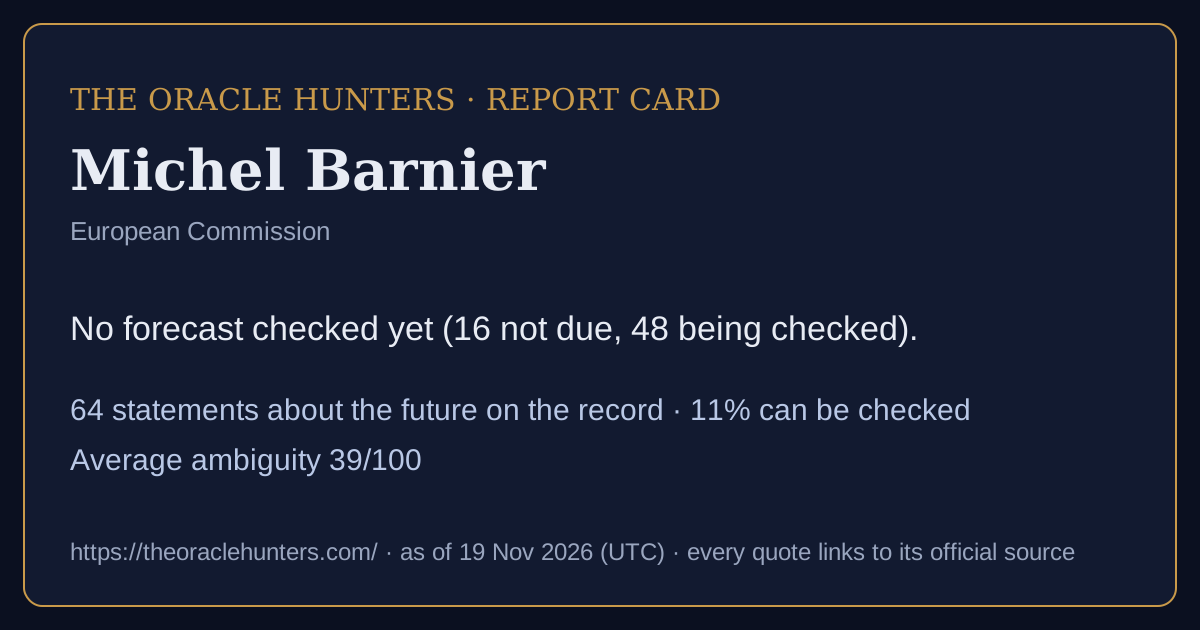
Track record: No forecast checked yet (16 not due, 48 being checked).
64forecasts & commitments on the record
11%can be checked as stated
39average ambiguity (0-100)
0goalpost moves recorded
0confirmed U-turns
Timeline
came true partly did not not due / being checked / too vague
Calibration score: shown after 10 checked forecasts with a stated likelihood (now 0).
How they speak about the future: based on data 53, stated on authority 10, educated guess 1.
Kinds of claim: forecast 43, mixed claim 13, commitment 8. · Download this report card as a picture
In the nine words
πρόγνωσιςInference from evidence50 · 78%προαναγγελίαPublic pre-announcement8 · 12%μαντείαInspired knowledge5 · 8%εἰκασίαConjecture1 · 2%
How to read this
Each box is one sentence a public figure or institution said about the future, word for word, with a link to the official text. Can be checked means it names what will happen, by when, and how likely - so it can be compared with official figures later. Too vague to check means it does not. Ambiguity (0-100) is how many different ways the sentence can be read. When the date passes, the forecast is compared with official data and marked came true, partly or did not come true. Labels judge the sentence, never the person. Full guide and glossary.On the record (64)
We will remain calm, constructive and respectful, but also firm and determined in defence of our principles and interests.
That is why we must also be ready to assume the consequences of a possible no deal, and must continue preparing for that scenario by the end of the year.
Let me give you some examples of what will happen on 1 January 2021, whatever the outcome of the negotiation:
This choice – its choice, not ours – will have automatic – mechanical – consequences as of 1 January 2021, even if we reach a good agreement with the UK.
Our future partnership will be shaped by the choices we make this year, together.
The first of January 2021 will not be like 1 February 2020.
2/ Our second task is to prepare ourselves on both sides for the changes that will take place in any event – whether we have an agreement or not – on 1 January 2021.
As of 1 January 2021, UK firms will lose the benefit of the financial services passport.
On 1 January 2021, whatever the outcome of the negotiation, there will be checks and controls on all UK goods entering the single market – as there are for any third country.
This choice will have consequences as of 1January 2021, even if we reach a deal with the UK on our future relationship.
Firstly, because, as of January 2021, there will be real, tangible change in every domain.
To prepare for the new situation that will come into being on 1 January 2021.
That is also the aim of the major project we are concerned with today – to build the Green Deal that will make Europe the world's first climate-neutral continent by 2050.
This means that the UK will leave the Single Market at the end of this year.
As you can see in this slide: By 2050, no individual European country can expect to be among the global top five economies.
1.An ambitious new Green Deal that will help to reconcile our economy with the planet, and turn the EU into the world's first climate-neutral continent by 2050.
Now, the UK wants a stricter migration policy that may apply to EU and non-EU nationals alike – possibly as early as 2021.
But we will also be watching closely to make sure that the UK government does the same for the more than 3 million EU citizens residing in the UK.
5) Finally, the Withdrawal Agreement makes provision, at the request of the UK government, for a transition period to run until 31 December 2020, which could be extended once by mutual agreement for a maximum of 24 months.
The agreement that is on the table commits us to use ‘our best endeavours' to conclude a subsequent agreement by the end of December 2020, which will replace the backstop.
if, as we hope, the withdrawal agreement is ratified by both parties, this negotiation on the future relationship will begin the day after the withdrawal of the United Kingdom on 30 March next year.
If we are not ready by July 2020, we could jointly consider extending the transition to provide for more time.
The United Kingdom will leave the European Union and all its institutions on 29 March 2019, in accordance with its wishes.
We will prepare ourselves and be ready to start these negotiations on 30 March 2019, the day after the UK's withdrawal.
To be clear, once the UK has left the Union the future relationship will be the subject of a new negotiation, in fact several negotiations – undoubtedly about ten parallel negotiating tables – during the transition period, until the end of 2020.
The UK will retain all the rights and obligations of a Member State for a transition period, until the end of 2020, at its request.
On 29 March 2019, in less than 6 months, the UK will leave the European Union.
In the United Kingdom's participation in Union programmes, for example research programmes, where we will be willing to use all the tools at our disposal for our relations with non‑EU countries in the 2021-2027 Multiannual Financial Framework.
To be clear, all these points will enter into force on the condition that we agree on the whole Withdrawal Agreement, which must then be ratified, I hope in the beginning of next year by the UK and by the European Parliament.
After Brexit, with 27 countries, 440 million consumers and 22 million businesses, we will remain a major partner for the US and a global player.
But make no mistake: certainty on the transition will only come once the whole Withdrawal Agreement has been agreed and ratified by both sides, hopefully at the beginning of next year.
However, certainty about the transition will only come at the end of the process, with the ratification of the withdrawal agreement by both sides –probably early next year.
The UK will leave the EU on 29 March 2019.
o Under our proposal, UK citizens, businesses, universities, farmers and regions will continue to have the same rights and the same obligations as they have today up until the end of 2020.
However, the UK will no longer be an EU member on 29 March 2019.
Their rights will remain unchanged until 31 December 2020.
The EU position is very clear: the transition will last for 21 months, until 31 December 2020.
As part of the transition, the UK will remain bound by the obligations stemming from all existing EU international agreements, for instance on trade and aviation.
Where allowed by our legislation, we will be able to consider some of the United Kingdom's rules as equivalent using a proportionate and risk-based approach, in particular for financial stability, which will remain our main concern.
But naturally, alongside this home market, the UK will remain an important market for many of you, and I understand the concern which is expressed here and throughout Europe about the consequences of Brexit, which we did not want.
The United Kingdom will become a third country on 29 March 2019.
These registration and administrative processes will be for those citizens living in a country that will become a third country on 29 March 2019 at midnight.
We will need to have the final version of the Withdrawal Agreement ready by October 2018.
On 29 March 2019 at midnight, the United Kingdom will cease to be a Member State.
Together, we have and we will keep a single market of 440 million consumers and 22 million undertakings that feel at home in each of our 27 countries as in each one they can find funding, solicit business and bid successfully for tenders.
Then the Member States will define in 2018 the framework of this new partnership with the UK.
2018 will mark the 20th anniversary of the Saint-Malo summit, which was a founding summit for European defence.
According to studies by the UK Ministry of Defence, by 2045 the major world powers will have doubled their defence budget.
In 2018 we will have to work on the framework of our new partnership with the United Kingdom.
And this Defence and Security Union will have to be developed without the British, since on 30 March 2019 the United Kingdom will, as is its wish, become a third country when it comes to defence and security issues.
Showing the newest 50 - the ledger has all 64.
Also said - not checkable as stated (12 newest)
Remarks about the future with no date, figure or likelihood that could be checked. They are kept on the record and shown here, but not scored.
We will seek the compromises that are needed from both sides to reach an agreement up to the last possible day.
We will insist on this up to the last moment to ensure lasting prospects for our European fishermen.
We will of course continue to inform you with full transparency.
And we will continue to insist on parallel progress on all areas.
In the meantime, and as agreed, we will continue our discussions in London next week.
Simply: we will never compromise on our European values or on our economic and trade interests, to the benefit of the British economy.
We cannot allow, and we will not allow, this cherry-picking.
These should be mandatory reading for every industry stakeholder exposed to the United Kingdom – and we would be grateful if you could share them with your partners.
3/ My third point is that: However good the agreement we reach with the UK, our trade relationship will never be as fluid as it is today.
I hope that this will help to inject new political dynamism in the 11 negotiating tables, which we hope will be able to meet physically again in the coming weeks and months, as this could help us gain in efficiency.
Of course, in the coming months, I will continue to work in full confidence and transparency with the Member States and the European Parliament.
It seems clear that we will not reach this target considering how the negotiations in this area are going for the moment.