Michael Gove
Department for Education · GBR
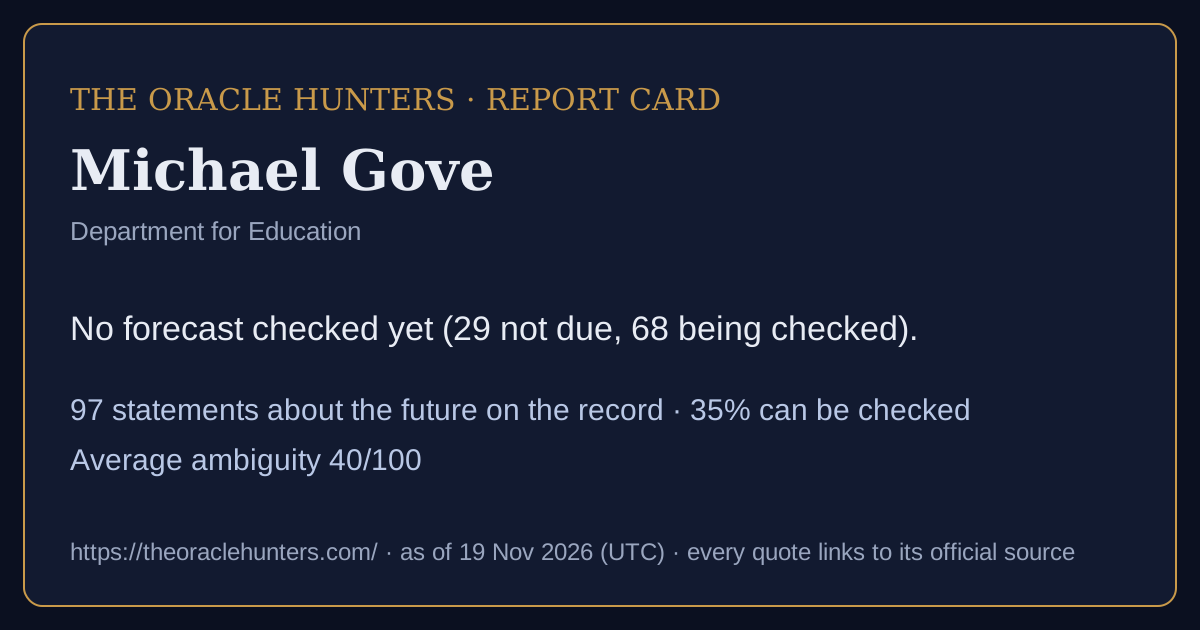
Track record: No forecast checked yet (29 not due, 68 being checked).
97forecasts & commitments on the record
35%can be checked as stated
40average ambiguity (0-100)
0goalpost moves recorded
0confirmed U-turns
Timeline
came true partly did not not due / being checked / too vague
Calibration score: shown after 10 checked forecasts with a stated likelihood (now 0).
How they speak about the future: based on data 60, stated on authority 34, educated guess 3.
Kinds of claim: forecast 56, mixed claim 28, commitment 11, scenario (if… then) 2. · Download this report card as a picture
In the nine words
πρόγνωσιςInference from evidence55 · 57%μαντείαInspired knowledge27 · 28%προαναγγελίαPublic pre-announcement11 · 11%πρόνοιαPreparing for the future2 · 2%πρόβλεψιςSeeing the signs1 · 1%εἰκασίαConjecture1 · 1%
How to read this
Each box is one sentence a public figure or institution said about the future, word for word, with a link to the official text. Can be checked means it names what will happen, by when, and how likely - so it can be compared with official figures later. Too vague to check means it does not. Ambiguity (0-100) is how many different ways the sentence can be read. When the date passes, the forecast is compared with official data and marked came true, partly or did not come true. Labels judge the sentence, never the person. Full guide and glossary.On the record (97)
But they know that if they Undermine Israel and the other dominos will fall.
I am delighted to be able to announce that we have agreed with West Yorkshire the final plans for their new Investment Zone, focused in particular on health tech. , It will direct £50m of additional investment to accelerate capital projects here in Leeds, and in Bradford and Huddersfield.
That is why the vision set out in the Liverpool Strategic Futures Advisory Panel report is so important and we will back it with £31 million of new money I can announce today for regeneration projects which trace an arc from the Knowledge Quarter to Bramley Moore docks on the waterfront.
And a further £25m of the funding will be used to give local people the skills they need to take advantage of over 7000 new high-quality jobs being created in the region all because of the Investment Zone.
They will report to me early next year and I hope we can agree a plan for reform and delivery with the Mayor.
We are also standing up our ‘super squad’ members – the new team of leading planners and specialists whose talents will be used across the system to unblock major housing developments: £13.5 million has been announced to support their work.
So we are going to use this £5 million to support a number of authorities with strong proposals in the pipeline to get LDOs in place – and if successful, we hope to expand this kind of support more widely.
However, the 20% buffer – which an authority needs to add to its housing land supply where housing delivery falls below 85% of its requirement – will now only apply to those authorities that do not have an up-to-date plan in place.
And today we are taking further steps by opening our new Cladding Safety Scheme – and also providing much-desired clarity to builders that 18m will be the threshold that we will introduce for new buildings requiring second staircases.
That is why we will enable brownfield development rather than green belt erosion, sustainable growth rather than suburban sprawl.
And we will meet our manifesto target of delivering 1 million new homes in this Parliament.
We have helped already over three quarters of a million people to buy their first home since 2010 – through programmes including Help to Buy, Right to Buy and shared ownership and we will go further later this year.
And we will continue to support the rapid regeneration of Manchester with £150 million to unlock brownfield land, and a trailblazing £400 million devolved housing investment.
So for new build homes we will roll out new design codes, and later this year we will consult on a universal Future Homes Standard – to deliver comfortable homes built to be zero-carbon: warm in the winter and cool in the summer.
And all local authorities that have Towns, Levelling Up and Future High Streets funding will also have more flexibility over their projects – I can confirm that they will be free to make output, outcome and funding changes up to a threshold of 30% without needing to seek any departmental approval.
We will also change how government provides local growth funding to local authorities, and we will increasingly move towards the use of allocation rather than competition.
Through the reforms in the Levelling Up Bill, we will strengthen the place of neighbourhood plans, we give local authorities the power to protect areas of environmental importance, we strengthen the place of design codes and give authorities more control over the character, the quality, the beauty of development.
Soon 75% of the North will have a deal, with positive discussions in the remaining areas which I look forward to developing later this year.
So, I’m pleased to confirm that, from next year, I will be introducing a 2-year financial settlement to give you that certainty and confidence.
We’ve guaranteed that by 2030, every part of England that wants one will have a new devolution deal with new powers, including the possibility of metro mayor or combined authority mayors being set up in counties and regions which hitherto haven’t had this opportunity.
We are also backing Sottish business with improved access to finance through a new British Business Bank fund in Scotland – which will be worth over £150 million.
Fourth, we will guarantee that Northern Ireland businesses will benefit from the lower tariffs that we deliver through our new Free Trade Agreements with third countries.
There should not be export declarations or any other processes as goods leave NI for GB, and we will deliver on unfettered access through legislation by the end of this year.
We have ordered laptops to help disadvantaged young people who will be sitting key exams next year.
From February 25 to May 2 we have delivered over 1.08 billion items of PPE across the health and social care system within England – and tens of millions more have been distributed by our colleagues in the Devolved Administrations.
Since the beginning of October, the remaining 18,000 ES agreements have been handled by the RPA; that number will fall to around 13,000 next year as some people are moved over into CS when their HLS agreements run out.
We also expect to pay 95% of CS final payments by the end of July 2019.
We have also committed to making payments to 95% of CS 2018 customers by March 31, and to meet this target I can announce today that we will introduce bridging payments of between £24 and 28million in early April.
We have been clear - across Government, from the Prime Minister down - that we will not lower our standards in pursuit of trade deals, and that we will use all the tools at our disposal to make sure the standards are protected and you are not left at a competitive disadvantage.
We have seen an improvement this year in BPS delivery and we will be making further changes to secure full payment for those whom have waited far too long.
While the EU have pledged to accelerate the process whereby the UK is recognised as a third country and we can continue to export food to their markets freely, all products of animal origin will have to go through border inspection posts and, at the moment, the EU have said 100% of products will face sanitary and phytosanitary checks.
Government will publish a long term policy statement next year, and the Environment Agency will issue a new 50-year strategy, also next year.
For London, under the high emissions scenario, levels are likely to be at least 53cm higher, and could be as much as 1.15m.
In 2016, we supported the Kigali amendment to the Montreal Protocol, which will introduce controls on the use of hydrofluorocarbons, a type of F-gas, from the start of next year.
That’s why next year, we will consult on a new English Tree Strategy in which we set out what benefits we value from trees and how we will accelerate woodland creation.
But to meet future carbon budgets and our long-term target to increase woodland cover from 10% to 12% in England by 2060, we will need to significantly increase planting rates.
Next year, we will publish a new England Peat Strategy.
We will, of course, be leaving the EU formally in March 2019 but the Government hopes we will secure an agreement from the EU to an implementation period to prepare fully for all the opportunities of the future.
That is why we have outlined a new direction of travel in our 25 Year Environment Plan, published earlier this year, and we will also be publishing a Consultation Paper on the future of agricultural policy in England very shortly.
And in farming specifically we have already said that we will pay the 2019 BPS scheme on the same basis as we do now.
We have guaranteed that the amount we allocate to farming support - in cash terms - will be protected throughout and beyond this period right up until the end of this Parliament in 2022.
I am encouraged so far that the RPA paid over 91% of farmers their basic payment for this year by the end of December 2017.
For anyone wondering what the focus of this year’s Oxford Farming Conference might be, it was The Archers provided an answer just before Christmas.
We will formally leave the EU in March of 2019 but the Government anticipates that we will agree an implementation or transition period for the whole country with the EU lasting for around another two years.
We will pay the 2019 BPS scheme on the same basis as we do now.
And next year, I will also be publishing the second National Adaptation Programme, a comprehensive plan of action to improve our resilience to climate change – an area where Defra is the lead government department, a responsibility I take very seriously.
We are responding to that consultation today and we will introduce legislation to implement that ban later this year.
This Government has pledged that when we leave the EU we will match the £3 billion that farmers currently receive in support from the CAP until 2022.
What a world-class education, and education system, will look like - not just today and tomorrow, but next year, and in 2024 and beyond.
We will, later this year, be outlining detailed proposals to ensure parents play their full part in guaranteeing good behaviour and outlining stronger sanctions for those who don’t.
Showing the newest 50 - the ledger has all 97.
Also said - not checkable as stated (12 newest)
Remarks about the future with no date, figure or likelihood that could be checked. They are kept on the record and shown here, but not scored.
That is why we have continually, since October 7th, stressed the need for aid to flow freely to civilians in Gaza, we have worked for diplomatic progress towards peace, emphasised that there will have to be, ultimately, a two-state solution and argued that military action must be governed by international humanitarian law.
I believe universities, schools, government departments, the NHS and local government - indeed all public bodies - should sign up to a charter against antisemitism, adopt the IHRA definition of antisemitism and make clear that antisemitic agitation will be met with clear disciplinary action.
And that is a promise we will never, ever, disavow.
These protests may ostensibly be presented as against Israel’s actions in Gaza but in reality they are directed against Israel’s continued existence.
But while it is necessary to be clear about where we may differ from the Israeli government at any point, just as we differ from other friends from time to time, it is even more necessary to be clear about what is going on more broadly.
We will also shortly be announcing more Level 2 devolution deals covering other parts of England.
Under the leadership of my friend Adam Hawksbee – who is committed to driving down power and opportunities much closer to these intimate communities – we will be building on the success of this programme in weeks to come.
We know that for towns to succeed our great cities need to grow, but we also know that it’s the specific needs of towns, their individual strengths, their particular challenges, that need to be addressed if they are to benefit from the growth that our cities are powering.
Local authorities must provide rigorous evidence justifying their departure from assessed housing need, they must do everything to identify other land suitable for development, and while the Planning Inspectorate will respect well-made cases, it will not accept under-shooting that is not firmly rooted in environmental or other safeguards.
But because we recognise there will always be cases where development must occur on greenfield sites, our new biodiversity net gain tariff will ensure that any loss of habitat is more than made up for by developer investment in new or recovered landscapes, which will be homes for wildlife restoration.
The 2-year blueprint for local government finances published last year should help support long-term fiscal planning, as will the settlements for trailblazer deeper devolution.
That is why we will engage and consult with you to create a system that both meets the needs of all of our citizens and can withstand economic shocks and inflationary pressures.