Michael Ellis
Department for Digital, Culture, Media & Sport (2017 to 2023) · GBR
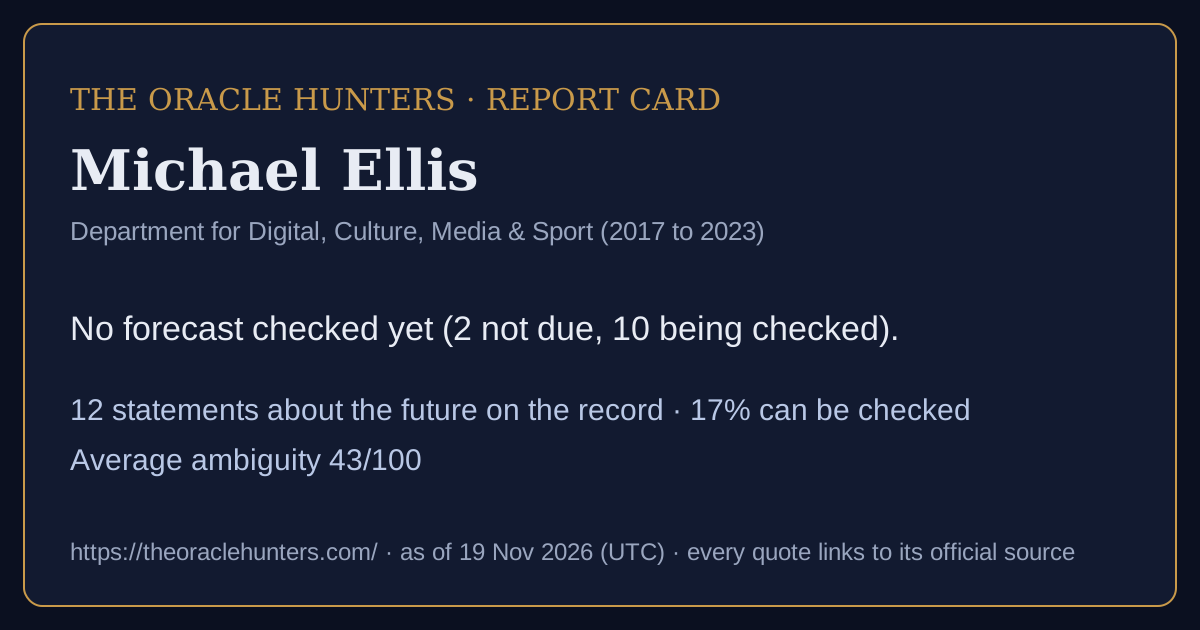
Track record: No forecast checked yet (2 not due, 10 being checked).
12forecasts & commitments on the record
17%can be checked as stated
43average ambiguity (0-100)
0goalpost moves recorded
0confirmed U-turns
Timeline
came true partly did not not due / being checked / too vague
Calibration score: shown after 10 checked forecasts with a stated likelihood (now 0).
How they speak about the future: based on data 9, stated on authority 2, educated guess 1.
Kinds of claim: forecast 9, mixed claim 3. · Download this report card as a picture
In the nine words
How to read this
Each box is one sentence a public figure or institution said about the future, word for word, with a link to the official text. Can be checked means it names what will happen, by when, and how likely - so it can be compared with official figures later. Too vague to check means it does not. Ambiguity (0-100) is how many different ways the sentence can be read. When the date passes, the forecast is compared with official data and marked came true, partly or did not come true. Labels judge the sentence, never the person. Full guide and glossary.On the record (12)
In April of this year, following a guilty plea, the SFO secured a conviction against GPT Special Project Management Ltd for corruption, which included over £30m in confiscations, fines, and costs.
In May of this year, the UK Government and UK Finance published a joint Statement of Progress against the Economic Crime Plan, covering the period from its launch in July 2019 to February 2021.
In July this year, the SFO secured its fifth DPA with Serco Geographic Ltd, which will result in payments of £19.2m and the SFO’s costs.
And by 2021, we will roll-out a public beneficial ownership register of foreign companies that own or wish to buy property in the UK.
Later this year we will be announcing those companies who will receive capital funding from the F4C.
Until 31 December 2020, EU citizens will be able to enter the UK by showing either a valid national identity card or a passport.
As announced by the Chancellor in the 2018 Budget Statement, DCMS will be providing £55 million as part of the Future High Streets fund, dedicated to supporting the regeneration of high street heritage assets.
Looking forward, Historic England will look to run a live trial phase next year with a competition launched to source a final design for the marker that will be used at each location.
We had our inaugural meeting in May of this year, and we had our second meeting last month.
At the same time, the UK continues to be recognised for its exceptional World Heritage: this year we nominated the Jodrell Bank Observatory for World Heritage Status, and it will be considered by the committee next summer, potentially becoming our 32nd World Heritage site.
And where we think those ideas are workable, where we think they can help to boost productivity in this hugely important sector, we will work with you over the next year to deliver them.
My former DCMS colleague, in his new role as Secretary of State for Health, Matt Hancock recently announced £4.5million for new or existing social prescribing projects in England.
Also said - not checkable as stated (12 newest)
Remarks about the future with no date, figure or likelihood that could be checked. They are kept on the record and shown here, but not scored.
So we continue to press the EU to resolve this issue, but have been clear that we cannot wait forever; we will be ready to deliver domestic alternatives.
We will not allow this to continue, we must fix the domestic impact of the Protocol, we must stabilise the situation in Northern Ireland and form an Executive – thereby protecting the Belfast Good Friday Agreement.
Firstly, we have never actually proposed scrapping the Protocol and we do not intend to – because there will always have to be a treaty governing the UK-EU relationship in respect of Northern Ireland.
And we will continue to talk with the EU, but we will not let that stand in the way of protecting peace and stability in Northern Ireland.
We will, of course, have differences of view, as we do today on the Northern Ireland Protocol, where we are asking the Union as friends and allies to understand our primary responsibility to protect the peace and stability of our country.
And the UK will be working with our international partners to ensure freedom and democracy are strengthened through a network of economic and security partnerships around and across the globe.
The overarching theme of this year’s Symposium is “who pays and who should pay?” for economic crime and the responses to the two parts of this question – first, who is actually harmed and pays for economic crime, and second, who should be held more accountable – have provided important guardrails in shaping the UK government’s own response to the …
We will deploy the full force of both the public and private sectors to deliver on these priorities, by way of 52 concrete actions.
We will continue to develop the National Economic Crime Centre as a genuine public-private hub for combatting serious and organised economic crime.
And with the NECC at the forefront, we will undertake further work to understand and enhance our capabilities, as well as develop public-private action plans to combat the economic crime threat.
We will implement the recommendations coming out of the Attorney General’s Disclosure Review and this includes working closely with the police, the CPS and SFO, as well as the tech industry, in order to explore further the possible technological solutions.
It’s a real pleasure to speak to you today (8 July 2019) about the role that low carbon fuels will play in our journey to zero emission road transport.