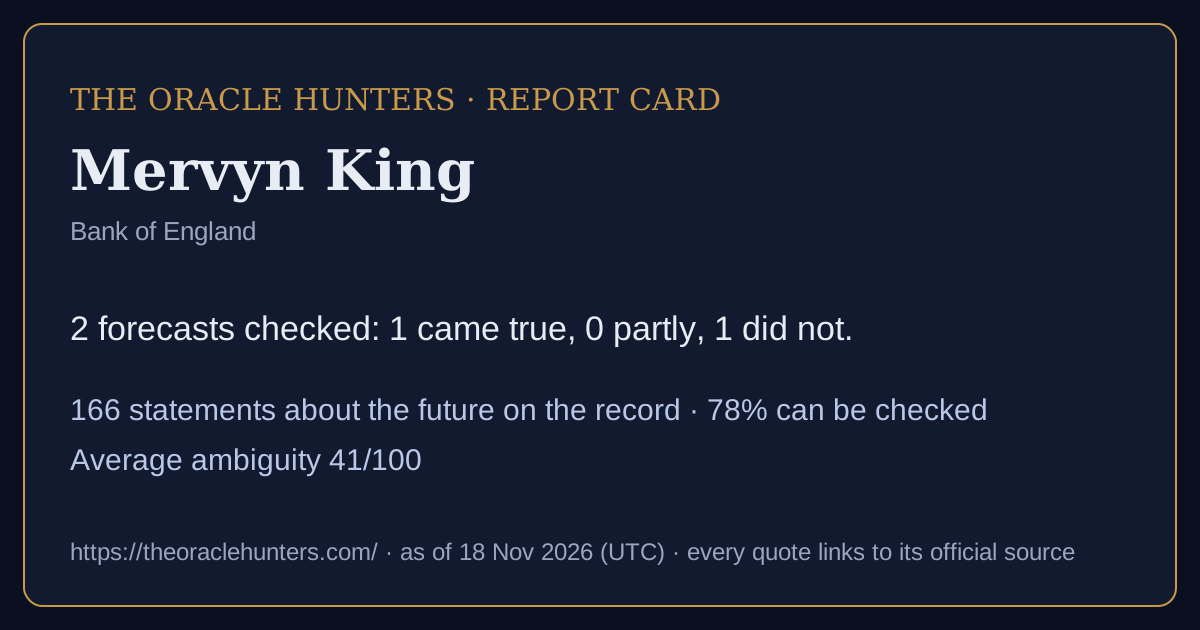
Mervyn King
Bank of England
Track record: 2 forecasts checked: 1 came true, 0 partly, 1 did not.
166forecasts & commitments on the record
78%can be checked as stated
41average ambiguity (0-100)
0goalpost moves recorded
0confirmed U-turns
Timeline
came true partly did not not due / being checked / too vague
Calibration score: shown after 10 checked forecasts with a stated likelihood (now 2).
How they speak about the future: based on data 91, educated guess 39, stated on authority 36.
Kinds of claim: forecast 103, scenario (if… then) 34, mixed claim 25, commitment 4. · Download this report card as a picture
In the nine words
πρόγνωσιςInference from evidence85 · 51%πρόνοιαPreparing for the future34 · 20%μαντείαInspired knowledge33 · 20%εἰκασίαConjecture8 · 5%προαναγγελίαPublic pre-announcement4 · 2%πρόβλεψιςSeeing the signs1 · 1%φρόνησιςPractical wisdom1 · 1%
How to read this
Each box is one sentence a public figure or institution said about the future, word for word, with a link to the official text. Can be checked means it names what will happen, by when, and how likely - so it can be compared with official figures later. Too vague to check means it does not. Ambiguity (0-100) is how many different ways the sentence can be read. When the date passes, the forecast is compared with official data and marked came true, partly or did not come true. Labels judge the sentence, never the person. Full guide and glossary.Checked
As commodity prices stabilise, inflation will fall back towards our target next year.
Came true. Said: inflation would fall in 2009. Official figures for United Kingdom: 3.5% in 2008, 2.0% in 2009 (World Bank open data). official data · checked 14 Nov 2026 · automatic check against official data (rules v3)
But how quickly and by how much inflation will fall over the next year or so is difficult to judge.
Did not come true. Said: inflation would fall in 2008. Official figures for United Kingdom: 2.4% in 2007, 3.5% in 2008 (World Bank open data). official data · checked 14 Nov 2026 · automatic check against official data (rules v3)
On the record (166)
And yet there are few signs of domestically generated inflation, which has remained close to 2% . 1 Pay rises and underlying inflationary pressure are low, and the medium-term outlook is for inflation to fall back to the target.
In future, the FPC and the PRA will work together to conduct regular stress tests of our banks, starting in 2014.
The other part of the remit makes clear that we are not expected to pursue 2% inflation in the short run whatever the cost - it recognises that attempting to hit the inflation target at all times may cause 'undesirable volatility in output'.
It is set to remain above target for much of this year in part because administered and regulated prices, such as those for electricity and gas, rail fares and university tuition fees, will put unusually strong upward pressure on inflation.
On Friday we shall see the first official estimate for growth in the fourth quarter of last year.
Inflation rose to over 5% but has now come down to 2.7%, and the Committee believes that it is likely to come back to the target over the next two years.
So prices set in the market sector of the economy will need to rise by only about 1% a year if inflation is to meet the 2% target.
Our current programme of asset purchases will be complete by next month.
Despite the probable rise in output in the third quarter, the big picture is that GDP is barely higher than two years ago, and remains some 15% below where steady growth since 2007 would have taken us.
And the zig-zag pattern of quarterly growth rates of GDP that we have seen this year is likely to continue, as we may see on Thursday when figures for the third quarter are released.
And the IMF recently lowered its forecast for growth in the advanced economies next year.
According to the latest IMF projections output will fall this year in no fewer than 10 European economies.
To shed light on whether that possibility warrants a change to the way we implement inflation targeting, I want now to conduct a counter-factual thought experiment and ask whether monetary policy before 2007 might have moderated the crisis if it had not simply pursued a target for inflation.
But if households extrapolated past increases in house prices into the future, then they may have mistakenly inferred that future incomes too would be higher, and so spending and borrowing more than could be sustained.
The improvement in credibility of policy is shown by the fact that whereas in 1992 expected inflation, as measured by the difference between yields on conventional and index-linked gilts, was close to 6%, today the same measure is around 2½ %.
From next year, the Bank of England will have those responsibilities, and the new Financial Policy Committee is already up and running.
In Britain, total output is today some 15% below an extrapolation of its pre-crisis trend, and that gap is likely to persist for some time yet. 2 In the light of such costs, should monetary policy go beyond targeting price stability and also target financial stability?
After the ravages of inflation in the 1970s - younger listeners might need to be reminded that inflation hit 27% in 1975 - it was I think understandable that we focussed on the need to bring inflation down.
The Bank will change again next year with its new responsibilities.
Next time we find ourselves with steady growth and low inflation, but with risks building in the financial sector, we shall be able to do something about it.
The burden of debt will go on rising in the former group of countries until these spending patterns adjust and the latter group will find their loans eventually repaid in depreciated currencies, if at all.
Without monetary stimulus - low interest rates and large asset purchases - there is a risk that growth will stall and inflation fall below our symmetric 2% target.
Once the effect of these temporary factors begins to dissipate, inflation should fall back sharply early next year.
Of course, at some point, Bank Rate will need to rise to more normal levels in order to ensure that inflation returns to its 2% target.
Output has probably grown by only around 1% or so over the past year.
between 5% and 10% for a number of years, and occurs once every fifty years, amounts to an annual cost several multiples of the revenue that will be generated by the UK bank levy (Haldane, 2010).
So not only can monetary policy play a role in smoothing the rebalancing process, it needs to do so if the outlook for inflation is to remain in line with the 2% target in the medium term.
Unless the fall in domestic spending coincides with the necessary increase in net exports, the path for the economy will be bumpy.
But if the recovery is slower than expected then the automatic fiscal stabilisers - the lower tax receipts and higher spending that result from weaker growth - will act to stimulate demand.
But it is indisputable that, because of the crisis, national income is 10% lower than was expected with a damaging impact on tax revenues.
Only if the two sets of policies work in tandem will growth prove sustainable.
If prospects for growth were to weaken, the outlook for inflation would probably be lower and monetary policy could then respond.
In May, CPI inflation was 3.4%, and for much of the past three years has been above the 2% target.
In our May forecast, the MPC judged that, under prevailing market interest rates, the odds were in favour of inflation remaining above target over the next year,
The statement that a diagnostic test has a 5% probability of a false positive is misinterpreted more often than the statement that 5 patients out of every hundred taking the test will show a false positive. 9 And this is compounded by the fact that many forecasts are not of the kind where reference back to a sample frequency is …
One idea that we are investigating is to show charts of the MPC's view of the probability that inflation will be above the 2% target at a particular point in time.
Remember, though, with 10% of the distribution not specified, the MPC were not ruling out the possibility that inflation might have remained unchanged or fallen.
Looking ahead, the MPC felt it was likely that inflation would rise again in the first quarter of this year [Slide 3].
But in an economic system - because people's beliefs about future policy actions affect their behaviour today - the control strategy has to comprise not only a plan for setting the instruments (e.g. raise Bank Rate if expected inflation rises) but also a plan to condition beliefs about how policy makers would respond in future.
And the rise in VAT back to 17.5% means that CPI inflation is likely to rise to over 3% for a while, or even higher for even longer were energy prices or indirect taxes to increase further.
It is clear that inflation is likely to pick up markedly in the first half of this year, a message reinforced by this morning's news that CPI inflation reached 2.9% in December.
It will pick up over the next few months reflecting higher petrol prices, recent falls in sterling and the reversal of the cut in VAT.
It is likely that in the second half of this year, the UK economy will return to positive, if modest, growth.
In deciding when and by how much our present programme of asset purchases should be either expanded or reduced, the Monetary Policy Committee will continue to base its decision each month on a judgement of the action required to meet the 2% target for inflation.
There are three solid reasons for thinking that a recovery in activity was likely to occur at some point this year.
For the world economy as a whole, consensus forecasts of growth in 2009 have been revised down from 3% to just 1% since September. 1
Since the summer, the exchange rate has fallen by almost 20%; and oil prices have fallen by around two-thirds, both of which will boost demand.
In the first half of this year, the rate of contraction is likely to continue to be marked, and our trading partners are experiencing similar problems.
Despite those big cuts, there remains a risk that inflation will fall below 2%.
Unless they are replaced by other forms of external finance, the adjustments in the trade deficit and exchange rate will need to be larger and faster than would otherwise have occurred, implying a larger rise in domestic saving and weaker domestic spending in the short run.
Showing the newest 50 - the ledger has all 166.
Also said - not checkable as stated (12 newest)
Remarks about the future with no date, figure or likelihood that could be checked. They are kept on the record and shown here, but not scored.
In March, the FPC recommended that banks' capital should be assessed using more prudent estimates of expected losses and risk weights.
That work is now complete, the banks know the results, and tomorrow we will publish them for each of the major banks.
I know the Bank will continue to do just that under Mark's leadership.
We shall have to wait for the historians of tomorrow to file the full match report.
The Financial Policy Committee's macro-prudential tools are the first line of defence against such risks, but in these circumstances the Committee may wish to allow inflation to deviate from the target temporarily, consistent with its need to have regard to the policy actions of the Financial Policy Committee.
Taking the entire period of inflation targeting - including the recent past - might give a more accurate indication of where this 'Minsky-Taylor' frontier lies than using data for the Great Stability period alone (Chart 4).
Monetary policy could be used to reach a point more like P in Chart 5, with less variation in the output gap and more variation in inflation than we have actually experienced over the past 20 years.
Put another way, higher interest rates in the run up to the financial crisis might have reduced the impact of the subsequent bust, at the cost of below-target inflation and below-trend output before the crisis hit. 2
In practice new macroprudential tools and better micro-prudential supervision will improve the possibilities available to monetary policymakers.
Nevertheless, consistent with the new remit 4 given to the Monetary Policy Committee by the UK Government last month, the experience of recent years suggests that there may be
And we will continue to assess the benefits and costs of further reductions in overnight interest rates.
In the long run, we will need to rebalance our economy away from domestic spending and towards exports, to reduce our trade deficit, to repay our debts, and to raise the rate of national saving and investment.