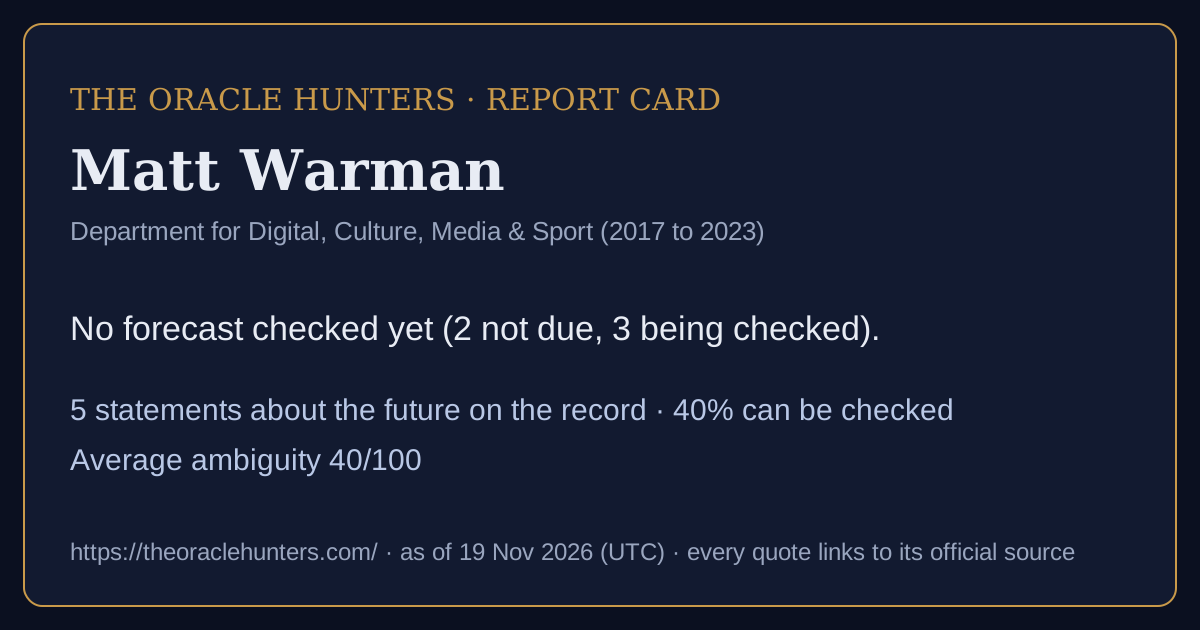
Matt Warman
Department for Digital, Culture, Media & Sport (2017 to 2023) · GBR
Track record: No forecast checked yet (2 not due, 3 being checked).
5forecasts & commitments on the record
40%can be checked as stated
40average ambiguity (0-100)
0goalpost moves recorded
0confirmed U-turns
Timeline
came true partly did not not due / being checked / too vague
Calibration score: shown after 10 checked forecasts with a stated likelihood (now 0).
How they speak about the future: based on data 4, stated on authority 1.
Kinds of claim: mixed claim 2, forecast 2, commitment 1. · Download this report card as a picture
In the nine words
How to read this
Each box is one sentence a public figure or institution said about the future, word for word, with a link to the official text. Can be checked means it names what will happen, by when, and how likely - so it can be compared with official figures later. Too vague to check means it does not. Ambiguity (0-100) is how many different ways the sentence can be read. When the date passes, the forecast is compared with official data and marked came true, partly or did not come true. Labels judge the sentence, never the person. Full guide and glossary.On the record (5)
The Scheme is open until March next year and there is £70 million worth of vouchers on offer.
The Strategy will set out how we will drive growth in the tech sector and economy, and ensure we maximise the benefits of a tech-led economic recovery.
In addition, thanks to our landmark Shared Rural Network agreement with the MNOs - the first of its kind in the world - 95% of the UK will have 4G coverage by the end of 2025.
We remain committed to delivering gigabit broadband, the 2025 ambition still stands but we know it’s going to be tough and that’s why we need to work together to maximise the opportunity.
And because we know that more citizens are increasingly living their lives online, we will be one of the earliest adopters of 5G coverage, with the majority of the population able to access 5G by 2027.
Also said - not checkable as stated (12 newest)
Remarks about the future with no date, figure or likelihood that could be checked. They are kept on the record and shown here, but not scored.
We will do this by establishing a trust framework of standards, rules, assurance and governance for the use of digital identity, in one place, that different organisations using or consuming digital identity can follow.
I am excited to announce that we will be publishing the digital identity Trust Framework as an alpha in the new year.
Because the foundation of this market will be based on trust, how we establish the framework is as important as what it says.
Government has always played this important role in the paper-based world — by issuing trusted documents like passports and driving licenses — and will continue to work with the private sector and civil society to enable this to happen digitally.
They often have to prove their age by showing their passport, for instances like onboarding at their university, applying for a part time job, for renting accommodation, or for purchasing alcohol.
We will shortly introduce the Telecoms Security Bill.
In the UK we will be taking forward our own approaches.
We will achieve this by focusing our work on three core elements:
This crucial piece of legislation will in time allow us to implement one of the toughest regimes in the world for telecommunications security.
It will give the government and Ofcom new powers to drive up security standards and control the presence of high-risk equipment vendors in our networks and enshrine in law one of the strongest regimes for telecoms security in the world.
The Bill will introduce a new strengthened telecoms security framework, including new telecoms security duties and requirements on operators.
Underpinning all of this work is our new digital strategy, which the Secretary of State announced we will be publishing this Autumn.