Matt Hancock
Department for Business, Innovation & Skills · GBR
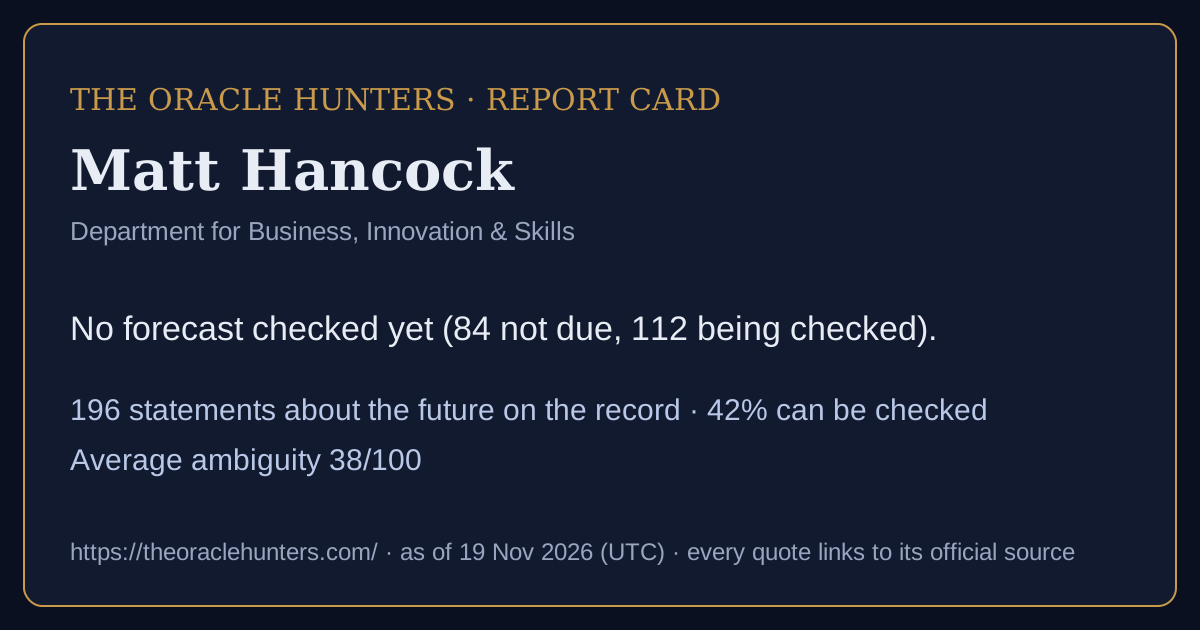
Track record: No forecast checked yet (84 not due, 112 being checked).
196forecasts & commitments on the record
42%can be checked as stated
38average ambiguity (0-100)
0goalpost moves recorded
0confirmed U-turns
Timeline
came true partly did not not due / being checked / too vague
Calibration score: shown after 10 checked forecasts with a stated likelihood (now 0).
How they speak about the future: based on data 148, stated on authority 44, educated guess 4.
Kinds of claim: forecast 131, mixed claim 35, commitment 27, scenario (if… then) 3. · Download this report card as a picture
In the nine words
πρόγνωσιςInference from evidence132 · 67%μαντείαInspired knowledge32 · 16%προαναγγελίαPublic pre-announcement26 · 13%πρόνοιαPreparing for the future3 · 2%εἰκασίαConjecture2 · 1%προφητείαInterpreting the will of authority1 · 1%
How to read this
Each box is one sentence a public figure or institution said about the future, word for word, with a link to the official text. Can be checked means it names what will happen, by when, and how likely - so it can be compared with official figures later. Too vague to check means it does not. Ambiguity (0-100) is how many different ways the sentence can be read. When the date passes, the forecast is compared with official data and marked came true, partly or did not come true. Labels judge the sentence, never the person. Full guide and glossary.On the record (196)
And by April 2022, the system approach, with its underpinning in law, will remove a huge amount of the barriers to integration that still exist, and help strengthen further that culture of collaboration which has built up so much over the past 18 months.
And to deliver that, we are increasing funding in mental health faster than elsewhere in the NHS and we will bring our mental health legislation into the 21st century.
And just as these changes in mental health have been needed for too long, later this year, we will also bring forward much-needed reforms in social care too.
Using different vaccines, if they can be mixed without reducing effectiveness – or indeed mixed and lead to an increase in effectiveness – then this could have a huge impact in speeding up vaccination campaigns all across the world and getting more people the protection that is needed from this deadly virus.
But those figures are not yet 100% and we will not rest until we get them there.
And that will be used, alongside others, as part of our booster shot programme from later this year.
This new data looked at people who tested positive after having received one dose of the vaccine and found that they were up to 50 per cent less likely to pass on the disease to someone else in their household.
Beyond vaccines, it is also imperative that we significantly enhance our speed of response to pick up new technologies, and in particular I want to mention the supply of novel antiviral treatments which later today the Prime Minister will be setting out the details of how we will be driving forward the deployment and development of antivirals here in the …
The UK will continue to support CEPI, and today I’m pleased to confirm a further £16 million investment.
And every local system will have at least a basic shared record solution in place by September this year.
Seven trusts will get up to £6 million over the next 3 years, and the rest will get seed funding to start creating their plans.
The data shows that if you live with someone who’s been vaccinated, you have a 30 per cent lower risk of catching COVID-19 yourself.
The NHS will contact you, and today, we’re sending over 2 million texts and letters and invitations to get vaccinated.
So at the same time as opening up vaccinations to all those that are 50 and above we are going to do whatever it takes to reach all those in the most vulnerable groups who haven’t come forward yet before we move onto the next cohort of people in their 40s.
We in the UK have licensed 100 million doses to protect our population, but billions of doses of the Oxford vaccine will be the mainstay of global access.
Almost 3 million children and young people will benefit from more mental health support teams, and those mental health support teams in schools will be working hard to ensure people get access to the support and care that they need.
To do that, and to make sure our vaccine programme has the funds it needs to keep up this incredible work, at the Budget on Wednesday, the Chancellor will set out £1.65 billion of new government funding to reinforce our vaccine rollout across all parts of the UK.
We’ve agreed an initial supply of 50 million doses, to add to the 400 million doses that are already in our vaccine portfolio so we’ll be prepared for whatever the future might bring.
Especially given the UN forecast that two-thirds of the world are projected to live in dense urban areas by 2050.
It predicts that if we do nothing, AMR will lead to 10 million deaths by 2050, at a cumulative financial cost to the global economy of 100 trillion dollars.
The UK played a leading role in the international effort to raise 2.4 billion dollars for the COVAX Advance Market Commitment, which will distribute at least 1.3 billion doses of coronavirus vaccines to 92 developing countries this year.
This Christmas, and the start of 2021, is going to be tough.
Today, I can announce 1,800 projects, which are being funded from our £600 million package to upgrade and refurbish hospitals across 178 NHS trusts this year.
Our new NHS Test and Trace Business Plan, which we published today, sets out how we will grow this yet further.
As more vaccines come on stream, we will open vaccination centres in larger venues, like sports stadia and conference halls next year and that’s when most people can expect to get their jabs.
We will deliver according to clinical prioritisation and operational necessity because the need to hold the vaccine at minus-70 makes this vaccine particularly challenging to deploy.
We were the first country in the world to pre-order supplies of this successful vaccine and we have 40 million doses pre-ordered for delivery over the coming months, enough for 20 million people, because 2 jabs are required each.
We will do this by returning to a tiered approach, applying the toughest measures to the parts of the country where cases and pressure on the NHS are highest, and allowing greater freedom in areas where prevalence is lower.
Finally, you will no doubt have seen the excellent news that Moderna have today announced results from their preliminary trial data, suggesting that their vaccine has an effectiveness of 94.5 per cent.
We have 30 million doses on order by the middle of next year.
I know that this has not been easy and that it has meant celebrating Diwali or commemorating the fallen in ways that have been different this year from what we might normally do.
It is a similar RNA technology to Pfizer/BioNTech, of which we have already ordered 40 million doses, which should that be proved to work will come on stream potentially at the end of this year.
And through our People Plan we will constantly strive to make the NHS a brilliant place to work, that is central to delivering on the promise that the NHS holds out for the people of this country and the patients who we look after and the citizens who we serve.
We will strengthen how systems operate, across all parts of the NHS, and tie in tightly with local authority colleagues who share our mission to the populations we serve.
The UN projects that by 2050, over two-thirds of the global population will live in increasingly large, dense urban centres.
Imagine if we hadn’t put the investment into broadband infrastructure so 99% of surgeries could offer remote consultations, virtually overnight.
We’ve injected an extra £1.6 billion and, as the Chancellor said, we will do whatever it takes.
Yesterday, more than 26 million PPE products were delivered to 281 different organisations, and I have agreed with the Northern Ireland Executive that we will immediately be providing more PPE to Northern Ireland to meet their needs.
It’s how, after this epidemic, we will bear down on the £9 billion a year lost to sickness absence.
Over the next 3 years the Lab will support a £140 million AI Award, designed to speed up testing and adoption of the most promising tools.
We will deliver an extra 50 million appointments a year in general practice within the next 5 years – by expanding the workforce, harnessing the power of technology, and giving GPs the support they need.
Because I want us to seize this opportunity and over the next decade, by 2030, have an NHS where everyone is empowered and supported to stay healthy and out of hospital wherever possible.
By the end of this year, every member of staff at Imperial College, and Chelsea and Westminster trusts will be using a single shared electronic patient record (EPR) system.
There will be more on that in the People Plan later this year.
Yet, for the 14% of adults who do still smoke, it’s the leading cause of illness and early death, and we know the less well-off you are, the more likely you are to smoke, exacerbating existing health inequalities.
The first 12 products being backed by the AAC could help more than half a million patients, and save the NHS up to £30 million.
We’re going to make up to £3 million available this year for care managers to access learning and development so they can improve their skills.
But these reforms must work for you, so we will launch a staff consultation across the NHS next month.
And with £1.6 billion in investments planned over the next 5 years, the North is where some of the most dynamic growth and exciting innovation is going to happen.
None of us can know exactly what 2030 will look like in my profession – perhaps not even what next week will look like…
Showing the newest 50 - the ledger has all 196.
Also said - not checkable as stated (12 newest)
Remarks about the future with no date, figure or likelihood that could be checked. They are kept on the record and shown here, but not scored.
And we know that as people re-present with problems - problems they might not have wanted to bother the NHS with over the last 18 months - we will see the waiting list go up.
I am determined that we rise to this challenge and I know, from everything we’ve done together, that we will.
The legislation will tackle the disparities and inequities of our system, improving how people with learning difficulties and autism are supported and ultimately, it’s going to be there for every single one of us, should we need it.
That it would take at least 5 years to develop in normal times and that a vaccine may never work.
I was often told it was unlikely we’d get a vaccine until well into 2021.
And I always believed that we could, especially with the power of the NHS.
But Britain’s incredibly high levels of confidence around the vaccine aren’t an accident, and weren’t something we could take for granted.
And we were honest about the uncertainties, for instance that it’d take time to discover what impact new variants might have on any vaccine.
We started early too on how we could make access to the vaccine fair.
I’m absolutely determined that our Antivirals Taskforce will channel the same positive, can-do, collaborative spirit that worked so successfully for vaccines.
Our response to this pandemic is been a big team effort and Eddie’s leadership will help make our team stronger still.
The UK believes that a pandemic treaty could provide the overarching framework for collective action, but we must not wait for it, we must act now – strengthening funding, strengthening transparency, strengthening our coordination of pandemic response.