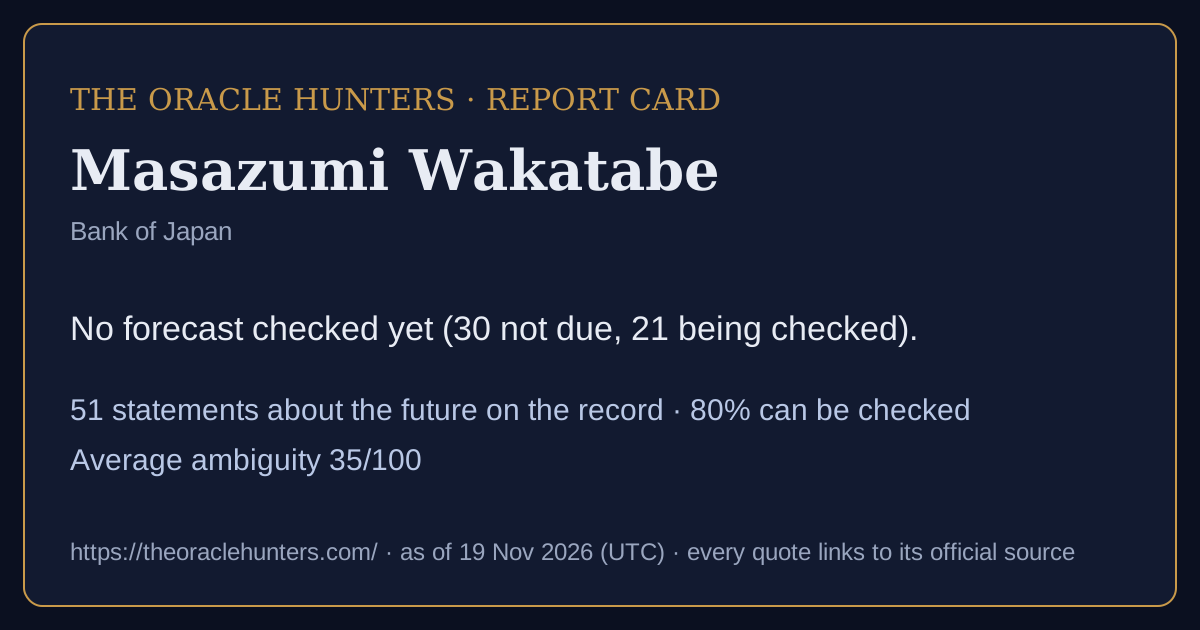
Masazumi Wakatabe
Bank of Japan
Track record: No forecast checked yet (30 not due, 21 being checked).
51forecasts & commitments on the record
80%can be checked as stated
35average ambiguity (0-100)
0goalpost moves recorded
0confirmed U-turns
Timeline
came true partly did not not due / being checked / too vague
Calibration score: shown after 10 checked forecasts with a stated likelihood (now 0).
How they speak about the future: based on data 45, educated guess 6.
Kinds of claim: forecast 36, scenario (if… then) 7, mixed claim 6, commitment 2. · Download this report card as a picture
In the nine words
πρόγνωσιςInference from evidence41 · 80%πρόνοιαPreparing for the future7 · 14%προαναγγελίαPublic pre-announcement2 · 4%φρόνησιςPractical wisdom1 · 2%
How to read this
Each box is one sentence a public figure or institution said about the future, word for word, with a link to the official text. Can be checked means it names what will happen, by when, and how likely - so it can be compared with official figures later. Too vague to check means it does not. Ambiguity (0-100) is how many different ways the sentence can be read. When the date passes, the forecast is compared with official data and marked came true, partly or did not come true. Labels judge the sentence, never the person. Full guide and glossary.On the record (51)
If the natural rate of interest continues on a declining trend, the challenge for central banks' monetary policy will continue to be how to lower real interest rates in an effective manner.
Conversely, if investment related to decarbonization rises, this could stimulate aggregate demand and feed into demand-pull inflation.
(4) The Bank will continue with powerful monetary easing.
For fiscal 2024, on the other hand, they are likely to push up the rate due to a waning of the effects they had of pushing down CPI inflation in the previous year.
The Bank will continue to conduct monetary policy with the aim of achieving the 2 percent price stability target, accompanied by wage increases.
In this regard, looking at the CPI for all items excluding fresh food and energy, which is not directly affected by energy price fluctuations, the year-on-year rate of change for fiscal 2024 is projected to be at around 1.5 percent.
In the Outlook Report, the year-on-year rate of change in the CPI (all items less fresh food) is projected to be 3.0 percent for fiscal 2022, and then fall below 2 percent for fiscal 2023 and 2024, being 1.6 percent and 1.8 percent, respectively.
In the latest Outlook Report, the real GDP growth rates are projected to be 1.7 percent for fiscal 2023 and 1.1 percent for fiscal 2024, suggesting that the economy is expected to continue growing at a pace above its potential growth rate.
In particular, the Federal Reserve raised its policy interest rate by 0.25 percentage points in March and 0.5 percentage points in May, and it has been communicating that ongoing increases in the rate will be necessary to curb elevated
(4) The Bank will continue with aggressive monetary easing.
Therefore, the year-on-year rate of change in the CPI excluding fresh food and energy is projected to moderately increase in positive territory, from 0.9 percent for fiscal 2022, to 1.2 percent for fiscal 2023, and 1.5 percent for fiscal 2024.
The year-on-year rate of increase in the CPI is projected to be 1.9 percent for fiscal 2022 but then decelerate as the positive contribution of a rise in energy prices wanes, registering 1.1 percent for both fiscal 2023 and fiscal 2024.
In terms of the medians of the Policy Board members' forecasts, Japan's real GDP growth rate is expected to be relatively high, at 2.9 percent for fiscal 2022, and then decelerate to 1.9 percent for fiscal 2023 and 1.1 percent for fiscal 2024; thus, the economy is projected to continue growing at a pace above its potential growth rate throughout …
The latest World Economic Outlook released by the International Monetary Fund (IMF) shows that, although they are projected to decelerate from the growth rate for 2021, the global economic growth rates for both 2022 and 2023 are expected to be 3.6 percent, staying at around the long-term average.
If households or firms expect that prices will decline in the future, their incentives to postpone consumption or investment will increase and a virtuous cycle from
This means the Bank will allow the inflation rate to overshoot the target of 2 percent even if it temporarily reaches that level.
In any event, we have learned from the history of the Great Inflation, which occurred from the second half of the 1960s, that unless domestic demand expands continuously, inflation will not be sustained just by cost-push factors. 21 Furthermore, in Japan, there is still a long way to go to achieve the price stability target of 2 percent.
For example, even if the inflation rate in the United States exceeds the 2 percent target and the Federal Reserve starts to tighten monetary policy given the achievement of average inflation targeting, this does not mean that the Bank will adjust its monetary policy.
Japan's economy has managed to avoid falling into deflation despite being affected by COVID-19, and this may be because the Bank has firmly maintained an active stance on monetary easing under the 2 percent target.
6 However, it should be noted that, as for the forecasts made by medium-sized firms and SMEs regarding the real economic growth rate over the next three years, the rate was 0.7 percent for fiscal 2020, declining slightly from 0.8 percent for fiscal 2019.
13 Therefore, changing the price stability target from a point to a range, say from 1 to 3 percent, could be regarded as a weakening of a commitment to monetary easing.
On this basis, the Bank will conduct an assessment for further effective and sustainable monetary easing, with a view to supporting the economy and thereby achieving the price stability target of 2 percent.
likely to continue for a prolonged period, it will take considerable time to achieve the price stability target of 2 percent.
By fiscal year, real GDP will only return to its 2019 level in around fiscal 2022.
The medians of the Policy Board members' forecasts of the inflation rate in the January Outlook Report indicate that the CPI is projected to be minus 0.5 percent for fiscal 2020, 0.5 percent for fiscal 2021, and 0.7 percent for fiscal 2022.
the real GDP growth rate is projected to register a significant negative figure of minus 5.6 percent for fiscal 2020, 3.9 percent for fiscal 2021, and 1.8 percent for fiscal 2022.
Thus, since there are high uncertainties over the impact of COVID-19 on economic activity and prices, for the time being, the Bank will closely monitor the impact and will not hesitate to take additional easing measures if necessary.
In Japan, the government has conducted economic measures with a project size of 234 trillion yen -- equivalent to approximately 40 percent of the country's GDP -- which largely exceeds the size of measures taken at the time of the Global Financial Crisis.
Under these circumstances, the International Monetary Fund (IMF), for example, projects that the global economy will recover from the second half of 2020 (Chart 7).
The baseline scenario in the Bank's July 2020 Outlook for Economic Activity and Prices (Outlook Report) assumes that the timing of Japan's real GDP returning to the level of fiscal 2019 will be around fiscal 2022.
voluntary ones, continuing to be taken, and the IMF states that "global GDP for the year 2021 as a whole is forecast to just exceed its 2019 level."
As presented in the July Outlook Report, the CPI is projected to be in the ranges of minus 0.6 to minus 0.4 percent for fiscal 2020, 0.2 to 0.5 percent for fiscal 2021, and 0.5 to 0.8 percent for fiscal 2022.
It is true that Japan's inflation rate has not reached the Bank's price stability target of 2 percent and the risk that the economy will fall into deflation again has not been dispelled completely.
Therefore, the Bank will continue to carefully examine economic and price developments and monitor whether the mechanism will be maintained in which the inflation rate increases toward the price stability target of 2 percent.
For example, in the IMF's World Economic Outlook Update , the global growth rate is projected to rise from 2.9 percent for 2019 to 3.3 percent for 2020 (Chart 1).
The growth rate of the global economy has decelerated since around mid-2018, and according to the latest forecasts released by the International Monetary Fund (IMF), the global growth rate for 2019 likely was slightly below 3 percent for the first time in 10 years (Chart 1).
It is projected in the latest Outlook Report that, with this mechanism operating, the year-on-year rate of change in the CPI excluding fresh food will be 0.6 percent for fiscal 2019, gradually rising to 1.0 percent for fiscal 2020 and 1.4 percent for fiscal 2021.
In the Bank's January 2020 Outlook Report, also taking into account that overseas economies are likely to pick up gradually, Japan's real GDP growth rate is projected to be 0.8 percent for fiscal 2019, gradually rising to 0.9 percent for fiscal 2020 and 1.1 percent for fiscal 2021 (Chart 7).
Among the bank locations closed immediately after the disaster, about 40 percent resumed business by the end of March.
14 According to a survey conducted by the Bank in May 2019, close to 80 percent of the financial institutions with backup offices in Osaka responded that they had introduced dual operation for some business in normal times.
As the expected growth rate rises, firms' investment and households' consumption will be encouraged further, thereby ensuring the path toward achieving the price stability target of 2 percent.
If growth expectations deteriorate due partly to an economic crisis or a decrease in productivity, and thereby firms become less willing to make investment, actual investment will decrease and the natural rate of interest consequently will decline.
The latest economic outlooks by international organizations such as the International Monetary Fund (IMF) also have pointed out that, although the global economic growth rate is projected to increase somewhat from the second half of 2019, this scenario entails substantial uncertainties.
In other words, it is not until the economic and price situation is normalized that monetary policy also will be normalized. 10 The Bank will continue with the monetary easing for as long as it is necessary to achieve the price stability target of 2 percent in a sustainable manner.
However, if the problems become more complex and prolonged, downward pressure on the global economy could heighten not only through the gradual spread of the negative effects on trade activity, but also deterioration in firms' fixed investment stance and cautiousness in financial market sentiment.
As the expected growth rate rises, monetary easing will more significantly boost the willingness of firms to invest and households to consume, thereby further ensuring the path toward achieving the price stability target of 2 percent.
This is expected to enhance the sustainability of the policy and consequently raise the certainty of achieving 2 percent inflation. 10
5 As shown in the Bank's Comprehensive Assessment released in September 2016, there are three reasons why the inflation rate did not reach the price stability target of 2 percent within two years as initially expected: the decline in crude oil prices, the slowdown in emerging economies, and the consumption tax hike.
The Bank estimates that the net burden on households due to the scheduled consumption tax hike in October 2019 will be smaller than that at the time of the tax hike in April 2014.
Japan's economy is expected to continue on an expanding trend from fiscal 2019 through fiscal 2020.
Showing the newest 50 - the ledger has all 51.
Also said - not checkable as stated (12 newest)
Remarks about the future with no date, figure or likelihood that could be checked. They are kept on the record and shown here, but not scored.
I must confess that although we had been expecting and preparing for natural disasters, we were not prepared for the pandemic, nor for the Russian invasion.' In the end, what central banks can do is inject liquidity into the markets, and control money and interest rates for the economy, but we have to be nimble.
Should these trends change significantly, my conclusions will also change.
On the one hand there is the government, and on the other, the central bank, and these two are expected to cooperate with each other.
How we should respond to climate change has been discussed from various perspectives thus far, but will be treated as a more practical, more global issue going forward.
The Bank will continue to provide firm support for their efforts.
Although different countries put priority on different risks, climate change risk has increasingly been recognized as a global issue, especially among European countries in recent years. 2 This could also be related to unusual weather, including concentrated heavy rains frequently experienced in Japan lately. 3
17 Bank of Japan Financial System and Bank Examination Department, "Questionnaire Survey on Business Continuity Management (September 2014)," Paper Series on Risk Management in Financial Institutions , May 2015, https://www.boj.or.jp/en/research/brp/ron\_2015/data/ron150515a.pdf.
Admittedly, a decline in the working-age population could exert downward pressure on economic growth, since the labor supply will decrease.
3 The potential growth rate here and the output gap, which will be discussed later in the speech, are based on estimates made by the Bank of Japan.
Furthermore, investment may be reduced as firms and individuals expect continuous depopulation and slower economic growth accordingly.
For example, in response to the decline, those who used to be outside the labor market may start working and their potential may be unlocked.
Also, firms may promote innovation and increase labor-saving investment in such areas as information and communication technology as well as artificial intelligence (AI) in order to make more effective use of scarce labor.